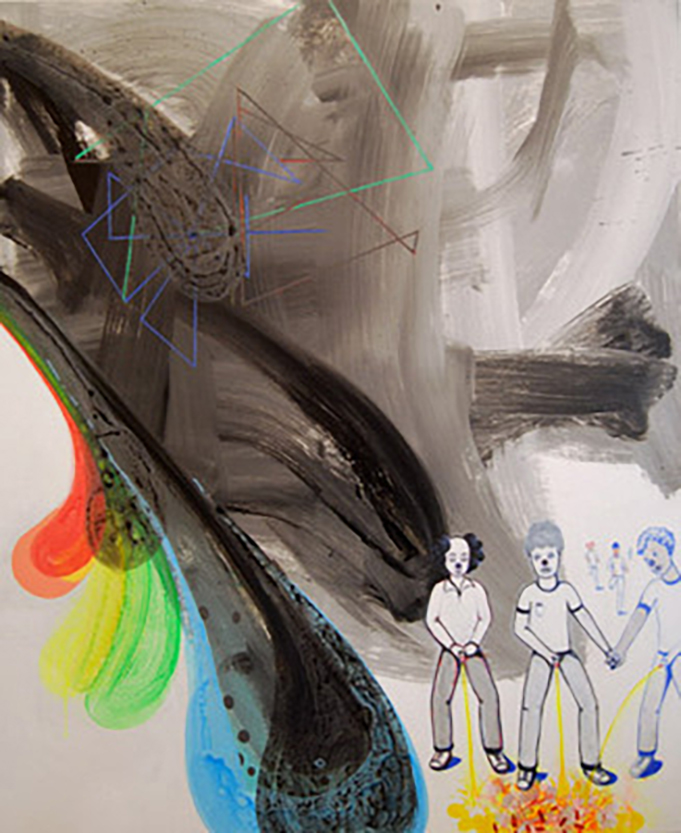
Clown Posse, 2012, 54 x 44″
Artist David Humphrey is a New York-based painter and sculptor, known for his abstract combination of Pop and Surrealism. Fueling this abstraction, Humphrey focuses his paintings on a protagonist, including subjects like puppies, kittens, clowns, and snowmen. David Humphrey is not only an artist, but also a writer. Blind Handshake is Humphrey’s most recent publication. This anthology offers art historical text from a firsthand point of view, which is noteworthy, as art historians often write these historical texts. Currently, Humphrey is preparing for his two upcoming November shows, one of which is in New York at Fredericks & Freiser (November 8-December 22) and the other in Washington D.C. at the American University Museum (opens November 3).
Interview by Eliza Philpott
How would you describe your current style of painting?
It’s a hybrid of modern art, pop and retirement home amateurism.
What are some influences that have directed you to this point?
Are you thinking of drugs? My doors of perception were opened in high school by Van Gogh, Cezanne, the impressionists and a lot of art at my local museum (the Carnegie in Pittsburgh).
Are you aware when your painting style changes?
I’m a restless artist with an appetite for unexpected images in my studio so I’m frequently trying out a range of what might be called “styles” to throw myself off (style is a word I generally avoid because I’m not quite sure what it means, unless I’m using it as an insult.)
What encourages the change?
Longings? Ideas? Other art? Drugs?
You create abstract sculptures using stuffed animals. Describe your process and the idea behind it.
I go to Kmart and buy two overstuffed animals of the same species and bring them back to my studio where I tie them up and cover them with a mixture of hydrocal and paperpulp. Then I keep working on them until they make me as happy as a sculpture by Henry Moore.
Would you say there are similarities between your paintings and sculptures?
Yes! They are equally fucked up. I try to fold some aspect of collaboration into both mediums, sometimes with found objects or images but also with split-off parts of myself: painting as a form of acting.
Your most recent book Blind Handshake is an anthology of your writing on art. What prompted you to publish this book?
The director of Periscope Publishing asked if I wanted to do a book. I’d been writing about art since the early nineties and had accumulated a pretty large archive. We thought it would be exciting to cut up and thematically reorganize that archive with images, in an inspired design by Geoff Kaplan, to make a case for writing as an extension of the studio. The book is mostly about other people’s work but I feel there’s an encrypted manifesto of what matters to me about artworks.
When did you first know you wanted to be an artist?
Somewhere in Junior High when I was trying to grow my hair long, wishing to be a hippie.
Even with a protagonist your paintings are very abstract. Do you have an idea of the meaning behind a painting or your overall vision of the finished product before you start?
I’ve barely a clue, that’s part of the thrill of making a new piece. Sometimes I have a pretty specific preparatory image but it usually changes along the way and when it doesn’t I still need to be surprised by the result.
You are currently preparing for two upcoming shows. Do you have a specific theme in mind for the works you are submitting?
In November I have a show of new paintings at Fredericks & Freiser in New York that will include an accident-prone spaceman, ambient spectators and an overturned cement truck. At the American University Museum in Washington, also in November, I’ll be showing selected work from the last ten years called Pets, a President and the Others.
Who or what inspires you?
My multi-talented and disarmingly funny wife Jennifer Coates, who weighs in on all my work and much else.
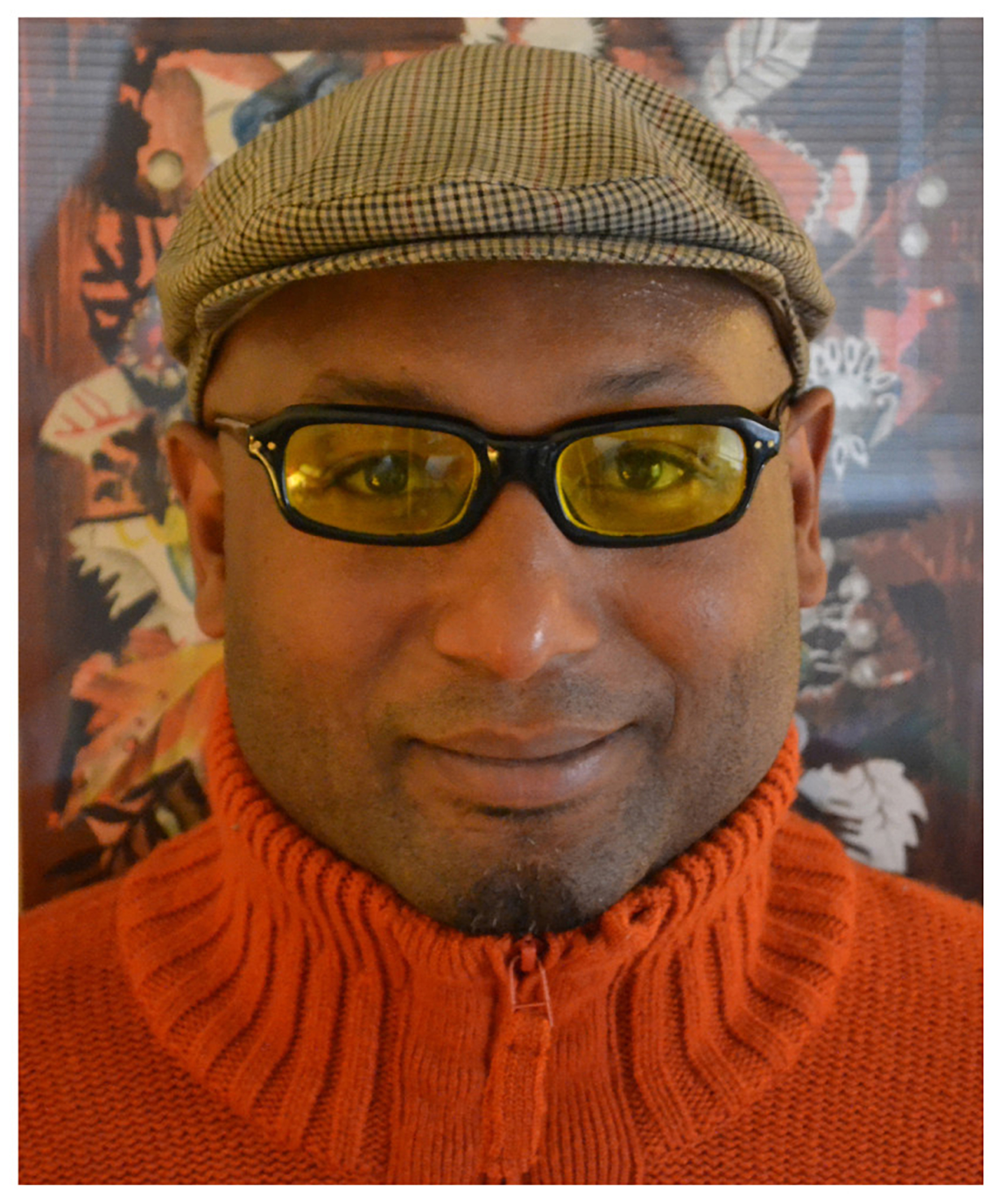
Photograph by Elizabeth Cowan
T Geronimo Johnson was born in New Orleans. His fiction and poetry have appeared in Best New American Voices, Indiana Review, LA Review, and Illuminations, among others. A graduate of the Iowa Writers’ Workshop and a former Stegner Fellow at Stanford, Johnson teaches writing at University of California–Berkeley.
His first novel, Hold It ‘Til It Hurts (Coffee House Press, 2012), explores a not-too-long-ago America, four years into war in Afghanistan and on the cusp of the devastation of New Orleans by Hurricane Katrina. The novel follows its main character, Achilles, in search of his adoptive brother through morgues and into drug houses; to a beautiful and impoverished, and then ravaged New Orleans; from the trauma and loneliness of post-combat into the ordeals and imperfections of a love affair. Johnson gets his readers in close to a perspective atypical of American fiction—the sensitive as much as cynical Achilles—a black vet of the war in Afghanistan who was raised by adoptive white parents in the suburbs. It is unusual to come across a several-hundred-pages-long story so unreserved about issues of race, sexuality, and gender in a context that is still so recent and thus so raw in American history, but what is most striking about the work is the haunting quality of Johnson’s realism, which is capable of great sensuality and great coldness in the same paragraph, and can hold the intensity of memory at the same timbre of the present moment in a single sentence. From the shards of baby-doll heads, anonymous bodies, kisses in the dark, mustard-trimmed windows, muzzled pit bulls, spilled brains, nightmares of war, scratch marks in an attic, and the search for a lost brother, arises a love story complete with revelations about sexual technique, early dates characterized by awkwardness and yearning, the mutual alienation of a fallout, the warmth of routine, violent anal sex, embarrassing visits with parents, and an aged sense of mercy in ambiguity.
Interview by Rachel Cole Dalamangas
Hold It ‘Til It Hurts is a novel that is perpetually at war, exploring such conflicts as race, gender, class, domestic violence, a soldier’s life post-combat, poverty, and so on. What’s intriguing is that a great deal of the tension that propels the text is resistance. This is a novel that resists socio-political idealism, resists easy conclusions in regards to intimacy, resists—and is uncomfortably aware of—the white gaze. Moreover this is a novel that resists being segregated to the genre of African American literature while simultaneously not rejecting African American literature as an artistic history. Although not shy about cultural criticisms, this novel insists on being understood as literature, first and foremost, perhaps because the overarching shape it takes is that of a love story in the background of warfare. How does one straddle so many political, cultural, historical, and social fences in the making of serious art?
What first comes to mind is that it reflects my worldview and my hesitancy to try and wrap everything up too neatly because that would feel completely unrealistic and would undermine the power of the narrative. It also has a lot to do with point of view and a desire to write about a type of individual that has gone through these experiences and is not yet able to process all of them, and balancing the risk involved in writing the character as I did. I was aiming more for life than a neatly delineated narrative. Sometimes when I was in school I would find myself reading such stories and felt as though those narrow depictions of the world ignored the social contours that give definition to our lives.
I wanted to avoid that. The driving question of the novel is: How do you learn to care about people who are not like you? This exploration demands a broad range of experiences. This is Achilles question, but it’s also the reader’s. I suppose by opening up a person so much and hovering so close to his point of view readers then finds themselves privy to things we might not share publicly or openly. So that’s part of the straddling.
But it’s not really straddling. We’re all a combination of these myriad influences. Borges says the text is the axis of innumerable relationships; the same could be said of character. The project is more about depth than breadth, or any breadth is achieved through depth.
Another guiding notion was the distinction between what we will say and admit to publicly, what we will say in private only, what we think and will not share, and then there’s all those impulses of which we are not aware. The latter have the greatest influence in our actions and opinions, and the latter, sadly, also resist easy persuasions. Much of the novel resides in that space, and that’s where this notion of resistance is coming from. Beneath the bounds of the polite discourse, at the subconscious level, we can take a look at how Achilles’ social conditioning has formed these particular worldviews, and how he struggles both consciously and unconsciously to reconcile them. From a technical point of view that’s how I was able to straddle these different elements—by not straddling them, but by simply pushing deeper. It was more at the level of impulse than craft.
I’m concerned that white readerships sometimes regard literature by a person of color who is writing about the struggles of people of color, with patronization—particularly in an era like ours that is witnessing a resurgence of overt racism and misogyny and the white guilt that accompanies such. How do you think the reception of American literature written by people of color will shift? How do we address this issue as we move out of post-modernism?
Very often literature by or about people of color conforms to our ideals of this country. It too often takes on the arc of a racial Horatio Alger narrative. Those served a clear social purpose in the past, especially in slave narratives where the thrust was the inosculation of literacy and enlightenment. If you are able to read, you are enlightened. Now North-North America will accept you as a human because it was only a lack of education that defined otherness, and if everyone had known all along that you could read they would have never offered you those agricultural jobs in the first place. We’ve moved away from that but it still often feels that stories about people of color have to conform to that particular kind of arc and characterization called for in Aristotle’s Poetics. I cannot abide that.
We are plagued by the myth of universality. While we do share impulses, needs, desires; while we are ninety-nine-point-nine-x-with-a-smile percent genetically identical; while the Russians love their children too (we hope!); our constructed social identities frame very different social realities[1]. As one author writing about single motherhood said, Even if the story is universal, the truth is in the details, and the details are what matters. In her essay, that author, a single white mother explains how much her reality differs, profoundly differs, from that of a mother in a two-parent household and how the differences in lived experience affect everything from a sense of time to the use of pronouns. I live in a very different world from the white reader. Social space bends differently around me. And this is the problem: How does one present those differences while still reassuring readers of our commonality and of the ultimate beneficence of our society? I’m not sure that we always can, but that is what many readers often want.
Marketing is an issue as well.
For example, a few editors said it was admirable that I didn’t follow the clichéd route and end up on the other side of the rainbow, but they couldn’t sell this kind of story. They think they’re conforming to the market when they are creating it. (At this point I have to say thanks to Jon Sternfeld and Anitra Budd!!) There’s this market pressure for writers of color and the stories about people of color to conform. Authors then are (inadvertently?) expected to do what in any other medium would be a shuck and jive. This pressure to perform a ritual of atonement goes back to the slave narrative. Even on my end, I had to, towards the final stages, interject purposefully a few details and asides to assure the reader of Achilles humanity—because it is not always assumed of black characters (readers don’t fill in the blanks the same way). And those details I inserted, which I will not list here, worked, sadly, as anticipated. That’s not your question, but understanding the pressures that black authors feel when reaching out to “wider (whiter)” audiences is necessary before we can even imagine a shift in perception or shift in reception. And I don’t know how that will resolve itself. If we don’t acknowledge who we are, how will we become?
I will not list any novels here, but the pressure is real. I have been wondering whether or not I would publish through the traditional channels anymore, at least not when you have a group of people who don’t know your experience deciding how you should best represent that experience. So as we move into a new era, I’m thinking less about the Gestalt or political evolution or theoretical shifts. As we move away from post-modernism (if we can, it’s the theoretical equivalent of Saran wrap and has the kinetic energy of Christian typology), as we move away from post-modernism, hopefully shifts in technology will enable people to tell other types of stories without bowing to a mediator. People can build their own markets.
I suppose it can be summed like this: in my artist statement I say that I write for the ones who didn’t get away. In the world we live in, for understandable reasons, people want stories about those that do. I understand that we need those types of stories, but it’s equally important to acknowledge that there are so many other narratives that are lived everyday and in many of these people are not fairly rewarded. (See Turing in the machine.) And if our society does not face these narratives, we will keep writing them—in bone, on flesh.
You said something interesting about how technology will make it easier for people to tell other types of stories—can you expand on that? How do you think technology may facilitate the telling of marginal stories?
I alluded to this above, but the slap of selling a novel guided by a marginal voice is that people alien to the experience are empowered to tell you how to render it, and I’m not talking about craft here. Your life is mediated through alien eyes. The mask and veil become huge zip lock bags, but we can make out faint contours, a ridge there or here, a chin, a mouth in vain. But that frustration is born of a specific publishing model and cultural aesthetic (Long live CHP!). Instead of delayed and hierarchical, distribution is now immediate and lateral (as poets have done for years with chapbooks). Modes of expression are changing as well. A scholar (I won’t name here) of fandom and transmedia heralds the latter as the great narrative equalizer. As the term is currently used, and the theory is currently practiced, transmedia means extending narratives across different media. From this scholar’s perspective, a show such as (I won’t name here) develops minor characters through webisodes and other low cost avenues. He claims this is beneficial for gay characters and others who may not receive ample screen time. (I want to call this ghettoization. Maybe I just did. Who knows?) From my perspective, though, transmedia a way for alternative voices to collaborate in unimaginable ways. Of course self-publishing and micro-publishing are growing, especially in the urban lit genre. And ebooks have enabled many new voices to connect directly to readers. But transmedia is exciting, and it’s probably what I would focus on if I were just starting as a writer today. A story is a cloud, a novel a storm, a transmedia narrative an entire climate.
A particularly interesting and uncomfortable thread through the novel is the intersectionality of gender and race. I hope this line of inquiry isn’t facile because I think it’s still at the heart of much overtly political American fiction: Can white American authors authentically approach writing about the experiences and perspectives of people of color? And can heterosexual male authors authentically approach writing about the experiences and perspectives of women? Essentially, can people of one privileged class effectively portray the perspectives of people who are of a corresponding underprivileged class?
Immediately that struck a cord for me because one East Bay interviewer asked the same question. She’d reviewed me and Chabon over two consecutive weeks. Chabon’s book features black characters and mine white characters. I feel like everyone has the right to undertake the challenge of portraying the lives of others, but it can be difficult. If I want to write about the female experience, I must not only acknowledge my privilege, but also acknowledge what it’s like to live without it, and how that frames the world differently, and acknowledge that I am a partner in oppression. What’s worse is that this involves interrogating my assumptions of what I have actually earned in this world. I think that’s what’s so hard about writing people who are unlike yourself, especially people who are at the other end of the continuum. To do it well, and burrow deeply, you have to move beyond that sense of, “Oh, I make less money,” or “Oh, I have babies,” of “Oh, people think I’m a bad driver,” and consider how deeply engrained sexism is, realize that it is, sadly, rebar embedded deep in the foundation of our culture, so deep that it defines language, self-perception, school performance, that it operates beneath the level of consciousness. I’d also have to consider how that can manifest as resentment and how also no matter how fair or good of a person I may want to be, by virtue of my privilege, I’m still an extension of an arm of oppression. I feel like it’s hard for people to really wrestle that and to face that and to harness that. For example, passive-aggressiveness is associated with femininity, but it’s simply the most practical solution for the acute angle in any asymmetric relationship. So then one wonders how to effectively dramatize that and critique the system at its source, as well as the less informed critiques of the strategy.
To consider a spoke of identity at the end of which is a character with more privilege than me is to face the challenge of avoiding bitterness or resentment, and rendering faithfully a full spectrum of humanity. Perhaps one of the best ways to think about those continuums is to mine the angst that resides where you are least empowered. This then is limited by your social profile. There’s a clear hierarchy in the world, some people have fewer restrictions no matter how you spin it.
Being a black male, if I wanted to write about a white female, at least to some extent I can think honestly about how a black male interprets situations where he is treated unfairly in relation to someone who is white. It’s very ugly because we want to tell stories that are reaffirming. I think, in fact, this is hardest for liberal white males who may want to believe, with all their hearts that we are alike (and tread carefully for fear of being accused of racist depictions). With Achilles, for example, I imagined what would happen if you were to go back 25-years and remove from a black male’s psyche all immediate, personal, positive experience of blackness. The vacuum that remains is filled by popular media. The result is different for a white male than a black male. A white male who meets his first blacks on COPS may be anxious in a dark alley, but a black male who meets his first other self on COPS might be anxious alone in a dark room (as I asked in my official CHP author interview, “How do you duck when you are punching yourself in the face?”). To conceive of that I must be capable of recognizing patterns of representation that are negative and deleterious even though they may not appear so at first observation, such as the color line and good/hair bad/hair debates, and these are the very realities we avoid facing. (Look at the revisionist Harriet Tubman in that Lincoln movie.) It’s hard for people to unravel the cultural threads in their security blankets.
We’re unexpectedly in my closeted space and it’s hard to answer because some of this comes from conscious analysis and some of it comes from artistic impulse, that thing that strikes you in the heart and then drives you to respond.
One of my concerns about the novel, because it’s not exactly hermetic, but it’s so close to Achilles’ perspective, was that people would not catch the flags and would read over the gender issues. Achilles is a Gordian knot of anxiety and negativity about black females. It’s been interesting to hear readers’ responses to the book because a lot of people don’t pick up on the intersection of race and gender. The first who did was a reviewer in New Orleans, a black female who tackled that issue directly in an interview and review because she realized that the issue was not resolved by book’s end. In the process of writing, I felt that if I put too many flags in or resolved that (which would be unrealistic in such a short span), that would undermine the experience for the reader. I didn’t want to narrate the experience for the reader. I also knew I was writing two books.
I believe you are from New Orleans and a huge portion of this book addresses the horrors of Hurricane Katrina. How does one write so closely to one’s own losses? What are the complications inherent to writing about very recent history?
Well, I’m actually in New Orleans right now. Ten minutes ago, I was taking a picture of the house my parents lived in when I was born. That neighborhood is being gentrified. But because the improvements come in the wake of an exodus, I think they call it revitalization.
I always wonder how you don’t write about what’s really close to you. What other purpose can sustain you as an artist in a society that guarantees no validation, financial or otherwise. Without that sense of purpose, I don’t know that I would be able to continue writing everyday. I must be fully engaged and invested and committed to a story that I want to tell, whether or not anyone wants to read it, a story I would be willing to give away. In the case of HiTiH, the research does take a toll on you because you’re processing so many painful emotions—reading morgue lists, looking at pictures, interviewing people, and reading newspaper accounts. It’s a harrowing experience because it feels like you have to read a thousand pages to distill it into that two or three sentences that really capture the essence of the experience.
In terms of writing about recent history, that can be difficult because the world is changing right in front of me, especially in New Orleans—this is my second time here in six weeks. I find myself wondering how much of what I remember is accurate and which memories are glamour shots fogged by nostalgia, and, even, how many of the structural changes are real. Recent history is so illusory. I guess that’s a challenge for all artists who are responding emotionally or critically to conversations not yet being had publically about, for example, demographic shifts. Here, I see white musicians where I used to see black musicians, and white artists where I used to see black artists, and even white beggars at intersections where I used to see black beggars. What am I to make of that? How am I to address and acknowledge my latent fears and anxieties about this shift? How am I to make sense of them to myself, let alone to a reader? Can a tent city be gentrified? Am I feeling saudade myself or mourning someone else’s? Can one even mourn the loss of saudade?
There’s a lot of uncertainty in writing about recent history because there are no fixed landmarks, but in the end—this is so corny—but I feel in the end I was guided by love. I was provoked by frustration and anger and then guided by love in the execution. My biggest anxiety at end was whether or not New Orleanians would feel that I misrepresented the city. I also had this feeling that if I didn’t do a good job, it would look as though I used Katrina as a mere plot point and that would be unforgivable, absolutely unforgivable. I suppose that takes a little more work to write about these types of events because you know that you can’t convey everyone’s experience, but you’re hoping that in some way you can reflect it accurately enough so that someone who wasn’t there can feel it, and it will be remembered when it is not longer so recent. Bradbury said we write about futures so they won’t happen. Maybe we write about pasts we hope not to revisit.
When say you were motivated by frustration and anger, this makes me think of Virginia Woolf’s idea about how social trauma—what she calls “impoverishment” in A Room of One’s Own— is ultimately disfiguring to art and her concern that marginalized writers (in A Room of One’s Own—women) have this special psychological struggle to make art. Although I wouldn’t presume to know how Woolf would assess contemporary American fiction, Hold It ‘Til It Hurts is not what I would rate a “damaged” or “disfigured” novel. The portrayal of Achilles is that of a character warped by the traumas he experiences—particularly evident in how he relates to language, but the novel itself is intact—at the level of narrative arc and sentence, and in the novel’s engagement with beauty. Did the frustration and anger that motivated you present struggle in your process? If so, how did you strategize?
Provocation is necessarily separate from execution. We’re exploring the gap between impulse and execution, and the gap between execution and interpretation. This is where craft—and its myriad of definitions—comes into play, this is where it becomes obvious that what I must write is a novel that appeals to a wider (whiter audience), this is where it becomes obvious that plot must be a generous machine. So the novel tells two stories, one for blacks, one for everyone else. This is not to say that only black readers will divine the story in the song lyrics, religious references, cultural signifiers, etc., but from the beginning I was conscious of the need to play several hands at once.
This became evident in my workshop era when I presented the first chapter. Readers of color read tension in the foreshadowed unraveling of racial identity. Many white readers (usually white male readers, but some females, too) would read chapter one, and say, “This cannot be a first chapter. It presents no driving, enduring question.” or “What is it about?” or “The story must be about more than whether or not he finds his brother.”
In retrospect those experiences strike me as odd because the response to the book has been positive and receptive. But, because of those responses, while I knew there were receptive readers, I also considered myself to be, on some level, writing for a hostile audience, or at least an audience alienated from the day-to-day reality of my characters.
So there was much strategizing (I am embarrassed to admit). Many of Achilles’ less favorable thoughts merely reflect common discourse, but I knew if I put those thoughts and words into the mind and mouth of a white character, the wider audience would recoil (not necessarily with self-recognition, but that would be the case with some). Likewise, Ines’ more strident race comments issued by a black male would alienate the wider readership. In fact, Ines has been referred to at times as “serving only to teach Achilles lessons” and “strident,” but what she is really doing is making comments usually heard only behind closed doors. This is part of what gives HiTiH some of its gravitas; the reader gets to be a fly on the wall. Conversations and attitudes that are of import but marginalized are brought to center stage where they can be juxtaposed against a more forceful articulation of conservative white values. Ines sounds strident only if one doesn’t know that a lot of black people agree with her. There is also a significant amount of ambiguity and doubling. In addition to a few other elements, the brothers’ names, for example, signify Greek myths, but that allusion is an allision. Craft, strategy, and privilege intersect here. Stanford and Iowa were not only exceptional educations, and sites of valuable exposure to how different people read, but also intensive extensions of my continuing education in biculturalism. At end, I am lucky to have both the social capital to get this book out, and a keener sense of how to balance the competing interests, desires, and dreams. Yet capitulation remains a concern.
As for Woolf, though she has much useful to say about the connection between art and financial independence, I’m unresolved on her observation about Bronte, and there is one point in A Room of One’s Own at which I bristle. Early in the essay she describes the narrator sketching a professor whilst pondering several treatises on the inferiority of women. The narrator is shocked when she notices that the professor is distorted. “Anger had snatched my pencil while I dreamt.” The narrator doodles cartwheels and circles all over the face until it resembles nothing more that “burning faggots on Hempstead Heath.” That distorted face, I argue, is a valid point of view. In brief, this is connected to the slave narrative and the concept of literature defined by the necessity of the time, but I’d argue that we need more “anger snatched pencils” and fewer fires on the (distant?) Heath. At the moment she blankets her expression of honest rage with innocuous doodles, she commits a violence to herself and her art, the same violence that is done when mainstream sensibilities and politesse silence marginal voices. I accept the efficacies of craft, but reject the assertion that rage is disfigurement.
I thought that the complex character compositions were especially successful in this work. In the first pages, Achilles’ adopted (white) mother encourages him to find his (black) birth parents, warning him that he shouldn’t leave himself, “undone.” Many of the characters are “undone” in some deeply personal fashion that is entrenched in larger cultural issues, but none of them can be categorized via easy assumptions or stereotypes. While it’s very clear that Achilles is not a mouthpiece of the author, are you concerned that readers will assimilate you with him?
Very, very. I’ve come to realize that maybe that’s a compliment. I had written a story that was in Best New American Voices a few years back, and it involves an African American graduate student who struggling with a cocaine addiction. He relapses toward the end. At some point shortly after that came out, I was at a dinner with a group of writers. I ordered a drink and a person in authority asked me if it was okay for me to be drinking. And I said, “I think so, I mean I paid for it.” (Consider, reader, that answer). It was one of those events where the institution pays for your dinner, but not your drinks. (Probably always wise with writers). “But you’re drinking,” said this person. And I said, “Yeah, why not.” And this person said, “But you’re drinking,” and repeated it two or three times, and it was a little bit odd. And finally the person said, “But what about your story?” And I realized that this person thought that the story (Winter Never Quits) was autobiographical. (So, now I have to ask myself why I am even at the event? Is it charity?) There are many reasons, there are many reasons to be offended by this exchange. But one thing that I’ve taken from it because I’ve told this story a couple times, is that to some extent it means that the story was convincing enough that it seemed based on personal knowledge. (Talk about wrestling an angel).
Rationalizations aside, this compliment is always problematic because the underlying assumption, as Sapphire argues, is that artists of color lack sufficient imaginations. This may also be connected to complaints that people of color write so often about race. But the same charge of lack of imagination could be lobbied against people not of color who never do.
With Achilles my concern is not that people think that I’m Achilles. My concern is that people will not read Achilles critically. I’ve never worried too much that someone will assume that I think about the poor or the homeless the same way Achilles does. My fear rather is that someone doesn’t stop and ask why Achilles thinks that way and consider how his opinion reflects our society. Achilles is a mirror. We’re all undone.
I found the juxtaposition of the progressive, compassionate, and educated Ines to the skeptical, disenchanted, world-weary Achilles interesting. Even their approach to social critique is disparate: Achilles criticizes culture frequently through profanities and his “soldier’s humor”; Ines through an academic vocabulary and passionate seriousness. I expected this “war” of sorts to be settled between them, with one worldview winning out over the other. Yet, these perspectives are never resolved—they’re given space, eye-to-eye, both uncomfortably undefeated beside each other. Why did you choose to leave the conflicting perspectives in this world shifted, but ultimately unresolved?
I couldn’t have resolved them within the book and written a believable story. That’s the first thing. The novel went through several drafts and several endings. I knew that the ending would be to some extent unsatisfying. Initially I didn’t think it could have an ending that would be satisfying at all. Where it has landed is a miracle of the third order.
The thought that Achilles could in such a short period become a different person is just so implausible. What’s really unfortunate is that Ines could become a different person, I think, more quickly than Achilles. Horrors and atrocities change us much more, and much faster than does love. Achilles’ active duty experiences, which are compounded by Katrina, are another reason the novel must resist too neat a resolution. He’s been exposed to disaster and violence on a scale that is overwhelming and so constant that some measure of desensitization is the only hope for survival. I have a lot of friends who’ve served and a lot of friends that are cops, and that’s one of their coping mechanisms, of course.
I was also resistant, in this novel, to over-narration. The experience of reading is more pleasurable and fulfilling if both of these worldviews have their time on the page to express themselves fully for readers to examine on their own as opposed to if I were to try to lean too much in one direction or the other, or contrive what would clearly be an artificial resolution. The worldviews are also part of the symbolic structure of the story, and are intimately intertwined with notions of assimilation, acculturation, mental colonization, the body as metaphor, internalized oppression, fear of intimacy, the burden of masculinity, love as balance, and a few other things.
From the perspective of a writer, the most realistic arc would be a falling out, a falling apart, shattering, not a coming together, and certainly not a full conversion. Achilles can’t be Saul on the road to Damascus. HiTiH is not a parable; it describes the arc of a life.
The social critique that unfolds in this novel rejects depictions of race and poverty by mainstream as well as academic perspectives. Facile good-intentions, armchair progressiveness, and superficial resolutions are rendered irrelevant by violence, marginalization, and grief. And yet, compassion ultimately survives in the world of this text. For example, one of the most disturbing moments for me was when Ines verbally and physically attacked a child for his response to Hurricane Katrina. This is an unexpected thing for her otherwise tolerant, socially responsible character to do. And yet, while this episode certainly adds darkness and dimension to Ines, it doesn’t ultimately tarnish her activism and humanitarianism. I would call the voice and perspective of the text, “a ruthless compassion.” How do ruthlessness and compassion figure into artistic process for you?
I suppose I have to talk myself into this answer. There are several different types of personalities in the book. I wanted to depict—obviously Achilles and Ines are at opposite ends of the spectrum with other people in between—I wanted to depict everyone as fairly and clearly as I could. While hope is a requirement to sustain oneself in the face of adversity, being progressive feels like a privilege. I like the phrase “ruthless compassion.” Along that vein I was thinking of a clarity of vision, a vision of a whole person, and compassion is a prerequisite, or co-requisite, for apprehending the whole.
Often we require personal security before we can extend compassion and concern to others. When you do not feel safe and secure, emotionally and financially, it’s hard to reach out to those who are less fortunate than you. Of course there is the story of the old lady in the bible, but that only proves the point.
Also, it seems that progressivism and liberalism are not always open to critique, or at least are difficult to critique because of their porosity and malleability. But nonetheless, it depends on a sense of security—it’s an issue of worldview. None of this is meant as a critique, as much as an acknowledgement of how frail our positions are. And that even is not a critique, but reminds us that much work and energy goes into maintaining a life about which one can feel good. I suppose in this case the critique is offered by way of juxtaposition and the novel is eidetic because part of the project is to humanize unpopular positions and to explore how people arrive at conclusions that we may not want to agree with or that we may actually agree with but not want to acknowledge harboring.
In terms of the process, HiTiH had to be eidetic. It had to be a realistic depiction of events instead of being overly impressionistic, though it is at times. And it had to be so close to Achilles’ perspective that we could come to this understanding that even though truth is personal and subjective, it is experienced as an absolute.
The force that this novel reaches for with agitated passion as well as with severe tenderness—and no less political than any of the other motifs—is love. One way that love works in this text is through subtle clairvoyance and the faintest suggestion of magic: early in their romance, Achilles claims to “hear” Ines’s thoughts, for example. Indeed a great deal of their dialogue—whether flirtatious banter or heated argument—is at a slant. This got me thinking about how literature itself is essentially a psychic leap across planes, a bridge between cultures that are really still terribly alien to each other. Where is the novel as an entity situated in the great landscape of cultural discourse?
It’s hard to say exactly where it’s situated. So many novels claim to be about or are described as being about the healing power of love or the power of humanity. I feel like that’s no less so the case with Hold It ‘Til It Hurts. But my philosophy is that we often love people in spite of who they are and not because of who they are, or, in spite of who they are as much as who they are. They say love is without judgment. I suppose that’s often true, but it has to be about understanding on some level. That driving question, again, is: How do we learn to care about those unlike us?
Achilles and Ines don’t always understand each other, but the hope is that the reader can understand both of them, and then share in their subjective gazes, which are driven by rich desires. But as you say, there is this “subtle clairvoyance” between the two of them, and yet we see them more fully than they see each other. Without this gap, the reader would feel less for them.
In the cultural landscape, the novel is opening the box to take a closer look at what we may not openly discuss or otherwise acknowledge, putting unpopular positions on the stage. I think that there are a lot of people like Achilles, but they’re not writing books. He’s been described sometimes as an anti-hero and I don’t know that he’s an anti-hero, but I think that’s more telling about our expectations of literature and expectations about the architectonics of stories and characters and whatnot, and points to a cultural divide.
While writing I knew it might be a story that people would not want to read and once I made peace with that, it freed me to be open. But where does that place it? I hope that it’s an un-varnished mirror. But in terms of cultural discourse, I don’t know if I have a good answer for that, because everyone’s reading the book so differently. Some people see the racism, some people see the gender, some people see only the war story. I suppose I’m still waiting to see how it will be positioned. I do like your concept of the psychic leap. I’ve always thought of written texts as alchemical bridges.
This is a novel preoccupied with appearances particularly in regards to how people are classed based on their appearance and in regards to how skewed mainstream views of disaster frequently are. What are your thoughts on other depictions of American involvement in conflicts in the Middle East? Why examine the reality of contemporary American warfare in the context of fiction?
We’re never really at war only with the other. We’re simultaneously waging internal battles, collectively and individually. This is important because part of going to war has always meant dehumanizing the enemy in the minds of both the troops and civilians. As of late, we’ve gone from communism as the specter to terrorism to alienism. It seems very much worth exploring how that type of ideological campaign affects both those at home and those who execute the mortal arm. Then especially what it means when they come home after having been conditioned and trained to kill—to cross the line. So, writing about the war is the same, to me, as writing about home. And not writing about a war that’s been going on for ten years seems to me an act of willful blindness that I find puzzling. Ernest Gaines once said that unless white students know the stories of black folks, they only know half their own history.
I didn’t read any fictional accounts of the American involvement in the Middle East while writing this novel. There weren’t that many until recently. I read primarily nonfiction accounts. This year a slew of books about the war have been released, and I will be reading several of those.
Who goes to war is also worth examining because those kids often have few other opportunities. That complicates the experience as well, especially for minorities. In Achilles’ case, the first time he’s ever in an environment where the majority isn’t white, he’s on active duty and everyone is in his sights so to speak.
One of the most sophisticated—and yet understated—gestures of this text is the uncensored exploration of a traumatized inner life. What’s radical about this quality of the novel is that it’s a rare, raw look at how one individual—privileged in a couple ways and extremely marginalized in others—is processing the culture wars of America. We see Achille—via frequently painful self-awareness—sort his feelings about domestic violence, addiction, poverty, sexuality, and so on. At a time when it’s artistically “in vogue” to write about contentious subjects from multiple perspectives, why did you chose to write this work from a single relentless perspective in depth?
As much as I love multiple perspectives and even use them the larger section from which this novel is taken, that would be too easy. The aim was not necessarily to reveal each perspective as an incomplete, or insufficient, account of the world, though that is suggested at times. The novel is not about seeing or hearing the perspectives, but trying to process them. The aim was to explore what it means to live what you believe.
The depictions of poverty were particularly visceral. One thing I think about when I attempt to write about trauma is what gets censored and what doesn’t. Your novel is a work that refuses to look away—refuses to not see the most disturbing, the most difficult, and thus also the most intimate, ranging from a merciless slaughter of dogs to shit on Achilles’ penis after having rough anal sex. Yet, this isn’t torture—or poverty-porn. I don’t get a sense that the gaze is voyeuristic—searching and insistent yes, but neither leering nor paternalistic. What advice could you give to writers seeking to presence difficult subject matter?
The saying is “To be cruel, be cold.” Be as clear as possible, almost clinical in your descriptions of those heightened events. I’m now apostate in all things craft, so I don’t follow this advice faithfully, but there is always a draft, be it the 1st or 10th, where it is helpful consideration. And I don’t know if this is good advice, but to avoid poverty-porn, I tried to avoid erecting a language barrier.
As literary writers we want it to be beautiful and we want sentences that no one has written before. We want the language itself to be the experience. But the odd thing with a story like this is that, even though the language (words) is the first level of experience, the medium of apprehension, I didn’t want the language (diction/figurative language/etc.) to filter or impede the experience. I guess I’m saying that there are times when extremely poetic language can be very effective at provoking emotion, but there are other times where you demand clarity over all else so that readers can have the response that’s appropriate for their own lived experience. You’re hoping that there’s enough clarity that the reader will have this accretion of responses resulting in a significant emotional experience that is more profound than it would be if obscured too much by language. I’m not making an argument for pedestrian language. I’m saying that there are times when prose can be so lush that the words themselves obscure vision and experience. And because Achilles is traumatized by what he sees, I wanted to present those same images to the reader. I wanted people to see so that they could feel.
What forthcoming works do we have to look forward to?
This was part of a novella collection set in Atlanta and New Orleans, and each features a character that does not know how he or she is impacting the others’ lives in critical ways. That project includes Wexler, Troy (Achilles’ brother), Pepper (the drug dealer that Achilles sets out to kill), and a few others. I have another project about four students who protest a Civil War reenactment by staging a lynching. But that doesn’t go too well because being city folk they are not good with knots. It’s funny. Then there is one about the seventh coming of Christ. I’ll say only this—Cover you eyes.
Those are the three projects I’m working on now. And a very short Trayvon Martin essay.
Read at excerpt of Hold It ‘Til It Hurts here: www.zingmagazine.com/tgeronimojohnson.pdf
[1] And research into the mind/body/build environment connection suggest that the various lived realities result in different psychological, emotional and physiological outcomes, so even those of us who share public space streets cannot, at end, claim to live in the same physical environment, at least not so long as we have the current correlations between race, ethnicity, gender, SES, and mortality rates.
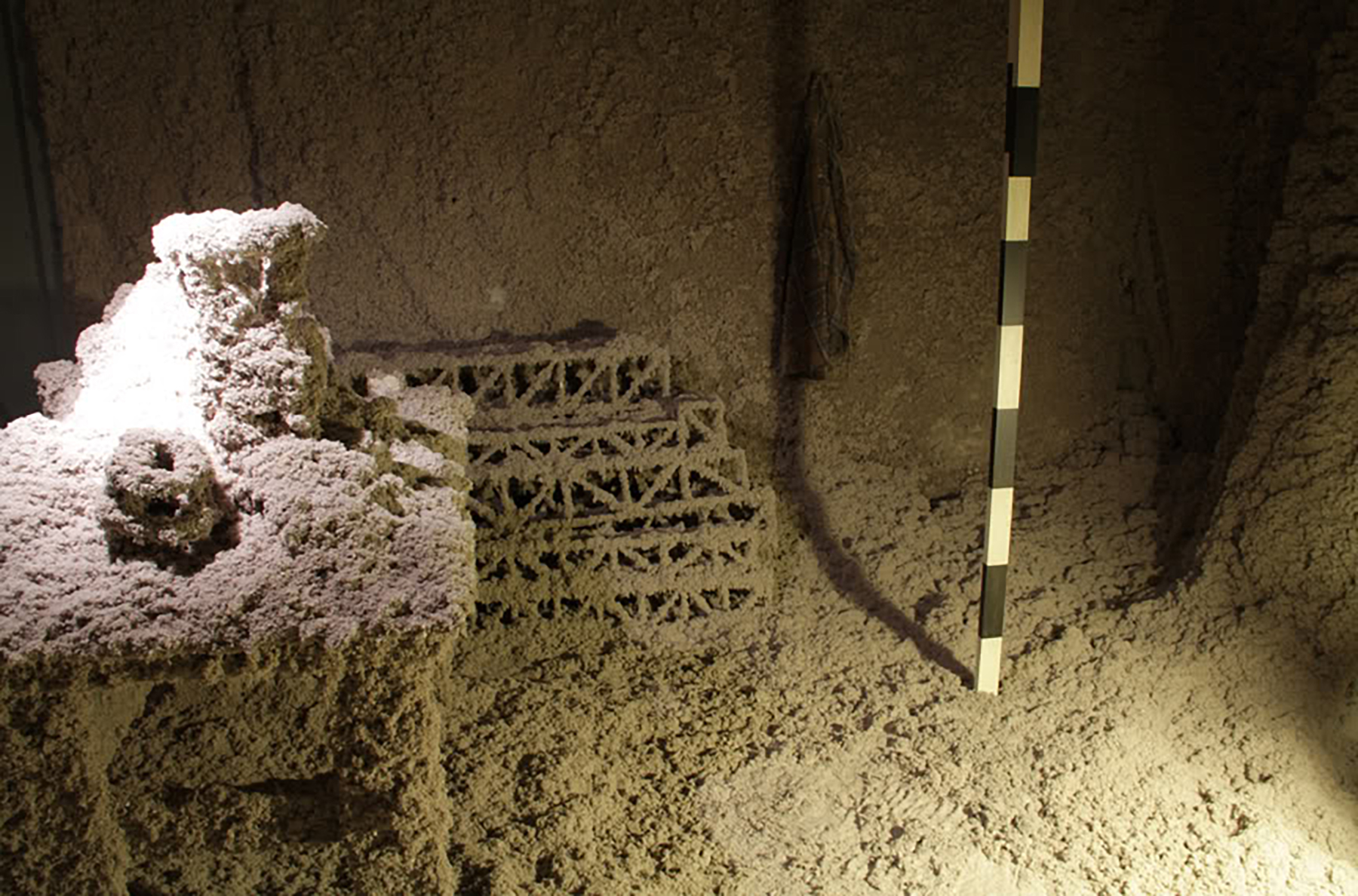
Ben Brandt’s life is currently in flux—lucky for us, he paused just long enough for a zingchat. Recently graduated from theMFA program at UT Austin, his studio (and the rest of his life) is now in New York City. Brandt has held residencies at Yaddo, Saratoga Springs, NY and Vermont Studio Center. A few of the venues where his work has been shown include Second Bedroom Project Space and Hyde Park Art Center in Chicago, Fort Worth Contemporary, and Champion Contemporary in Austin. Brandt was also included in the 2011 15 to Watch: New Art in Austin at Austin Museum of Art. We spoke following his farewell to Texas, his solo show at Co-Lab Project Space, All_Over.
Interview by Josh T Franco
I was not expecting to discuss clothing following your recent show at Co-Lab, but now I can not stop thinking about those peeks of plaid and some comments you made about the role of clothing. More broadly, something about texture and material as a “screen” between us and the world. An odd thing to end up thinking about in an immersive environment of pulp-coated objects. With such a powerfully monochrome space you created, why those two or three dusty plaid accents?
There’s a number of reasons that may seem obscure if we keep in mind that the primary impulse to expose those items was relatively intuitive and also formal. I like contrast, and I wanted a different kind of break in the monotony of the surfaces in the space. But more importantly, I was thinking about the relationship between buildings and bodies and the sort of primal need to stay warm (not an issue that comes to the fore in a place like Texas, but I grew up in the Midwest); the way we retain heat energy with clothing and a layer of body fat—an inner and outer layer of insulation that is mirrored in the mise-en-scene of the installation. Except that here, the insulation that is normally found on the interior of a building’s structure is being presented on the surface of everything. Part of my project is to draw out the relationship between bodies and buildings; the systems and structures they share. So you’ve got the plaid flannel shirt and the plaid “canvas” that is a kind of skin, and then the two-by-four wrapped in plaid is a kind of progression of “clothing” the building.
I think, really, what those items do, is to become the “middle” period in the history of this building’s sort of fictional timeline, as if those were the last items to end up in this room as it slowly accumulated years’ worth of sediment before the final intervention of the supposed present day, with the painted poles and lighting.
There is certainly that sense of time that comes with accumulation in your objects, often compared to one what might encounter scuba diving a shipwreck. There’s also a very immediate sense of time though that is post-apocalyptic, Pompeii-like. So there’s a vertigo that was particularly emphasized by the floor-to-ceiling coverage of your Co-Lab show: is this an ancient ruin? Or did I survive a nuclear blast that happened within the last few hours? It puts the viewer in that ambiguous position. How do you understand this very active vibration?
Yeah, vibration. I’m glad you can get that. I think vibration is fundamental to the nature of things, right? That it’s all energy vibrating at different frequencies. But in terms of time, it becomes more an issue of scale: did the timeline of this scenario happen over ten thousand years, or did happen it instantaneously? And in a way, these are the same thing. All of time is made up of one dimension, the present “now”, so how long or short is the “now”? It makes my head spin to think about, but I do believe that all of time is enfolded in the present moment, and our experience limits us to seeing just a small part of that at one time. I want the viewer to experience that uncertainty as well, to get a sense of the enormity of scale that is available within every moment. This aspect of simultaneity, when something is two or more things at once, is a fascinating aspect of art objects; it is BOTH two different things AND the same thing. So where is the line between the two? the division of states through which it flickers back and forth? It reminds me of the “screen” you mentioned in your first question. Is the back and forth continuous like a sine wave, or discreet? For me, it’s the coniunctium oppositorum, the unity of opposites. I’m talking about the fundamental nature of reality, man.
I recently got to spend some time on Lake Michigan, and a friend pointed out a strange phenomena related to the horizon line of the lake. Taken all at once, it appeared to be the most “straight” line that simply divided the air and the water, but when you tried to focus on it, it started to jump around and waver and shake: this very fixed line becomes elusively indefinite. I think this kind of vibration exists just below the surface of things, which is another, symbolic, interpretation of the plaid fabric in the installation. The nature of plaid fabric is so regular; its a conventional grid. But the effects that that kind of regularity produces is often very visually dynamic.
If I may rely on yet one more natural metaphor; there’s a cave-like silence about your work. It is silence, but not in the negative sense. Large amounts of paper pulp and insulation have a profound effect on an environment’s sound. How do you think about sound? Would you consider running sound experiments in an environment like the one you created at Co-Lab for future projects?
Sound is not my preferred medium, but I do take it into consideration as a part of the vibrational aspect of our experience. If you read about John Cage’s experiences with anechoic chambers, he talks about his realization that, even the most scientifically soundless spaces are filled with the noises our bodies produce, that there is really no way to experience true silence, right? Silence is full of sound.
In this installation, the apparent silence does serve to foreground the experience of the vibration of time and timelessness. It was often the first thing people noticed upon entering the space, that there was a deadening of sound. I like that the piece has a direct effect on the viewer’s body, it is another way to connect the artwork to the person experiencing it. For me, it was a very death-like silence, to be in a space that could be a thousand years old made me feel like I was a thousand years old, which made me think, “well I must be dead then.” But that’s just me.
My favorite sound artist is a woman who’s name I’m trying to rediscover, who made a kind of electronic noise/music that caused the listener’s eardrum to vibrate in a way that it produced it’s own sound. It was thrilling and invasive and layered, I loved it.
The relationship between object and pedestal is treated in a striking range of ways in your work. There are works placed directly on the floor, e.g., your depiction of the universe through a heavily treated dropcloth; there are works where objects and shelving are surfacely homogenized through the indiscriminate application of pulp and insulation on the entire apparatus; and there is at least one work, Bog Tree (Sediment Settles), in which the insulation-laden object sits atop a rusted rectilinear platform you constructed especially for it, if I am not mistaken. In the latter, there is a fascinating relationship between two types of decay; the negative decay of the metal enacted by the rusting process, and the additive decay of the object layered with abject substances. Do these represent a progression in your thinking? Or are they co-temporaneous forms you play with for what reasons?
To be honest, this is an issue I struggle with; at what register, at what degree of remove do I want the pieces to engage with the viewer? Which is important, I think, as it has some ideological implications that I haven’t worked through yet. And it comes back to the those all-important mediating devices of the support: the stretched canvas, and the pedestal. Despite it’s bourgeois implications, I’ve always been a fan of the pedestal. To me, it is the “frame” that signifies a remove from the world of the “real” back into the realm of symbol. It says this thing is what it is, and, it is representative of something else besides what what the viewer sees in its surface attributes. I guess the same could be said about the gallery space itself, but that’s a distinction that still generally resides below full consciousness. Some of my earlier works, that were wooden structures with various treatments, I saw as “models”, a representation of an idea or a system that exists in another form. So, I wanted the viewer to consider that these objects were metaphorical constructions of ideas; that the sculptures referred back to ideas outside of themselves. I don’t know, I could be over-thinking it, or assuming too much.
Lately, it seems that work is more within the realm of the here and now, that everyday and over-looked objects are filled with mystery. But I don’t necessarily want to rely on the context of the gallery to provide that type of frame. I’m a big proponent of living with art, and allowing a relationship with an object to grow and deepen. It’s an aspect of art that resides so heavily in the realm of ideas that it requires the institution of a museum to sustain it, that leaves me feeling a certain lack.
One of my intentions for the Co-Lab Project was to acknowledge the setting of the installation, both real and imagined, as the garage/barn that it once was, in order to upset the viewer with the indistinction of gallery as symbolic space, and architecture of real space. Thus it was filled with stuff that you’d find in a garage, stacks of scrap wood, utility shelving, a table piled with various tools of indeterminant use, a rotting hammock and an old work shirt, all transformed into sculpture, not by their location in a gallery but by their transformation via accumulation of a “foreign” substance. Even the “paintings” that were installed in this garage cum gallery, served as tools to measure the space or provide lighting/illumination.
You have stated before that your move to sculpture came out of a frustration with the two-dimensional media of painting and photography that are your background. Along with your use of abject and industrial materials, it is difficult not to hear echoes of artists like Donald Judd and Eva Hesse, though the results are certainly different. How do you understand yourself in that lineage constructed by art history, if at all? How is your work imbricated with contemporary post-industrial and cultural conditions? In Austin? In the US?
The art historical context question is difficult because it’s hard to see myself making a contribution within that narrative, but I would choose different artists to align myself with. Kurt Schwitters and Robert Rauschenberg addressed the complications of materials and abstraction in a less pure way than Judd and Hesse did, I think. My model artist of the 70’s would be Joseph Beuys if I weren’t such a (reluctant) cynical capitalist. I see myself dealing with the issues at the intersection of materials and images, artifacts and objects, and the body and it’s environment. But at heart, I’m an expressionist, and I read my choices as clues and symbolic artifacts that lead me towards deeper meaning, like dreams.
I feel torn between the agency and artifice that I can command with traditional art materials and practices, and the more current practice of using the materials of existing contemporary culture. I think an artist like Rachel Harrison utilizes this tension to good effect, but it’s not a tension that I want to focus on. Rather, I see it as a struggle between Romantic and Classical worldviews that I wish could be brought into accord. I see Texas artists like Andy Coolquit and Sterling Allen moving in that direction, mixing both laid-back and rigorous attitudes towards cultural detritus with loaded (?) narratives that are neutralized by the artists’ playful yet deep understanding and utilization of abstraction.
I lean more towards romanticism and fantasy, with only a toe in the camp of assessing the here and now. My flights of escapism and drug-induced enlightenment and other utopias are only tempered by a practical consideration of the need to address realism as way to actually live successfully. The artifacts and materials of Industry were my initial introduction to the sublime. Our post-industrial condition still feels like a loss to me, and I’m hung up on the aura of faded glory of a centuries-old technological revolution. Unfortunately, and despite my disavowal, whatever attitudes and ideologies of that era that made those artifacts possible, to the degree that I align myself with them, I open myself up easily to criticism of my privileged condition.
You are preparing to move to New York City. What impact are you expecting this move from Austin to have on your work? What will you be leaving behind, conceptually, materially?
I imagine the work may shift in scale fairly dramatically if I decide to stop producing objects that end up in the trash heap because of my unwillingness to store them. That wouldn’t be my preference, as I prefer to work at a scale that connects to architecture and the body, but maybe it will push the work to display it’s own discomfort more prominently.
As much as I enjoy working outside of the studio, I love the mix of concentration and opportunity for dreamy imagination that a regular, private studio provides. I have no idea what kind of studios will be available in NY, so that I’m almost grateful for the lack of adequate private studio space at the University of Texas that I had to learn how to deal with my first two years there.
The rest is uncertain. I have a vague sense that I need to limit the scope of mediums that I’ve employed over the last few years, which was basically everything you could think of. But that could be a misconception of the requirements of engaging with the market for art, which by the way, I’m hoping to do. But I will miss Texas, I like it here. The people, the climate, and a supportive art community have all been comforts that have helped to make me willing to experience some discomfort in a totally new place.
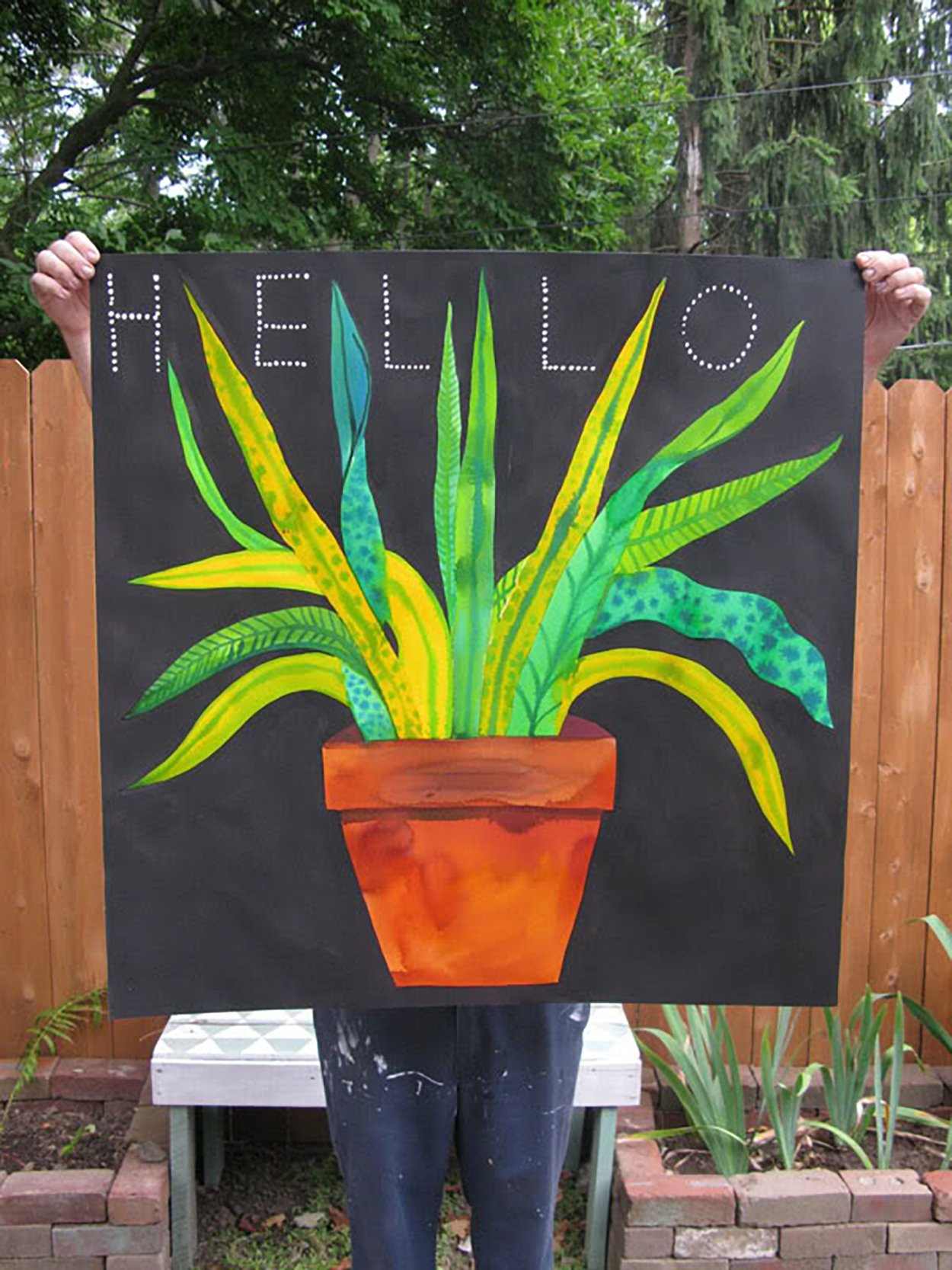
Although Indianapolis-based artist Nathaniel Russell acknowledges that we can turn to dust at any moment, let’s hope it doesn’t happen to him anytime soon. His pieces—created in a variety of different media including sculpture, painting, drawing, and printmaking—manage to access the rawness and honesty of being human. Often accompanied by words and phrases, his work is both sincere and humorous. As Russell explores themes of thoughts and the universe, space and people’s place in it, he employs charmingly unusual characters and inspiring written mantras to make for some pretty dreamy pieces. While setting up for his recent show, I had the opportunity to ask Russell a few questions and got answers as genuine and honest as the work he creates. Catch his show “Instant Dust” in its last few days at Ed. Varie, closing August 5th.
Interview by Jessica Butler
You studied printmaking in college. How did you first get into the practice and what is it about the medium that you’re attracted to?
I started messing around with silkscreen and woodcut in high school art classes. I made a few screens to make shirts for myself and some friends, too. In college I was drawn to the different printmaking processes as a way to bring out different qualities in my drawings. I was also attracted to the printmaking culture; it’s less flashy and has a more ‘rootsy’ feeling than painting. The ink smells real good, too.
You also work in a variety of other mediums, including sculpture. How does your process vary from each medium? Do you have to think about your imagery differently?
I don’t think my imagery is all that different from medium to medium. I usually just adapt whatever it is I’m thinking about to the particular method, but sometimes things just feel better and more realized in certain forms. That said, everything starts as a drawing and I just take it from there.
Many of your pieces include words and phrases that are oftentimes humorous, extremely honest, and always very ‘human.’ Where do these words and ideas come from and what importance do they have in your work?
The words are a really important part of the work. The right combination of words and image can alter the meanings and perceptions of both. The words usually come from notebooks I keep or things I see on signs, overheard conversations, talks with friends, the radio—whatever catches my ear really. It’s just a matter of finding a good way to use them.
What does the title of your current show, “Instant Dust,” mean for you?
For me, it’s about death and being; the fleeting qualities of life and experience. Sometimes when I get too hung up on art problems or money problems or life problems, it’s somehow comforting to think that we’re all going to be dust at any second anyway. That may seem morbid or dark, but I really think of it as a way to appreciate the things in life that really matter and notice the interesting and beautiful relationships between things, people and everything else and not to trip out so much on the bullshit.
When we were chatting, you mentioned an affection and proclivity for things that are awkward, flawed, and “slightly off.” Why are you drawn to things like this and how do they appear in your work?
It’s just more relatable to me as a person. I’m not attracted to perfection or very polished-looking images, people, or objects. The mistakes and so-called imperfections are what makes us human and what I find to be the best and most interesting parts of people. I think in my work they appear in the non-labored way that I draw. I like to let things happen and try to draw in awkward ways for myself. Sometimes that means that if I’m drawing a person, I’ll start with the feet and work my up since I’ve always started with the head and face before. That’s not to say that a lot of things don’t make the cut because I don’t like the way they look or that anything goes. It takes a lot of tries and work to make things look un-perfect. I know that might not make sense but that’s how it is.
You also talked a bit about the overwhelming “bigness of things” and the “littleness of our lives.” What are some things that you notice from day-to-day that make you aware of this “bigness?”
Trees, the sky, other people, dirt, worms, animals, birds—the list is endless. I think if you look at anything that’s not manmade and think about where it comes from it’s enough to make your head spin. The fact that I am being interviewed for this article out of billions of people in the world is insane. The fact that we are a consciousness in a body that has a whole life and thoughts and feelings and relationships is the most unbelievable thing I can possibly think of and it’s something we take for granted every day.
Aside from your visual art, you also make music under the name Birds of America. How did that get started? Do you ever find your music and your art overlapping?
I started playing music in college because I liked a lot of music that seemed like it was possible to make myself. It has taken a long time to get to a point where I feel comfortable and have found a little morsel of what it is I want to make or say with music…and then I don’t play music for a while and I have to remind myself and find that all over again. I tried to keep art and music very separate for a long time but as I go along, I find it’s all the same thing and the same themes. It’s overlapping now and I’m actually going to play some music at an art show soon which I always used to feel stupid about.
What’s the process like for writing lyrics?
Just writing things in notebooks to start, then filling in the cracks once I get some chords or a melody together. It’s not something I sit and fret about; I just sort of get in the zone and stick with what feels good.
What were you like in middle school?
Probably a huge dork: braces, really into skating and music, wishing I were cooler and wanting the girls to be into me. I did badly in middle school for a while. I think that’s when it started getting very social and kids started being jerks. Anyway, I found my friends and we did our thing. There is a picture of me in a yearbook somewhere wearing a Cure t-shirt.
Finally, you also mentioned writing a book in your future. Any ideas what it’ll be about?
Well, I wouldn’t call it “writing” a book…it’s mostly going to be a collection of drawings and some writing. We’ll see what it turns out to be. I’m sure it won’t be much like I’m thinking now. I’m hoping this time next year there will be something to hold in your hand.
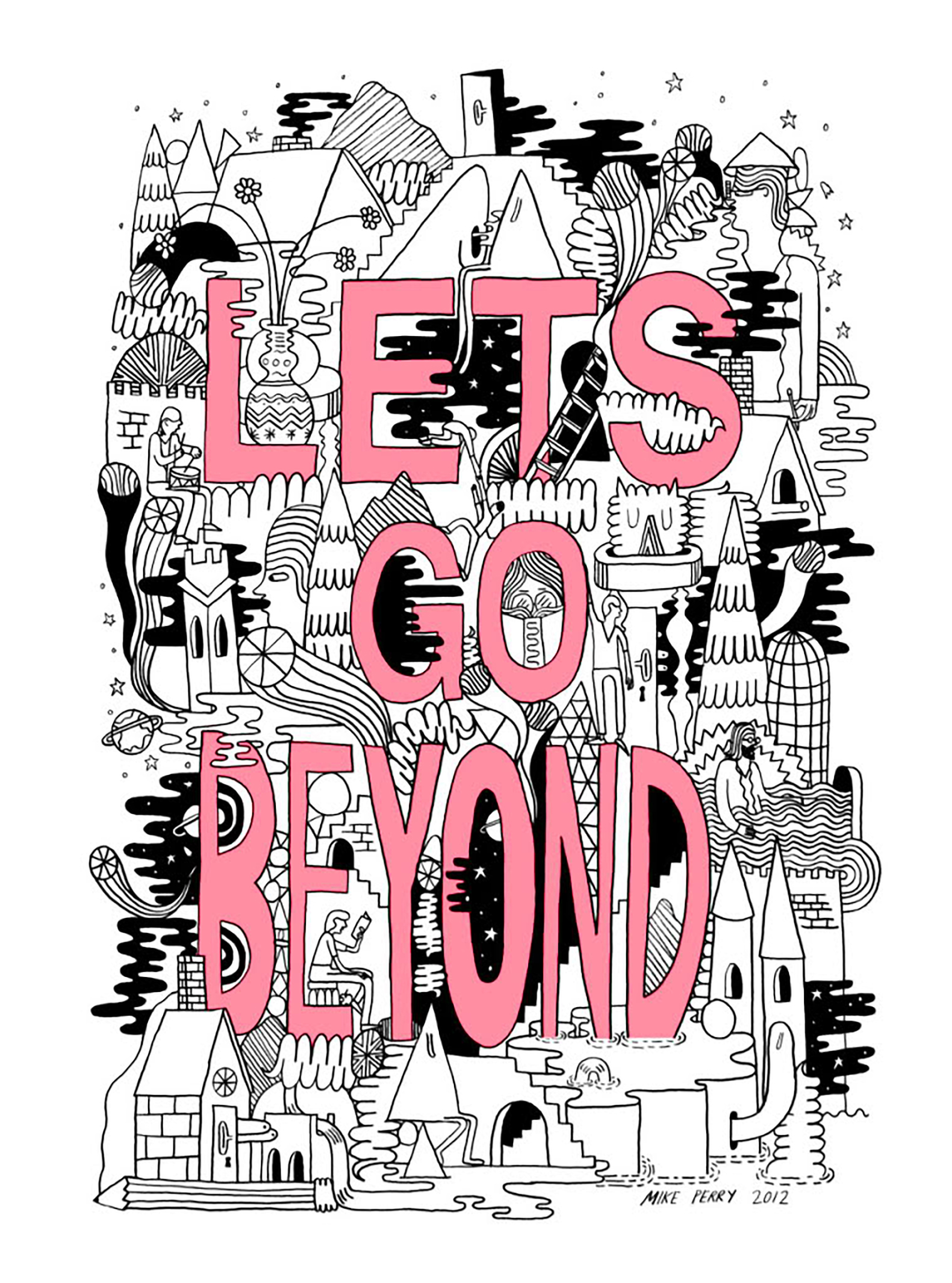
You may’ve seen Brooklyn-based designer and artist Mike Perry ’s work around. He has exhibited throughout the world and has worked for a variety of clients, including Urban Outfitters, The New York Times, Apple, Nike, Zoo York, and Target, to name a few. He has also published four different books on screen-printing, hand-drawn type and patterns, and—most recently—Wandering Around Wondering, a collection of his work so far. With an emphasis on hand-drawn and the “transformative power of making things,” Perry’s work is incredibly distinct and full of character. His work often deals with patterns, shapes, and anthropomorphic objects that join together to create a greater whole—and a glimpse into the mind of the man himself. Recently, I had the opportunity to check out Mike Perry’s studio and sit down to chat with him about everything from personal process to figuring out the universe (sort of). If you happen to be in Ohio, you can also check out the exhibit “Night and Day” at the Yes Gallery, featuring new work by Perry and artist Naomi Reis. It runs through July 20th, 2012.
Interview by Jessica Butler
Before getting into graphic design, you used to paint significantly in your teens. Does this background in painting have a role in your work now?
I would assume it does. The more I think about my work from the past, so much of it has been about getting these ideas out—an obsessive desire to create something all the time. So many of my hours are spent thinking of ideas or pulling a pencil across a sheet of paper. This always works well for me in a graphic design sense because deadlines are short and I would need to generate a lot of process before committing to a final outcome. The work I make now vs. the work then is so different. I was painting a lot of figures, a lot of portraits; things were very moody and my painting work now is getting more and more abstract. I was obsessed with John Singer Sargent then and now I find more comfort in someone like Alexander Calder.
It has been a great journey so far. This is my favorite part about being alive. Seeing what I used to make and how it turned into what I make now. Seeing the progress and the process. To me, some of the most exciting pushes in my work came from those stumbling accidents and my desire to look back at them and learn from them.
How did your time at Minneapolis College of Art and Design shape your trajectory?
My opinion about higher education has diminished over the years. That said, I got everything I needed to get and it was so brilliant. I was so lucky. Surrounded by so many amazing and inspiring people. Most of my education didn’t happen in the 9-5 of class time but in the hidden after hours in the studios talking shit, listening to music, and being surrounded by people in a place of ultimate creative freedom. As you get older it’s harder to be able to sit around and just make. I miss the sounds of someone running through the doors laughing. The screams of someone’s computer crashing and him or her not saving. The late night walks to the coffee shop before it closes to sneak in a little more caffeine. Within all of that was passionate, obsessive, powerful, abstract, fun, beautiful, creation.
Developing one’s own style can be a long, and sometimes difficult process for many artists. When do you think you reached the point where you felt you had “your own style?” What process goes into getting to this point?
Style is or can be a funny thing. I hope that everyone comes to their own style on their own. There is a way that your mind works in relation to your hand. Which works in relation to the world you were born into. And in relation to when you where born and the things you have seen, experienced, the tragedies, the comedies . . . This is your style. When I put my pencil on a sheet of paper it has everything I have been through, making its way out. It is who I am. This is my style. This is how you develop a style. You live life. If I hurt my finger or wrist then my drawings are different, if I am in the country with nature, this affects my work. Take it all in and be yourself.
Do you ever feel a sense of “comfort” or security in what you’re creating because of this seemingly established and unique style?
I guess maybe style is like finding your self. Which if you look at it like that, finding a style as a journey makes sense. I would say I do feel comfort. I am at a place where I feel both comfortable with making things that are unpredicted and just flow out, but also the ability to make things exactly like I vision them. I spent a lot of time trying to figure out how to make the work I wanted to make. Seeing the disconnect between brain and hand. It has been a growth experience and an adaptation to my hand’s ability.
You’ve worked for a variety of different clients throughout your career and have acknowledged the importance of business. Does your artistic integrity ever feel at risk?
I hope not. It would be a bummer for people to decide my work is not artistically valid because I needed to make a living.
I guess what I mean is, since you have a lot of different clients asking for a variety of things specific to their brand/business, do you ever feel like you need to change your style slightly in order to satisfy the client? If so, how do you deal with this and manage to stay true to your personal style and work?
It kind of depends on what kind of hat I am wearing for that project. A lot of the time people hire me to make something that looks like my work. In that case I just do my thing and hope they like it. But when it’s a problem-solving environment I like to explore and make according to the brief. I love the exploration part of making. I often give myself briefs to follow because I love visual problem solving.
A lot of your work contains similar patterns, images, and symbols. When we spoke you called it something like a visual “vocabulary.” How do you think these occurred? Is this idea of repetition something you encounter elsewhere in your life?
I think this vocabulary has been there the whole time. It was just the process of putting the book together that really opened my eyes to how much it is a part of the work. My guess is that most creative people have a lot of repetition in their work. These are shapes, ideas, colors that make us feel good. There are shapes and colors that when I use them I just feel good. Feeling positive about something you’re making can cause you to want to make more.
In our studio visit you also mentioned you’re a bit of a science guy and showed me an incredible sketchbook full of pages attempting to solve a cosmic problem you had in your head. Would you say the universe is a theme you gravitate towards? What sort of significance does the universe and science have for you?
I love the science fiction of the universe—that anything is possible if you can imagine it. It feels freeing and comfortable. I often feel like I am building little universes and placing planets and stars in their cosmic formation. I love that it is a great unknown but we understand the elements that have formed this greatness. Like the color red is an atom in a drawing I am making.
Are there any other themes, ideas, or sources of inspiration that you are especially drawn to?
Heritage, the future’s relationship to the past, the difference between silence and chaos (I try to work with this a lot. How to make something filled with chaos feel silent.) Organic vs. Geometric.
What role do words play in your work?
Words are very important to me. A lot of my ideas start as words. A quick one liner jotted in my notebook that comes out as two men playing tug of war. But then the opposite happens where I will draw a little face that turns into a poem. I love writing poems. I am trying to feel better about sharing those poems but it’s hard. I often hid poems in the work.
What’s something that makes you laugh or smile?
I just watched the new 21 jump street movie. I laughed a lot.
Finally, what can we expect from you next?
Isn’t that the question? I have a lot of ideas. Not sure what will happen in what order. Some books, exhibitions, maybe a few years of silence. Who knows!