Cowboys, Sun, Snow, Fire, Labor Wars, Gold and Genocide: 150 Years of Colorado in a Rare Curated Survey at MCA Denver
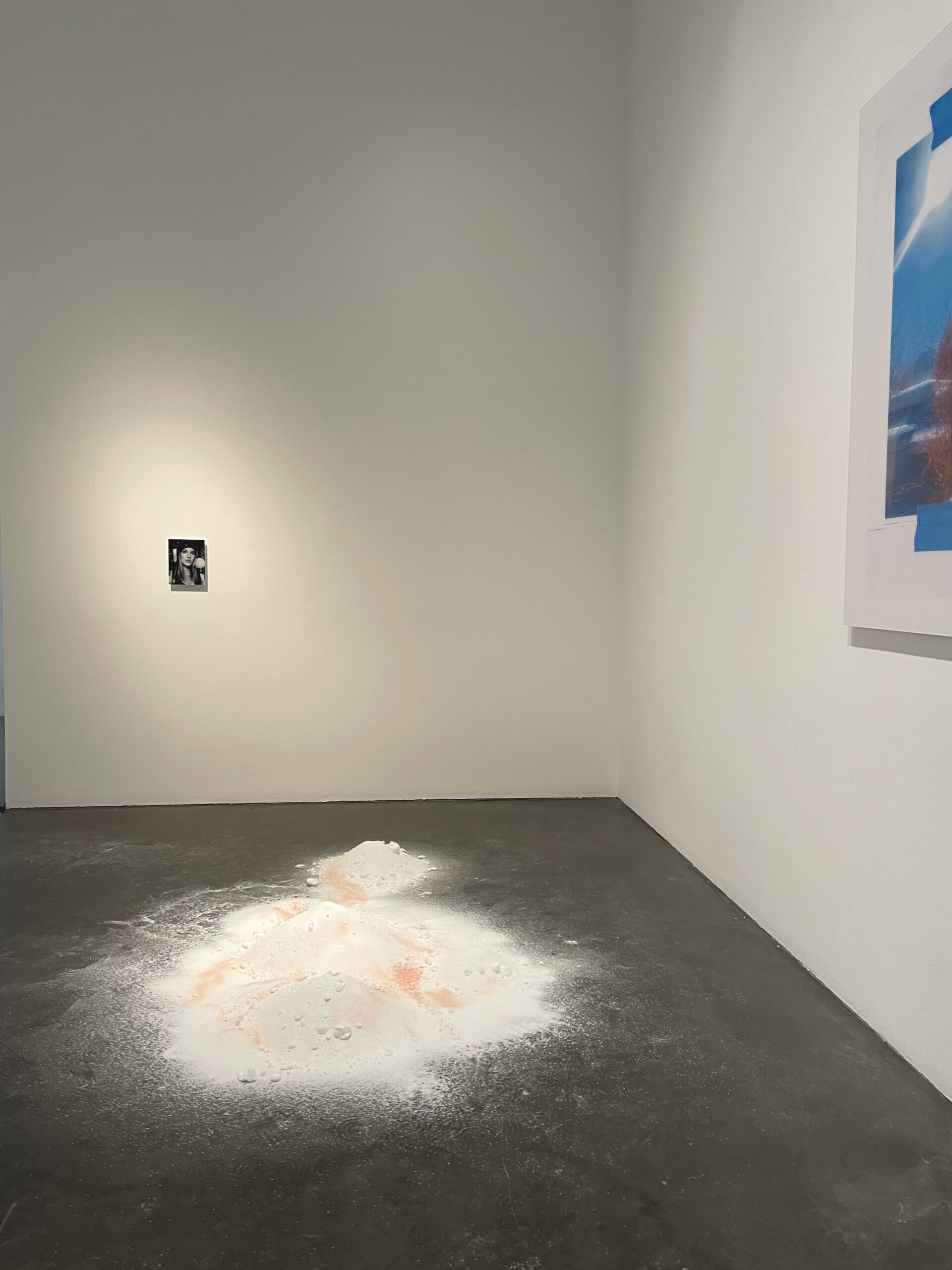
Devon Dikeou, THE INCONSPICUOUSES
.
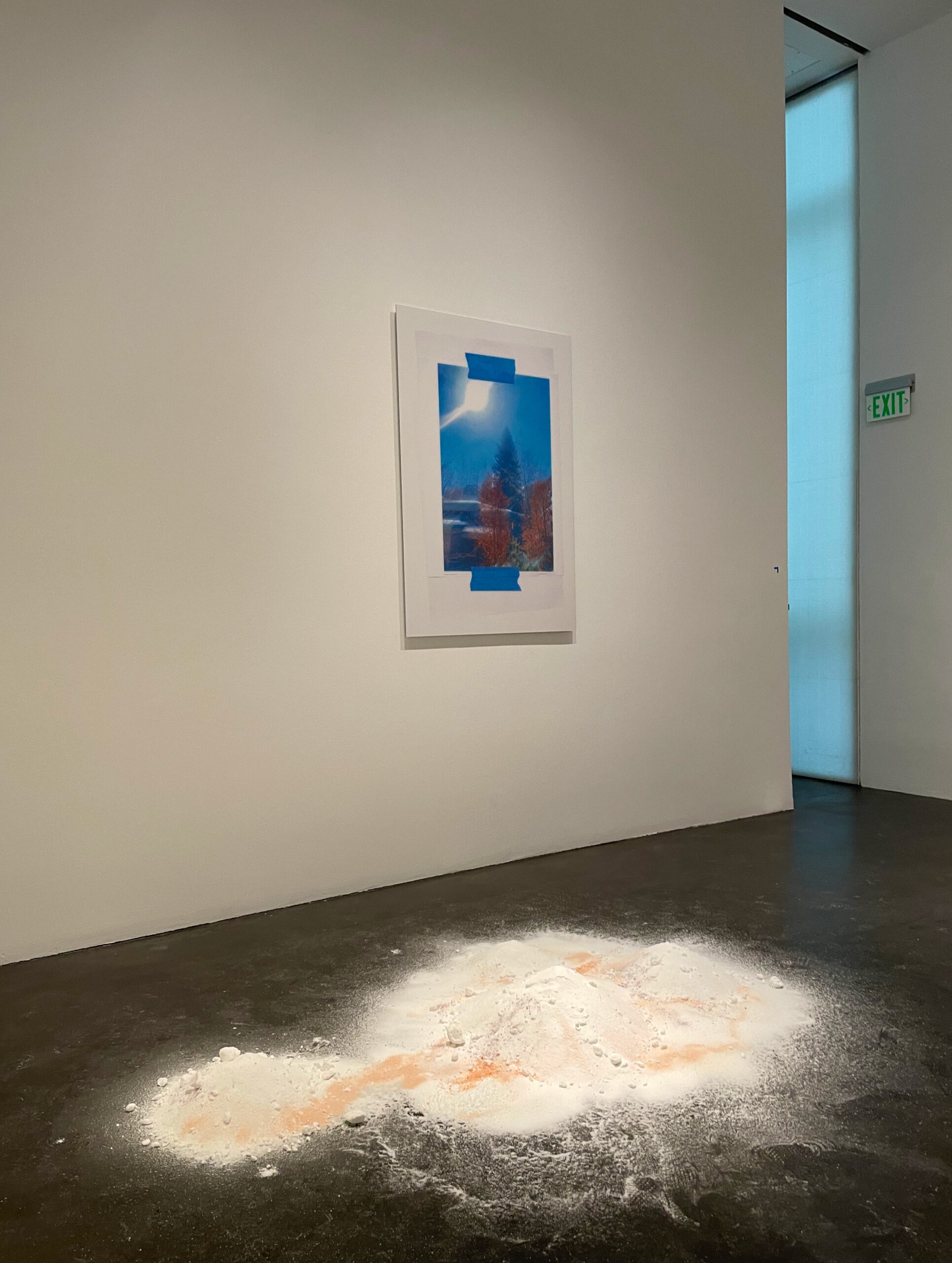
Floor: “Aspen Snow: Mountain (MCA Denver: David Adjaye Building)” 2024/2025 Ongoing
200 Pounds of Salt (Various Blends), Spread Over the MCA Denver: David Adjaye Building, Concrete, Mary Caulkins & Karl Kister Gallery. Dimensions variable
.
Wall Right: “Vision Board (American Academy in Rome: Rome Prize; McKim, Mead & White Building)” 2024/25, Ongoing; Photograph of a Vision Board Including a Collage with Painters Tape, Photographic Print Out from a Window in Aspen (Taken by an Aspen Domestic), Bulletin Board at American Academy for Rome Prize Project, THE INCONSPICUOUSES—based on Annibale Carracci’s exploration of Landscape as a Primary Subject and
.
Middle Ground, and Inspirational Window of Stevie Nicks’s Song, “Landslide”. Real Window for the Stevie Nicks’s Song Unknown’; C-Print on Aluminum
Wall Far: “Stevie (American Academy in Rome: Rome Prize; McKim, Mead & White Building)” 2024/2025 Ongoing; Appropriated Image of Stevie Nicks from the Internet, from Approximately the Time She Wrote the Song, “Landslide”, Inspired—Lore Has It—of a View from a Window of an
.
Aspen Lodge where She Worked as a Domestic; C-Print on aluminum, 11 x 8 1/2”
.
Photo credit: Devon Dikeou
On the occasion of 150 years of statehood, Colorado Currents, a survey of 28 contemporary artists who claim Colorado as home or homeland, is now on view at the Museum of Contemporary Art Denver (MCA Denver). Among them is zing’s founder, artist-editor-publisher-curator, Devon Dikeou, who presents recent work from her fellowship at the American Academy in Rome. Born and raised in the Queen City of the Plains, Devon and her brother Pany also founded Dikeou Collection, a trove of contemporary art in downtown Denver, which has since become a fixture of the local scene.
The show presents a rare look at Colorado as a hub of artistic activity, featuring work carefully researched, organized, and selected rather than chosen through open call. The project is led by Miranda Lash (MCA Denver Ellen Bruss Chief Curator)—founder of the modern and contemporary art department at the New Orleans Museum of Art. She further spent six years at the Speed Art Museum (Louisville, Kentucky), where she co-organized Southern Accent, a survey of the American South in contemporary art. She is joined in her efforts by Leilani Lynch (MCA Denver curator), who previously was a curator at The Bass (Miami). At MCA Denver she has organized Kambui Olujimi: Movements Towards Freedom (2024), Anna Tsouhlarakis: Indigenous Absurdities, and Breakthroughs: A Celebration of RedLine at 15 (both 2023).
Miranda Lash and Leilani Lynch on Curating Colorado Currents
as Interviewed by Rachel Dalamangas
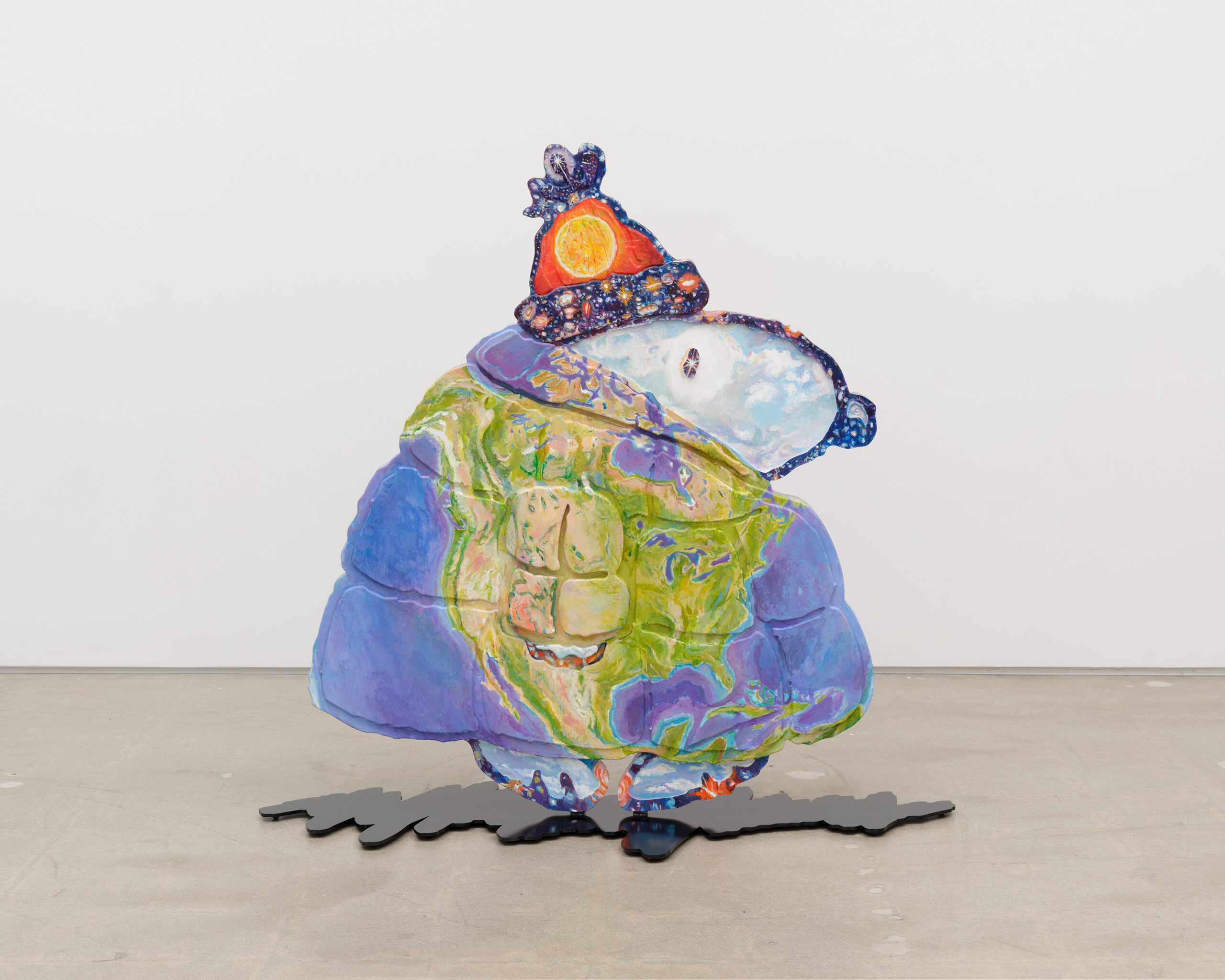
Keith Mayerson “Earth Snoopy” 2026, Acrylic on wood and steel, 48 × 49 × 18″
Photo credit: Wes Magyar
Are you both originally from Colorado?
LL: Neither of us! I’m from California originally, but I was living in Miami at the time before moving here. So I’ve been here almost four years.
ML: I’m also a California native—so, you know, we both tilt west in our leanings. I was living in Louisville, Kentucky before coming here. I’ve done a lot of work about how we understand the American South, which is in so many ways also a complicated region to understand.
To me it felt correct to bring the same type of open-ended questions to Colorado—really to any place that has deep histories of violence and deep histories of beauty. How do you hold both? Acknowledging the darkness doesn’t mean that you can’t appreciate all the things you love about a place—and in fact I think it translates into deeper love, because real love needs understanding of what it is.
I would build upon that theme of holding both. For example, Ronald Rael’s beautiful 3D-printed adobe structure is called “Coyota.” It’s based on a term used in the San Luis Valley for people of mixed lineage.
The Spanish colonizers brought over to what was then New Spain what they called the system of castes—a caste system based on your racial lineage. At the top of this hierarchy were people who were of purely Spanish descent. At the bottom of the hierarchy were people who were of Indigenous and African descent. And then they had a ranked system based on how much blood you had of different races. So coyota was a caste category for people of mixed Indigenous and Hispanic descent.
But because terms and ideas migrate over time, it’s now a way of describing with positivity mixed lineage in southern Colorado—embracing this idea of being born of multiple cultures.
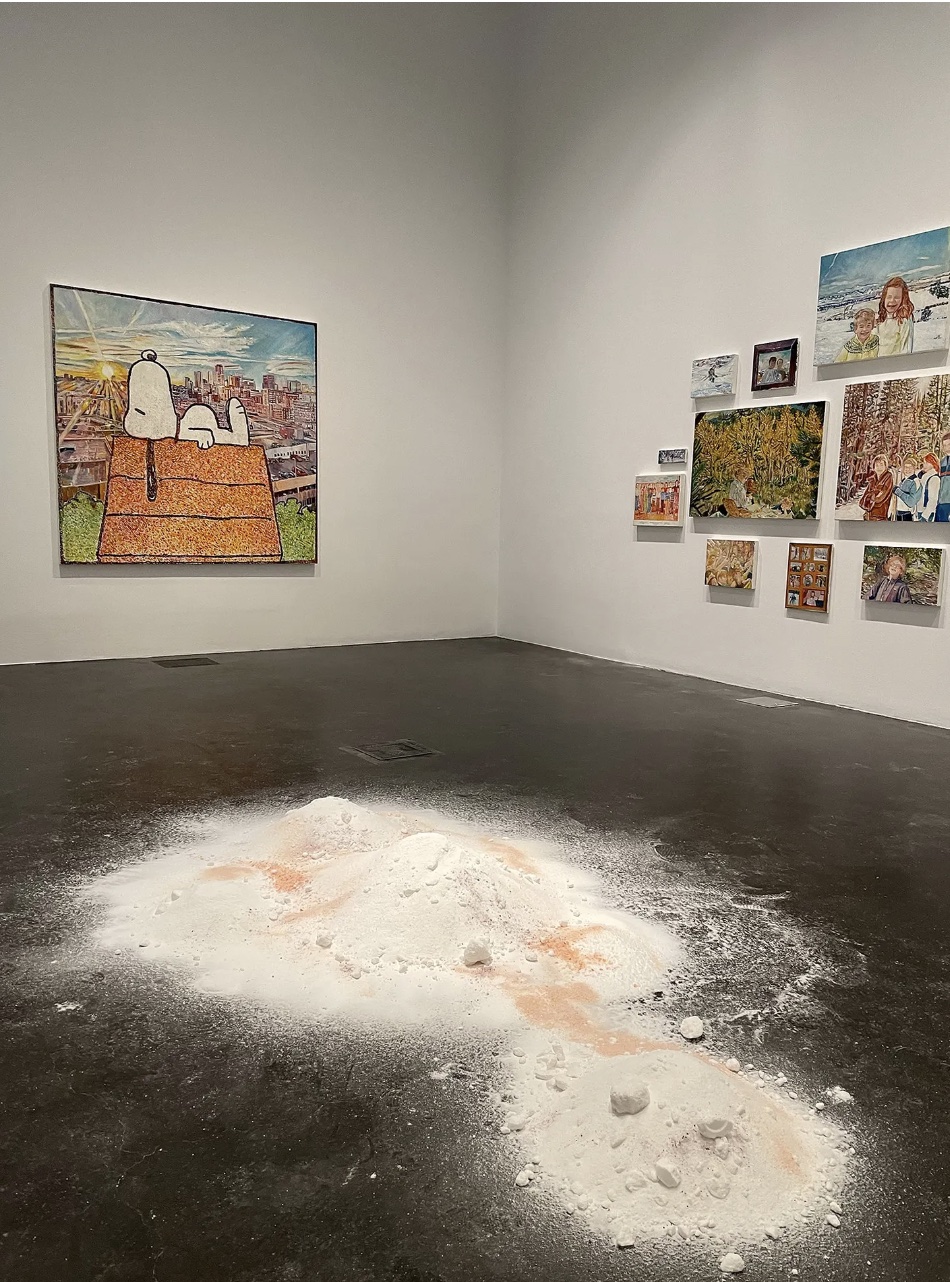
Keith Mayerson, “Snoopy Dawn over Denver” 2026, Oil on linen, 70 x 72”; Salon Wall of Family Photos, Oil on Linen, Ongoing
.
Devon Dikeou, THE INCONSPICUOUSES “Aspen Snow: Mountain (MCA Denver: David Adjaye Building)” 2024/2025 Ongoing; 200 Pounds of Salt (Various Blends), Spread Over the MCA Denver: David Adjaye Building, Concrete, Mary Caulkins & Karl Kister Gallery. Dimensions variable
.
Photo credit: Hayley Richardson
Who Is a Coloradan?
Keith [Mayerson] and I, when we were chatting, were trying to figure out: what does it mean to be a Coloradan? And it’s funny, because we’re coming from the perspective of diaspora Coloradans, and then you’re coming as transplants into Colorado. What does it mean to be a Coloradan?
LL: I think it comes with an appreciation for place. One of the things Colorado stands for is really the natural beauty that is here—but layered in that are so many histories and complications. A progressive spirit, I think, at least where we stand now. And a spirit of openness.
But that’s my perspective. In thinking about our conversations with artists, it was interesting just to pose that question—I don’t know that the question of what does Colorado mean, or what emblematizes this place, comes up all that often. Maybe in specific subsets. Whereas maybe different states get that question more, and maybe it’s the region.
ML: And I think it’s also fair to say we met so many incredible artists that essentially said, “I’m not really interested in that question.”
I think being outdoors is often part of it. My children’s school has this sign above one of the doorways that says, “There’s no such thing as bad weather, just inappropriate dress.” Whatever the weather is doing, we’re going to still be out.
There’s this awareness of water and land, and how the land has been used. Because this was considered the frontier, there is this spirit of openness—come here and define yourself and do what you want. The flip side of that coin is, it’s on you to decide what is good for you. There are many nuances to rugged individualism and how that plays out.
A great example that I remember noticing with an artist who was visiting Colorado: we were going through Independence Pass, and she said, “How are there no guardrails on most of this winding path?” And I replied, “I think it comes from this ethos of, it is your choice to take this path, and also your assumption of risk. If it works out for you, great, but it’s your responsibility to take care of yourself.”
That libertarian ethos can sometimes play out in providing a sense of freedom—the idea that someone can do whatever they want. In other cases it leads to holes in infrastructure, as well as holes in acknowledging our histories and maybe what is owed.
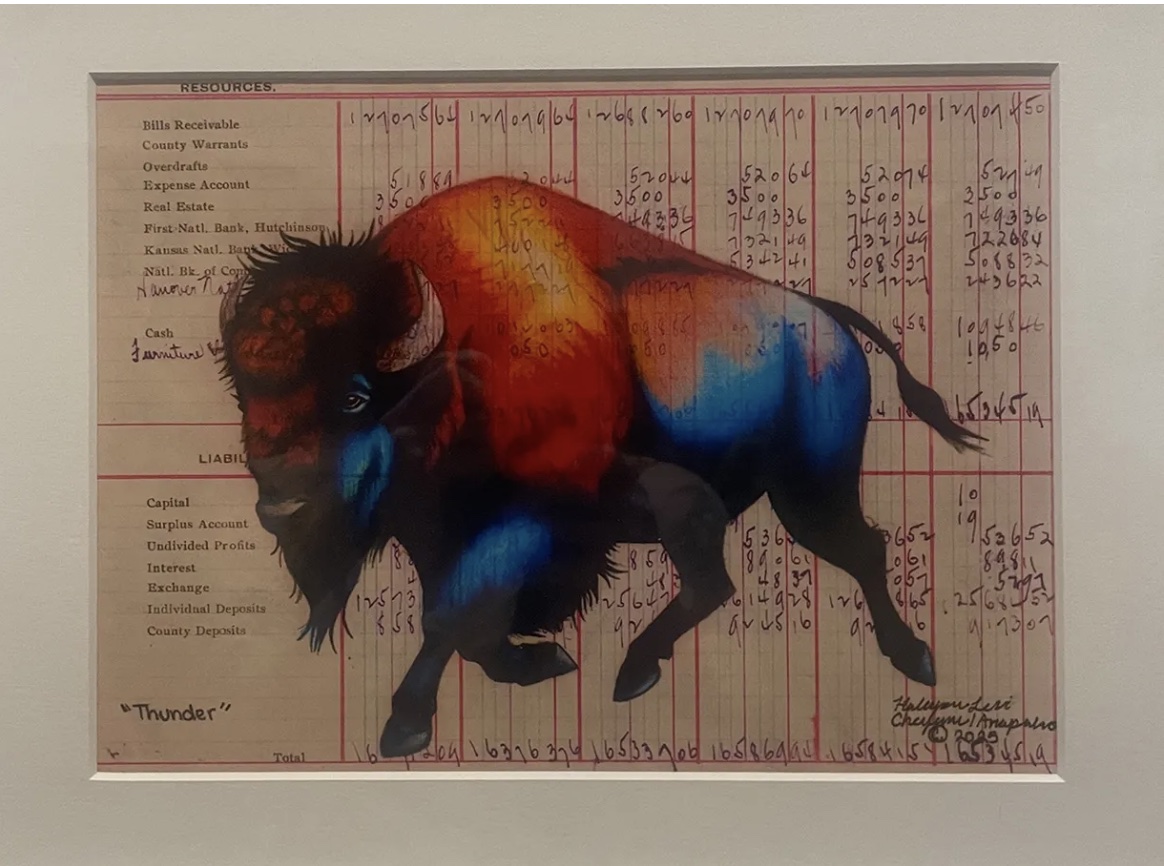
Halcyon Levi, “Thunder” 2026 Giclée on Paper, Framed: 13.5 x 15.5”
And that shows in the way this exhibit is structured: it’s not exclusively Colorado natives.
LL: I think we wanted to intentionally leave that a little bit more open than saying you had to be from here or be living here. We have many artists who are living in Colorado, practicing here, and also many like Keith [Mayerson] or Caleb [Hahne Quintana] who don’t live here now but grew up here; and then others like George Curtis Levi, his wife Heather, and their daughter Halcyon [Levi] who are Cheyenne and Arapaho and live in Oklahoma, but reflect the history of Indigenous communities being driven out.
Colorado is a homeland for those people, but they no longer reside here. That doesn’t mean they’re no longer tied to this place. It was really that feeling of connection to Colorado that we ended up expanding into.
ML: We decided to choose artists who consider Colorado home or homelands; acknowledging the Indigenous tribes who considered Colorado homeland, but who may not live here for reasons of historical expulsion.
I would use DesertArtLAB as an example. Their practice is very much grounded in understanding the flora and fauna and ecology of the desert, and acknowledging that deserts, mountains, rivers don’t stop at the state lines. Their piece involves mapping the image of the cholla cactus over this region, expanding into New Mexico, conveying that this is another way to think about region. The state line is almost irrelevant.
They also talk about how one of the reasons the southern border was placed where it is was to divide the Hispano population to diminish their voting power. That was very intentionally executed.
They asked me the question: “Haven’t you ever thought how strange it is that Colorado is a box, with no correlation to any geologic phenomenon? A lot of other state boundaries are determined by mountains or lakes.” That’s not an accident. There were intentional political decisions around that demarcation.
So that was another reason that we thought, let’s let go of the box. Let’s literally think outside the box.
Masculinity, Cesar Chavez, and the Ideals Worth Keeping
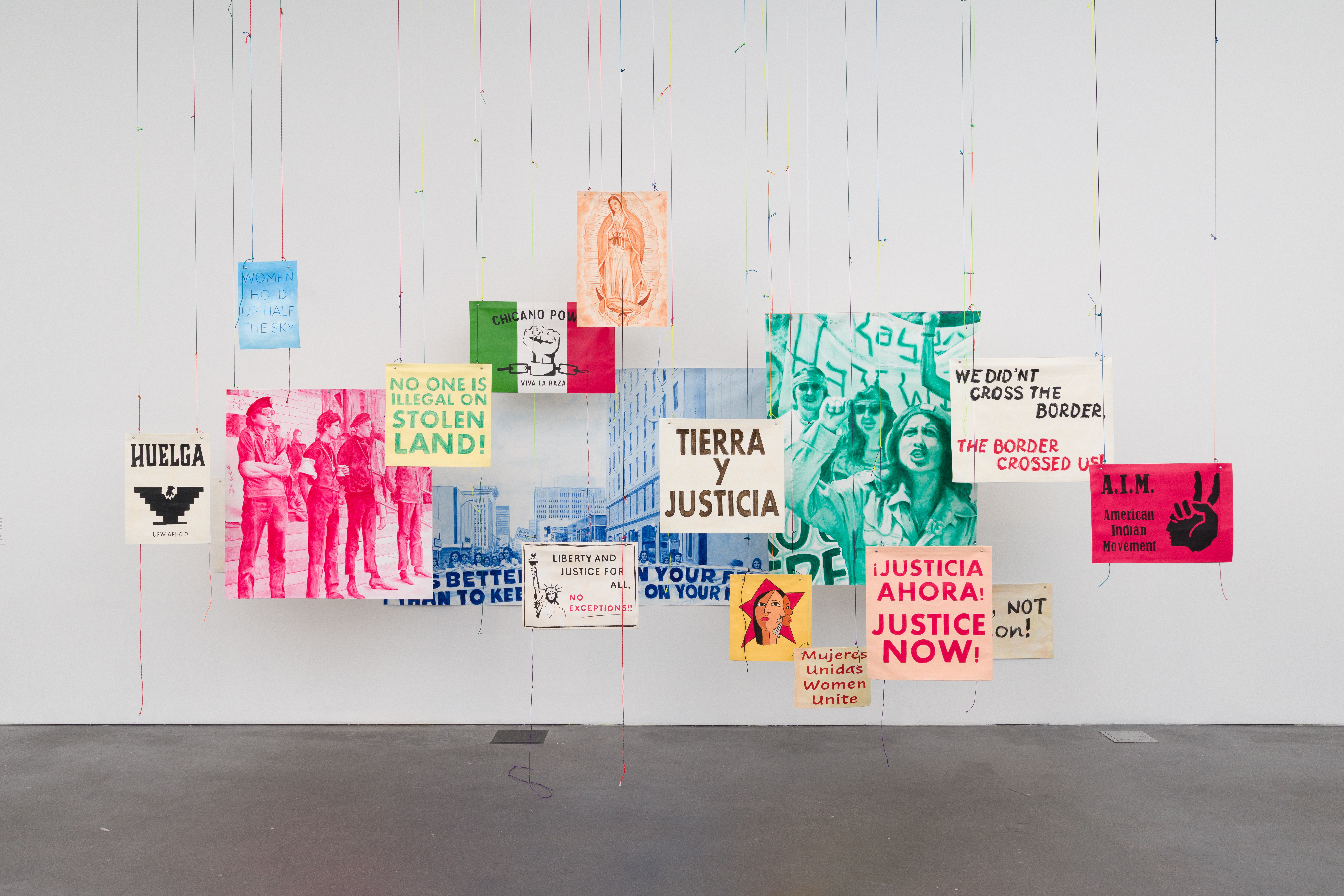 Carlos Frésquez, “. . . and Still, I March!” 2026, Acrylic on Unstretched Canvas, Approximately 108 x 180 x 48″
Photo credit: Wes Magyar
Something that surprised me was how masculinity was explored and expressed in the show, particularly because it is fully present without being centered.
ML: The point isn’t to say that any one identity or approach is wrong. The point is to say there is space in this country for everyone and everyone’s approach. There’s a beautiful painting in the show by Keith Mayerson of him with his husband, just sitting on the ground. There’s nothing extraordinary in what they’re doing, other than just asserting that they have a right to be there.
What kinds of masculinity are acceptable is an active conversation we had on a number of fronts, and how we talk about it. For example, Carlos Frésquez and I talked a lot about the revelations that came out in the last year about Cesar Chavez—these deeply saddening and painful accounts of how he abused young girls. I grew up revering Cesar Chavez. My mom is a family physician for migrant workers, so I was always taught to think of him as a heroic figure.
We talked a lot about what it means within the context of upholding the ideals of the Chicano movement. How do we talk about that moment? How do we talk about United Farm Workers? You might notice in his multi-panel painting, he decided: I’m going to show the symbol of the United Farm Workers movement, the eagle, because it’s true to the history. But there are no references to Cesar Chavez.
In every case in the exhibition, we had to be guided by what the artist felt like they wanted to do. We really don’t like being prescriptive about these things. One of the joys and challenges of contemporary art is that you’re often very directly speaking to the moment.
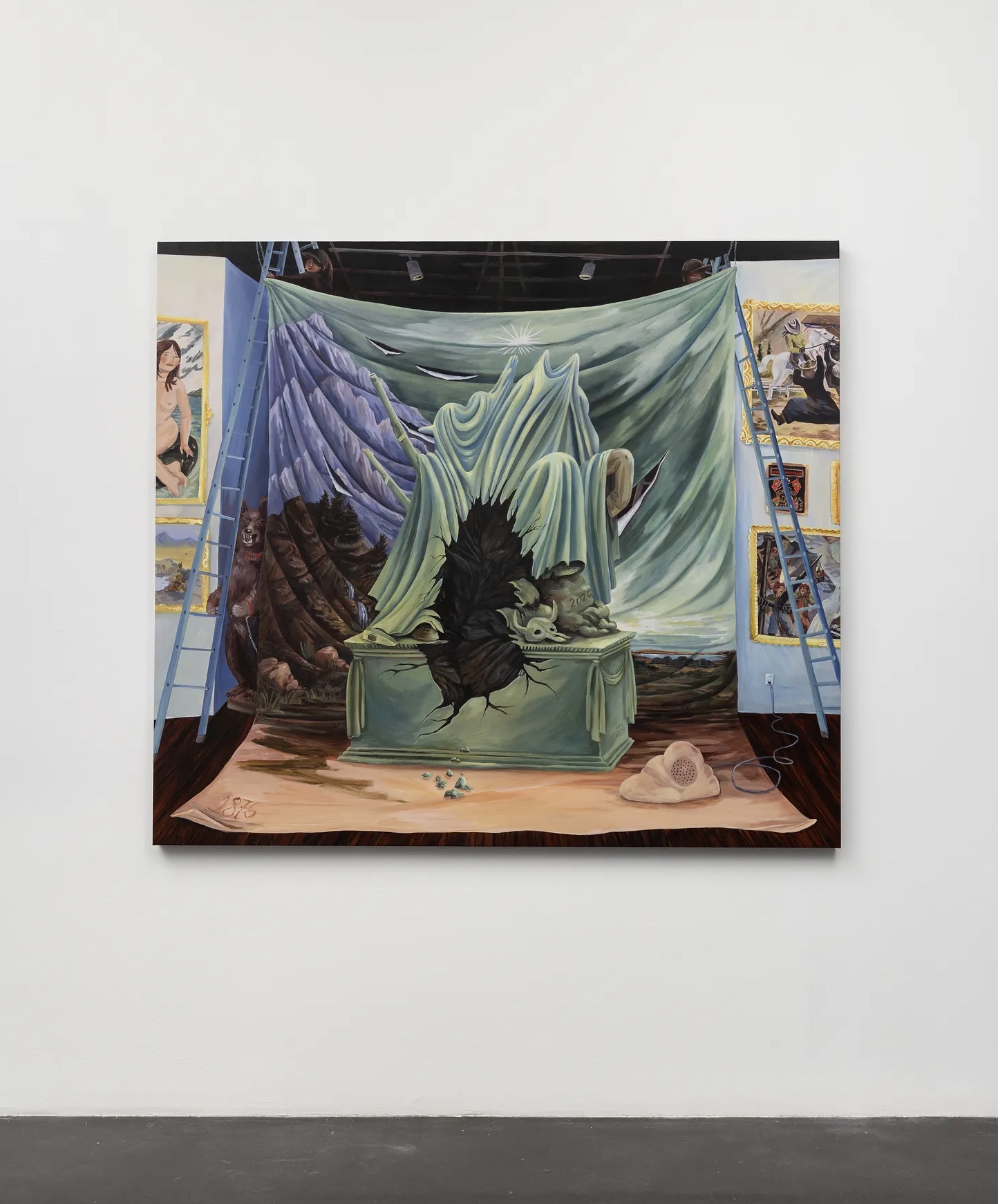
Grace Kennison, “Everything Conquered” 2026, Acrylic on canvas, 61 x 69 x 2”
Photo credit: Wes Magyar
The show doesn’t shy away from addressing the violence that still haunts the land: mass shootings, massacres, near-erasure.
LL: I think the earliest conversations about the show and the timing are because of this anniversary [of 150 years of statehood]. We started there, but our research with artists began to lead us to think more expansively—this isn’t just a celebration, although many of the works in the show do celebrate this day. I think every work ultimately is in some way speaking towards what this place is, if not always in a tone that’s celebratory. But also acknowledging that for others it isn’t a celebration, and it’s not a significant moment.
ML: I do believe that artists lead the way, and if they’re pointing us toward new ideas of how we can think about gender—or really anything else—it’s worth listening to. They’re always seeing around corners.
Grace Kennison made this amazing painting that addresses how one holds the idea of contradictions. It’s a painting within a painting that shows a shrouded monument. You can see on the stonework of the shrouded monument, 2026, and then in the corner, 1876—a reference to the year that statehood was established.
This willingness to hold the contradictions within history—where America’s ideals clash with its systemic cruelties—complements our nationwide revisioning of the grand monument, in the wake of so many Confederate memorials coming down. The widespread removal of these monuments triggered discussions around the country, asking, what are we commemorating with these statues? What are we marking? What did these used to mark? And what do we want to do in the future?
I think it’s really interesting that Kennison shrouds the central monument related to Colorado’s sesquicentennial, but then on the sides of the painting, within these mini-paintings [within the painting], she commemorates the Western Federation of Miners. There are histories of labor that haven’t been commemorated with big statues but are no less relevant.
Also the whole painting is set within a museum—basically implicating the role of the museum in marking time and holding histories. Because it’s Grace Kennison’s work, and her work always questions what is real? What is a construct? You see fake rocks, you see people pinning up lights—indicating, ultimately, the narrative is what we construct.
Fire, Water, and Land Use in Colorado Art
Do you see any patterns emerge across a large show of 28 artists like this?
LL: A lot of the artists engage with the various histories of Colorado—whether that be mining, ranching, the Indigenous communities that have been based here—all the way to more urban concerns, family histories, wanting to trace back roots and pronouncing what Colorado is from various perspectives, and acknowledging that it’s not a monolith, obviously.
And then, really, nature. Nature plays a huge role, and that is arguably one of the biggest through lines, I think. The ways in which people move here to enjoy nature—but also nature is unpredictable and is doing things that we can’t really control. There’s a lot of artworks that talk about land and water usage.
ML: There are definite themes around our responsibility to the land, and the historical uses of the land. You can’t talk about Colorado without talking about mining. It’s a big part of the story of why the Indigenous populations were pushed out, and how people amassed wealth here.
A number of the artists in the show talk about water and water usage, what water means. There’s an homage to water by JayCee Beyale with neon lights—it’s gorgeous. Maeve Eichelberger talks about the upper and lower basin in her clothing-based work. She has a piece called “Prosperity”, and it’s a saddle with images of Telluride as one of Colorado’s many gold rush towns.
But there’s also very loving approaches to land, to nature, to landscape—artists that love being close to nature. We have these wonderful drawings by Evan Forrest Mann that come from walking in nature, making work in nature.
Fire plays a role too. Erica Osborne’s very close-looking at the burn scars and the life that returns. We’re in love with this painting called “First Responders”, inspired by her trips out to the mountains’ burn scars with scientists. She studies the first plants that return after fires. They’re so often plants used to heal the body. Aloes and arnicas—the same salves that we use on the body after a burn are often the first responders when the mountainside has been burned.
Erica talked to us about the history of fire management—not just in Colorado but in the US—and this ethos that pervaded for almost a century, that every fire is bad, which resulted in an extremely proactive role in suppressing every fire. We all grew up with Smokey Bear and the idea that “only you can prevent forest fires.”
That approach is very much grounded in a colonial ethos. There’s a great recent exhibition called Fire Kinship: Southern California Native Ecology and Art, organized by the Fowler Museum in LA. It addresses how the early Spanish colonial settlers coming to California and to the West aggressively stopped Indigenous burns. The exhibition acknowledges what so many tribes understood for centuries, if not millennia: that fire was an important part of how the landscape regenerated and cleansed itself. They’d been doing controlled burns long before Europeans arrived.
Taking such an active stance against fire for so many years is one of the reasons we have such severe fires now—the undergrowth hasn’t been cleared.
That’s a recurrent gesture in the exhibit—recognizing loss as much as gain. How do you show, for example, fire as regeneration without minimizing what people lost?
ML: We didn’t want to skim over the terrible loss that is associated with fires. Some of our artists in the show speak very directly to that loss.
LL: Erin Hyunhee Kang is an artist based in Boulder who lost her home in the Marshall Fire. She’s thinking about that very personal loss of losing your space and having to rebuild. There is a projection of her home amidst water, and then the construction sounds of rebuilding—thinking about that kind of regrowth and rebuilding from both, like, what does nature do, and also how do we as citizens of the state and of the broader world cope after paying the price of some of these practices?
Colorado’s Histories of Activism and Censorship
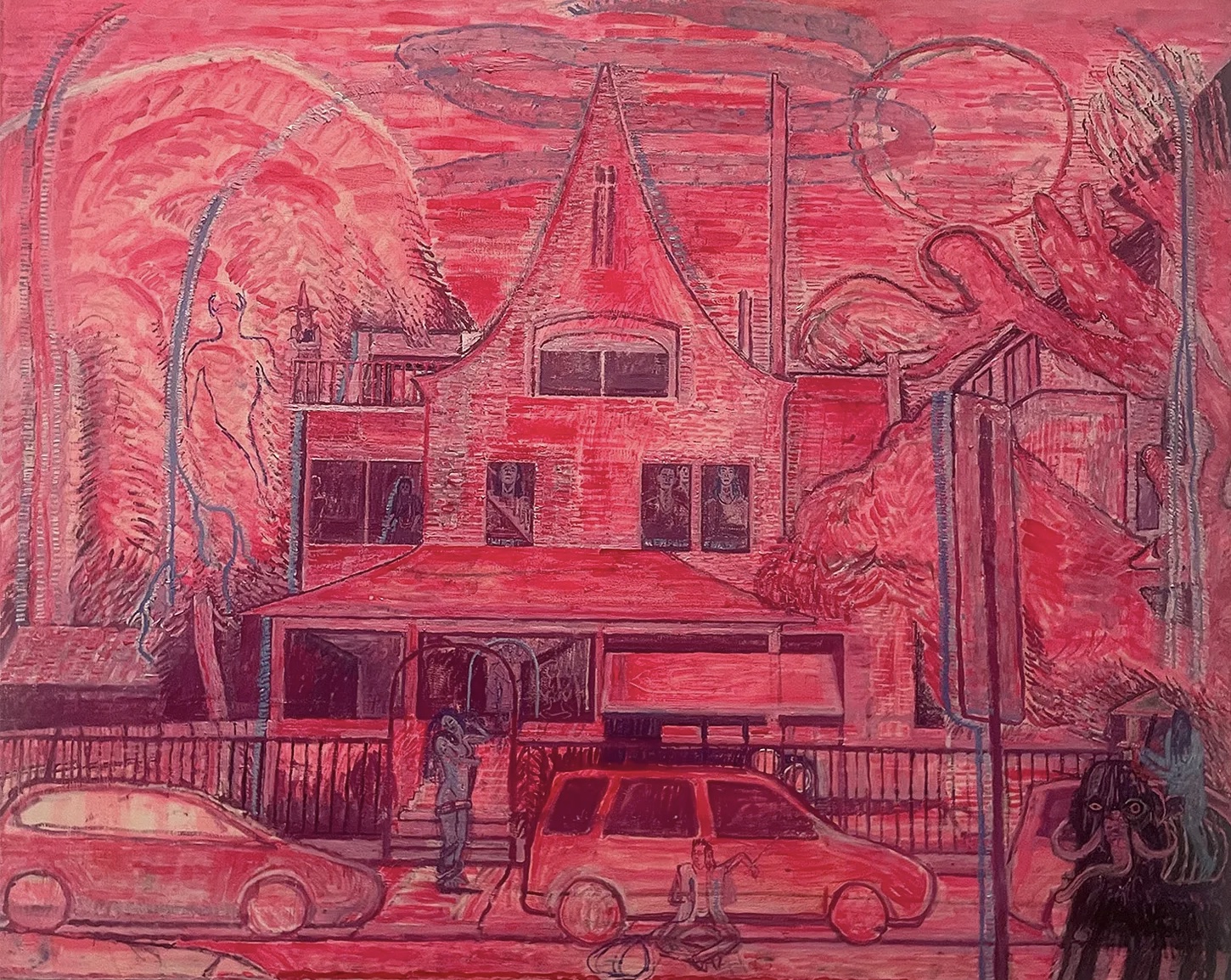
Lydia Farrell, “Lilith”, 2026, Oil on Canvas, 48 x 60”
ML: I think another important theme bouncing around is also the histories of activism here in Colorado. We live in one of the more progressive states in the US and part of that traces back to very long histories of activism here.
From the late 19th through most of the 20th century, discrimination was legal here. Segregation was actively enforced. Colorado was a major site of activity for the Chicano movement. Colorado also played a significant role in advancing LGBTQ+ rights. There are these beautiful histories of activism that inform why we have certain freedoms here that are very precious and we wanted to acknowledge that through several artists’ work.
I do appreciate that we can talk about these things in Colorado, because Colorado is not a state that has currently flagged words related to gender as subject to review or censure. And I say that in contrast to Texas, which has very recently passed laws subjecting certain forms to review, and in contrast to the museums that are under review by the federal government, where there are reviews and censure of using certain terms as they relate to gender.
So, the fact that we can even have this conversation right now—we can talk about the work of Lydia Farrell and use the word trans and use the word advocacy and be completely open. No artist in the show would be happy to say my work is about my identity and nothing else. That’s just way too simplistic an approach to their practice. But it is inevitably part of what informs their work.
I’m saying that because I don’t want that to be a freedom we take for granted, because it is being actively dismantled in different parts of this same country. And this is not metaphorical. It’s very literal. This is not conjecture. This is not speculation. There are very coordinated and active efforts to censure what art we can show and how we can talk about it.
But like any place, it’s complicated. We do talk about mass shootings in the show as well. It is part of Colorado’s story.
Devon Dikeou’s THE INCONSPICUOUSES at MCA Denver
Devon Dikeou’s THE INCONSPICUOUSES was first conceived in the McKim, Mead & White building at the American Academy in Rome. In Denver, the site-responsive work has David Adjaye to contend with.
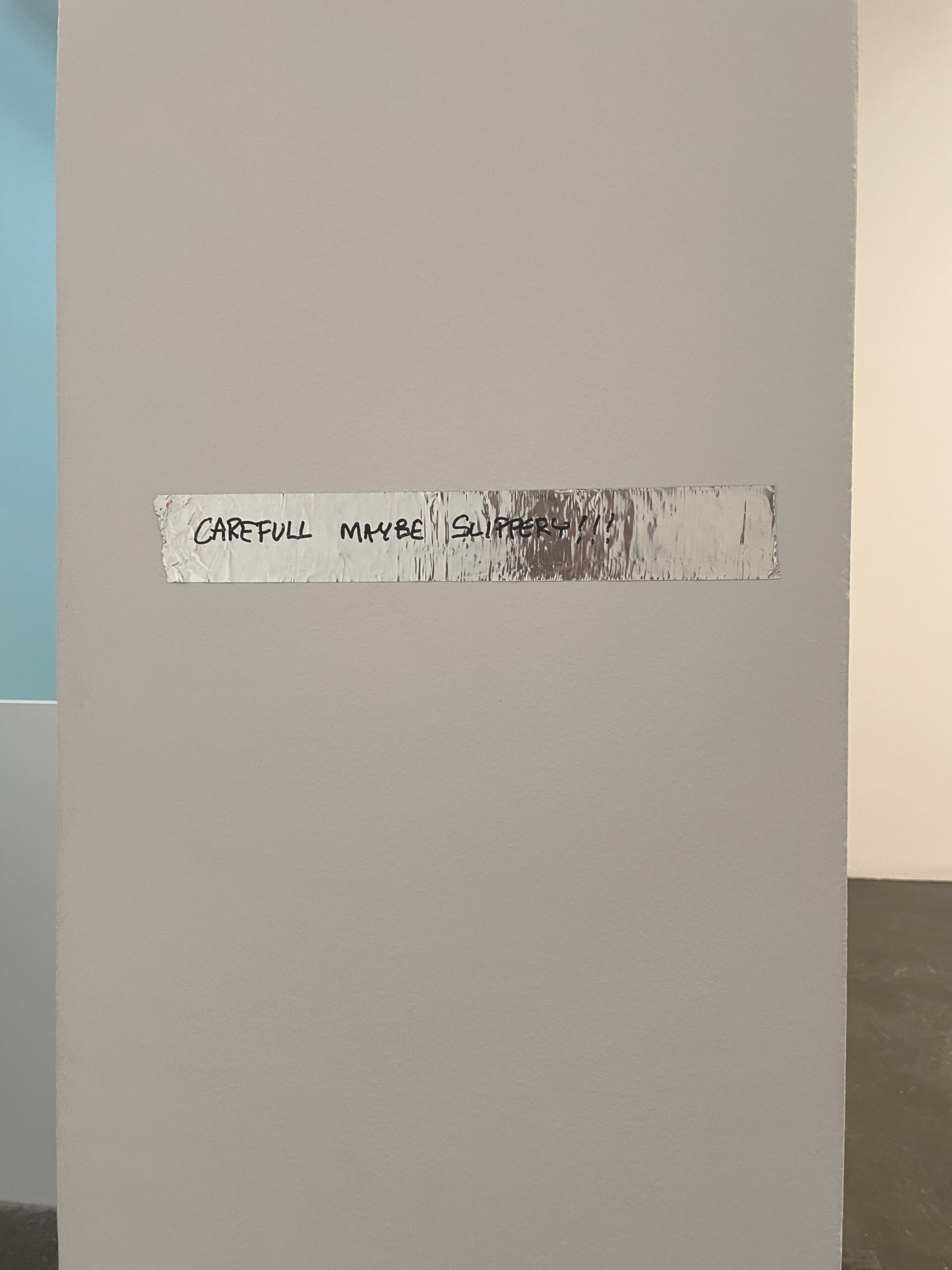
Devon Dikeou, THE INCONSPICUOUSES “Tape (MCA Denver: David Adjaye Building)” 2024/25 Ongoing; Foil Multi-Purpose Tape and Sharpie Taped Near the Installation of Aspen Snow (Both Versions) with Cautionary Instructions
.
Photo credit: Devon Dikeou
Devon Dikeou, THE INCONSPICUOUSES
.
“Vision Board (American Academy in Rome: Rome Prize; McKim, Mead & White Building)” 2024/25, Ongoing
Photograph of a Vision Board Including a Collage with Painters Tape, Photographic Print Out from a Window in Aspen (Taken by an Aspen Domestic), Bulletin Board at American Academy for Rome Prize Project, THE INCONSPICUOUSES—based on Annibale Carracci’s exploration of Landscape as a Primary Subject and Middle Ground, and Inspirational Window of Stevie Nicks’s Song, “Landslide”. Real Window for the Stevie Nicks’s Song Unknown
C-Print on Aluminum
.
“Aspen Snow (MCA Denver: David Adjaye Building)” 2024/25, Ongoing; 200 Pounds of Salt (Various Blends), Spread Over the MCA Denver: David Adjaye Building, Concrete, Mary Caulkins & Karl Kister Gallery; Dimensions variable
.
Photo credit: Devon Dikeou
Loss and Nostalgia: Devon Dikeou, Keith Mayerson, and Margaret Kasahara on Memory in Colorado
I attended Littleton public schools myself.
ML: I think that is part of contemporary life. We’re both parents, and so part of the reality of being a parent is knowing that the school is not a safe zone per se. And so how do you cope with that and deal with that, and do it in a way that feels sensitive to the loss?
I think of Margaret Kasahara. She has a daily drawing practice of notations, chronicling her life in Colorado Springs. There are drawings that do touch upon, for example, the King Soopers shooting in Boulder and the Club Q shooting in Colorado Springs. Her method is abstract, but I think very elegant. She has these incredibly small, detailed graphite drawings. They’re so intricate. You have to get so close to them to see the detail.
And then she puts single grains of rice arranged in a grid. She talked to us about the idea of the preciousness of a single grain of rice, reminding her of the single snowflake of falling snow, the single individual, the preciousness of every individual life. She gilded grains of rice in silver and in gold. And it was her way of indicating preciousness of life, fleetingness of life, trying to capture that. That was her way of paying homage to that loss.
So it’s not a comprehensive show.
LL: No, there’s no way.
ML: There’s no way. But we tried. And I think Devon [Dikeou]’s and Keith [Mayerson]’s work also touches on the sweetness of some memories in Colorado. Keith, as you know, because you did a beautiful interview with him—speaks to tender moments of growing up in Colorado, what it means to be Coloradan, what it means to grow up in snow.
I think Devon very much in her own ways is linking personal memories of growing up with snow in Aspen to this beloved pop culture legend of Stevie Nicks composing “Landslide” looking out at the Aspen snow.
There’s a lot of moments where the root of the inspiration is personal, but then it extends out to these universal themes.
I really appreciate the ambition that the artists brought to the show. I would use Marcus [Correa] as an example: biking the streets of Denver, crisscrossing the city, flying in a photographer from Paris, working with dozens of designers. But doing it because it’s about home, and this assertion that more people need to understand what home is for him. He’s one who said, I’ve been talking for years about how Denver is distinct, it’s its own voice. The North Side is not the same as a Latino neighborhood in Los Angeles. They’re not interchangeable.
The artists really wanted to present their best work. Because home is always emotionally loaded, and home can be the hardest place to talk about.
Colorado Currents was co-curated by Miranda Lash, MCA Denver Ellen Bruss Chief Curator, and Leilani Lynch, MCA Denver curator, and is on view through November 1.