Ana María Hernando’s exhibition Seguir Cantando at the Museum of Contemporary Art Denver takes its name and inspiration from “Como la cigarra” (“Like the Cicada”)—a song written by Argentine poet and composer María Elena Walsh in 1972. Walsh wrote it originally as a song of hope for artists who lose momentum in their careers, but its lyrics—tantas veces me mataron, tantas desaparecí, y seguí cantando (so many times they killed me, so many times I disappeared and I kept singing)—took on new and specific weight after the military coup of March 24, 1976, when General Jorge Rafael Videla overthrew the government of Isabel Perón and launched what the junta called the National Reorganization Process.
What followed was a systematic campaign of state terror: disappearances, torture, and murder targeting anyone considered subversive, with an estimated 30,000 people killed or disappeared over seven years. Artists, intellectuals, teachers, students, and union organizers were disproportionately targeted. Writers and musicians went into exile, among them Mercedes Sosa, Argentina’s most beloved folk singer, who was detained at a concert in 1979 with her entire audience and forced to flee the country. It was Sosa who made “Como la cigarra” a people’s anthem, recording it in exile while the song remained banned in Argentina. Walsh herself had been banned from radio and television.
Women occupied a particular and paradoxical position in this history. The junta’s ideology was explicitly patriarchal, built on order, hierarchy, and the suppression of anything ungoverned or ungovernable. Yet it was women, specifically the Mothers of the Plaza de Mayo, who began gathering in 1977 in front of the Casa Rosada with photographs of their disappeared children, and whose persistent, quiet, weekly presence helped delegitimize the regime. The feminine, it turned out, persevered.
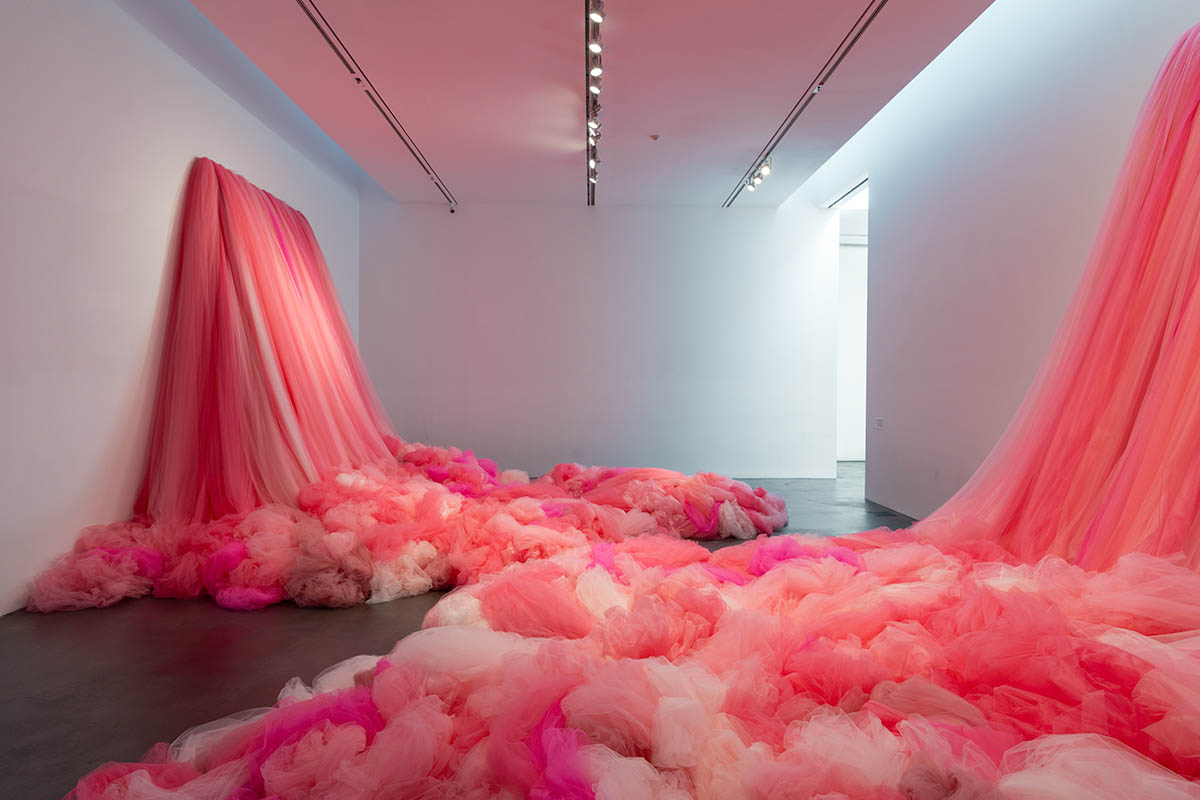
Hernando, a Colorado-based artist who grew up in Buenos Aires during the coup and came of age as an artist after the return of democracy in 1983, carries this history into our own present moment with Seguir Cantando, the centerpiece of which are two 12’ waterfalls made of some 8,500 yards of pink tulle.
Ana María Hernando as Interviewed by Rachel Dalamangas
What is the picture right now in Argentina?
People are suffering. I have most of my family still in Argentina. And you think it cannot get worse. Last week, it was the 50th anniversary of the coup. So it’s an emotional time and you know this government censors a lot of things and stories and I think it might be producing the opposite of what they want because more people are coming out with their stories.
Before the coup, it was very chaotic and there were kidnappings and you didn’t know from what side. It was just very difficult and then at the same time you go, you know, this is life.
Then when the coup came, they took over the press and everything. My school was what they call intervened, meaning they took out the director, the principal, and they put one of their own. There were friends that you were going to meet and they didn’t show up. And at the same time you are reading what the government is putting out and then afterwards you see all the lies. It’s just a way of governing through lies and wanting to control what is uncontrollable.
What was school like after that?
I went to the same school from first grade until I graduated from high school. Before the coup, there were many moments that were very uncertain. I remember one instance, a group of people were marching towards our school and it seemed like maybe they were aggressive and they wanted to get into the school, so we were locked inside. Then by the time when the coup happened, that’s when my school got intervened.
My school was a nun school. In Argentina, Catholicism took different ways than how I have experienced it here, where the message was more about how to help each other and my school was more aligned with that part of Catholicism. And so when the coup happened, they sent these nuns away and then they put in a different director. There were other things happening like some teachers stopped coming and then later I learned that one of them was killed inside a church with six other seminarians.
And you couldn’t talk much about these things. It was all kind of in whispers and people wouldn’t ask, “Oh, that teacher stopped coming?” I mean it was years after that I learned that teacher had been killed.
Were you afraid of being targeted?
At the beginning before the coup, there were a lot of kidnappings and you hear this and that and they were saying the left and the right and we were all a bit afraid. Like, in the streets you had to be with your ID—if they would stop you and you didn’t have your ID, that was grounds for them to take you in. And I was stopped—there were times like I was with friends and it was late and we were stopped by—it wasn’t the police, it was people from the army with guns.
And then, I had another teacher. I was doing theater and one day we are waiting for the teacher, the teacher is not coming, not coming and nobody said anything . . . you know, you couldn’t be public about your fears. The government was very clear about how they were looking into everything. And at some high schools a lot of students disappeared.
All the press was in the hands of the junta, so I mean, all the information you had was not accurate, I would say, you know, they were lies, but nobody knew exactly. Some people, of course, when they took people from your family, you knew. But the messages that the government was saying was that “Oh, the left was doing things, they were killing people,”—but by then, it was mostly the government killing people. So there was a lot of misinformation.
By the time I got to art school, Argentina was already a democracy. The art school had been decimated of creativity. And the teachers—I’m not sure how it had been there in the art school before, but the teachers were very rigid and it was more academic in a way of like going to the gym, you had to draw perfectly in a way that really didn’t have much of a spirit in it.
And the art is a response to those experiences?
It was based on and some pieces are named after a song by María Elena Walsh, Como La Cigarra. It’s a song that she wrote in ’71 or ’72 and she was very outspoken. Over time it became an anthem about perseverance and persistence.
And I think we are in a way in a time that—as I see it, I think we need nourishment. I hope my work is like a vitamin in some ways for people and a way of connecting in the midst of everything to joy. I think if we don’t have that it depletes everything, depletes us, and it’s hard to stand strong and if you feel defeated it’s hard to fight and so it’s based in experiences like that and how trauma marks you. I love how the song says, “I have been killed so many times. I was dead so many times but I keep coming back and I keep singing.”
The part of “keep singing” I think it’s the part of the arts that brings this renewal and a life that is beyond each of us individually. So that was one thread and feeling of what’s happening in the world, in this country and everywhere.
It’s chilling how much you can see a lot of what’s happening today in what you experienced in the past.
Yes. The sense of someone telling you how things should be, that they know better than you and this sense of controlling everyone else, the views of some specific very small group of people. I think at the end that brings, well, poverty—poverty of heart, of spirit, of mind, and physical poverty.
No doubt that made a deep impression on you as a young artist.
Yeah, and I think not as a way of running away, but what I see is that for us our survival is in staying light, meaning—not superficial, but very dynamic, you know, very aware and our eyes open and be very fast and quick at reacting at things.
The world is full of heavy energy. When you are light, you can move quicker. You can let go of things and be more open to what’s there at the moment.
If you are swallowed by the darkness then you just cannot move, it paralyzes you. I have seen how that has been at times a danger for me personally. It’s like I have gotten paralyzed for that moment. And it’s hard to explain how—why—to other people who have not gone through that. Like, at times I could be stopped with people with guns, I just stay quiet and still and also as a woman you are also very aware of that too.
Tell me some more about this concept in Andean cosmology that is important to you—you called it salka?
I would like to acknowledge my friend and teacher Don Américo Yábar, mystic of these Andean traditions. Without him, I would have only had shimmers of all that beauty.
Salka is a Quechua word that means undomesticated. I have been to Peru a lot, but more in the area of the Andes and the high jungle. They talk a lot about the salka, that the salka is that energy that it’s uncontained, and I think also is the energy of creativity. Where is the energy of the river and the forest and the clouds and it’s something you cannot contain. It informs my work where I’m following intuitively a form and then I discover more what that form is about. I think the salka is very nourishing to us, to life.
For art if you can connect to that energy, I think your work expands. And then you are lighter because for the salka to happen, you need to be more in this light energy.
Which makes sense that you’re working with very light material.
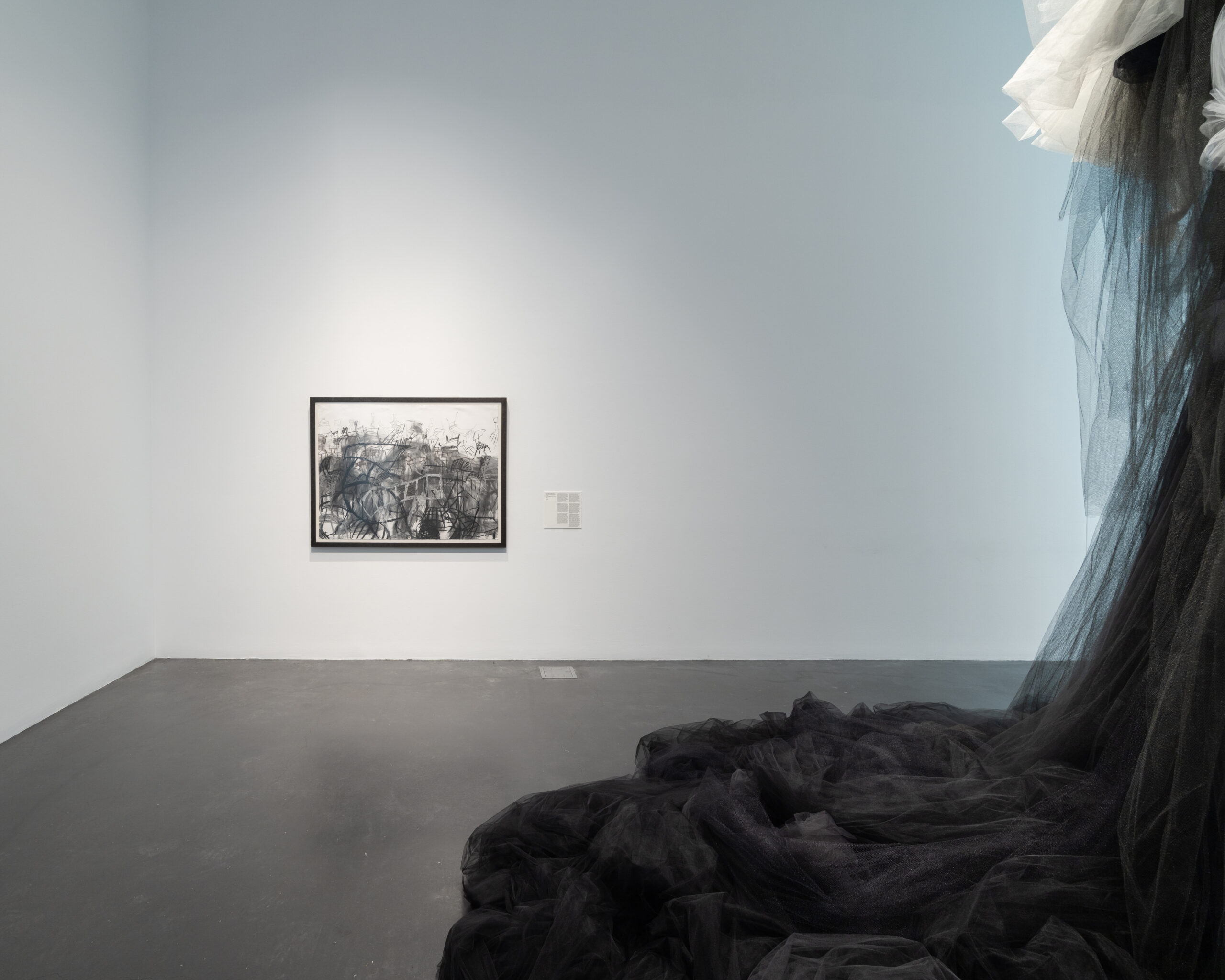
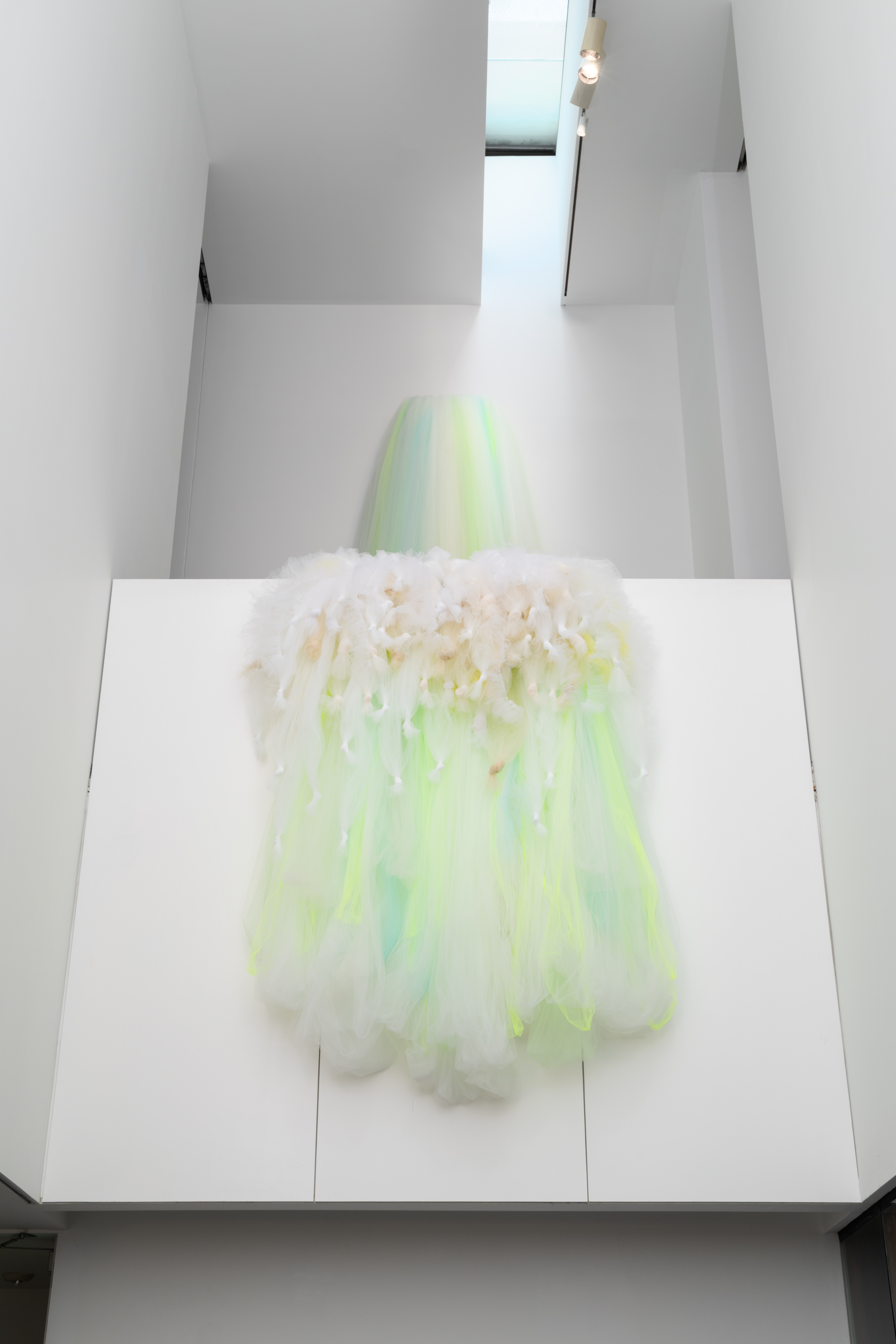
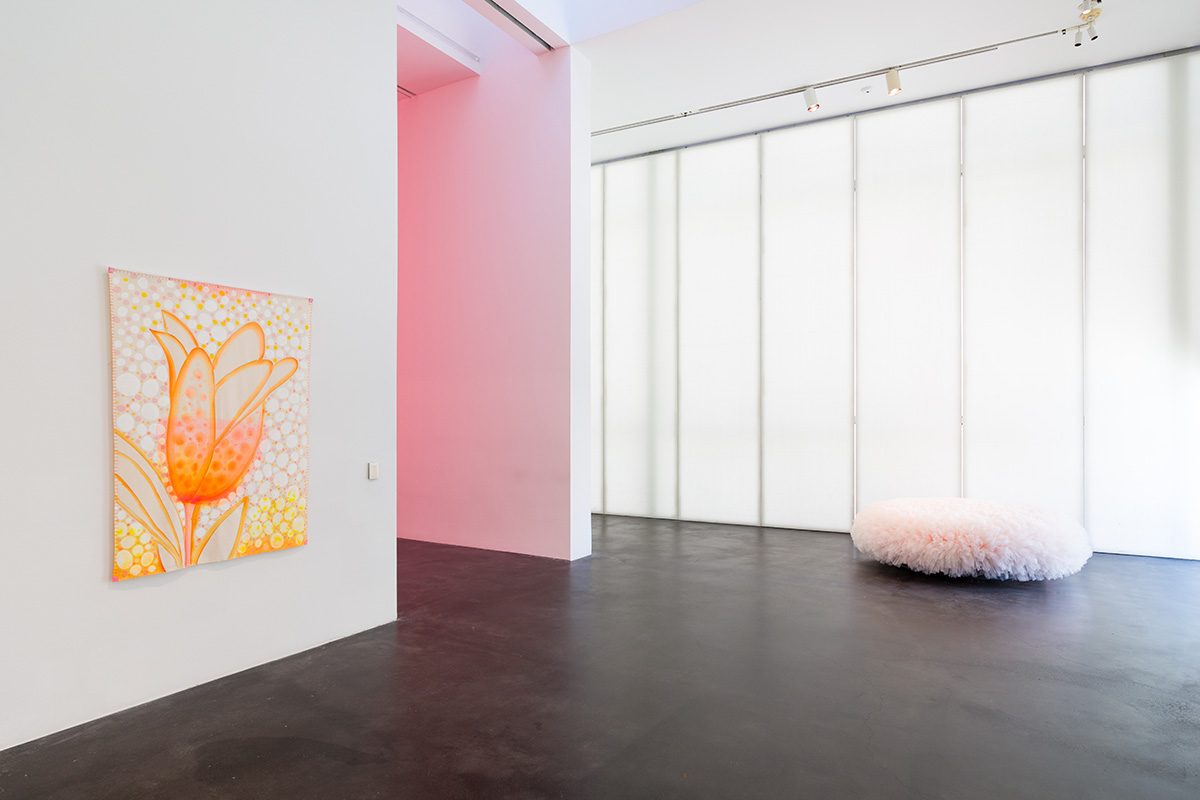
I’m a painter and tulle and the fabrics that I have an attraction to allow me to paint with fabric. So I use all these different colors, but by layering them I can make other colors. The tulle allows me to make these sculptures and give shape and work with volume in a way that paint doesn’t let me.
But then tulle also you think of the bride and you think of the princess and the ballerinas and it’s an archetype of the feminine that tells you you’re better off if you stay innocent and beautiful as if you are a package for others. And I rebel against that archetype.
So I’m using that same tulle that communicates those ideas and I use enormous amounts of tulle as a way of talking about power and agency and to question those ideas for young women.
Why pink?
Pink because of all the connotations of pink and how people think of women or girls, and I wanted to make it really pink and explosive. I don’t know what time of the day you saw the show, but in the evening, when you’re on the terrace, and the color is coming out from the skylights and you see the pink on the floor. I don’t know how it is with tulle that it glows. I’m not sure about the physics of it but I love it. I just wanted it to be enormous and unapologetic.
How do you dream up these waterfalls and design them?
I am responding to the building that—as I said—I love it and when I have the luxury of being able to be in a place, I sit with that place and I mesh with it and I can see what I want to make and then I walk towards that image.
So I make sketches then I try to figure out what is that about and by now I really trust these images and I trust that afterwards I discover more about the work that it’s not coming from my head but I feel it comes from another part of me that is wise, that knows, that’s connected to other things that are happening that are unattached to the mind. I think the mind sometimes it’s more poor than all of these other things.
Were you thinking about the exhibition space as a landscape?
I don’t think of them as landscapes, but as happenings. For those pink waterfalls—how they are—they come together and they transform the space of that room. So you cannot cross the room, and one of the things that I want to invite people is to be more aware of the surroundings. And I know that in most museums or spaces when people go to see a show, they have been there before many other times. And I wanted in the room to present another way of relating to the space, that you couldn’t cross but you had to go around and go on the other side. Then when I think about water and how water looks for each other, looks for more water, and as it begins, you know, thin and a small amount and then more comes together and becomes more powerful as it finds more water and other waters. And I love that image for how we are more powerful as we find each other.
Rachel Dalamangas
New York, NY
2026
All Photos:
Installation view, Ana María Hernando: Seguir cantando (Keep Singing), Museum of Contemporary Art Denver, March 5, 2026 – July 5, 2026. Photos by Wes Magyar.