Are you the same person you were a decade ago?
If you asked me to explain Animal Wisdom—a riveting quasi-immersive seance/play/existential crisis with no plot—based on what I remember from experiencing it at Bushwick Starr nearly ten years ago, I would say it is about death. Everybody’s and nobody’s. A series of deaths performed onstage, but also the many selves we go through and bury in one lifetime, and about death as something we all do ‘alone together.’
I was in a cynical period of my life. I’d watched the agonizing weeks my father spent dying of cancer at the age of 61. I was in my 30s and it felt like the great claw of capitalism had reached out and plucked me up like a stuffed animal in one of those toy vending machines and installed me in a life I was tremendously unhappy in and said, “you go here.” I was no longer sure what I wanted in a career or in a personal life or anything really but apparently I was put on this strange, glorious earth to take messages, make lunch reservations, send invites to ‘important’ people to ‘important’ events, manage ‘important’ projects and about a hundred other ‘important’ things, none of which had anything to do with anything that really mattered. Most of all, I had become disconnected from the closest thing I’ve ever had to religion: art.
Watching Obie-award winning playwright and musician Heather Christian take center stage that night was like witnessing a medium thin the veil between what the living can know about the dead and what the dead can tell the living about life. I remember thinking she played the piano like she was riding a horse: the instrument becoming more animal than object, powerful and willful.
In one scene, the lights in the theater went out and you could hear the music with your whole body, the voices of the performers, instruments, piano, and whatever other ghosts might be there, vibrating up and down the string of one’s own soul. There was an uncanny sense of both fear at the great emptiness, a black hole without a bottom that awaits us all, as well as a near-delirious relief at being one drop in an unimaginably great ocean.
In its second production, which will run through June 14 at Signature Theatre’s Romulus Linney Courtyard Theatre, directed by Keenan Tyler Oliphant, there are a number of changes to Animal Wisdom. Mum’s the word on how certain immersive elements and effects have been adjusted to suit the performance space. But perhaps the most notable difference is that Christian is no longer performing the intensely personal role of H, choosing to pass it on to longtime friend Kenita Miller, with Emma Duncan sharing the role in select matinees. And since Animal Wisdom is at its core about ‘escorting whatever ghost you have through hell and out the other side,’ this felt like a natural progression: what happens, Christian asks, if it’s just a ‘channel of a channel’? What if the onion’s just one layer thicker?
Heather Christian as Interviewed by Rachel Dalamangas
On your decision not to perform H for this production, you say that you’ve never seen your own play and want to see what someone else can show you about the role. Can you tell me more about the decision?
It’s tricky with work like this, which is not overtly autobiographical because there’s no narrative per se. There’s micro narratives and I’m very much telling stories surrealistically, poetically, sometimes in code.
I used the show as a way to get something out of me. And it’s ten years later and I’m ten years older and a lot of those specific griefs and questions live in a different place in my body. I felt like I articulated something for myself and with the help of the audience that showed up every single night, I was reminded that we are broken in community together.
But I’m not in the same place I was, and so it’s necessarily going to have to be a performance to a certain extent and if it’s already going to be a performance, I am more interested in the idea of the show becoming something that can expand beyond the bounds of my body.
And the piece is already about channeling and putting on the personality of your past selves, but also putting on the personality of whatever ghost it is that you’re trying to escort through hell and out the other side.
So this felt like a natural progression. What happens if it’s just a channel of a channel, if the onion’s just one layer thicker.
Tell me a little bit more about your creative practice actually. How much is it a kind of practice of spirituality?
I mean, all of it. I don’t know how I’m defining spirituality. I think because spirituality is so alive in my life that it infests everything that I become obsessed with. So I’m not thinking ever in terms of making something specifically spiritual but it always ends up that way because that’s just the kind of story that I am drawn to.
I’m interested in these unanswerable questions that increasingly we don’t sit with in this age of information where we can Google anything including why are we here? We don’t really have time to sit with those kinds of questions, nor do we have the practice of sitting with them.
There’s no real place to do that anymore because the churches have become more and more fundamentalist, and it’s gotten more tied up with politics. Christianity has turned into a four-letter word for a lot of us with moral conscience who want to be living in a place that has a moral conscience in terms of how it treats people.
There’s not really a place for us to go and mourn. There’s not really a place for us to go and scream. There’s not a productive place other than a protest for us to feel like we can get any of that shit out or to sit in contemplation of it.
And I don’t know that we’re going to get out of this tangle that we’ve gotten ourselves into, which is the confluence of so many different socopolitical and economic and technological things. Unless we sit with it as individuals either in community or alone or alone in community, which is, I think, what theater is.
I feel compelled to create a space where we can sit with these questions that we don’t have time or the wherewithal or the emotional distance to come up with a productive solution of how we might individually move forward, let alone how we might move forward as a group of humans.
And this big question of God or logic I think is just a deeply unhelpful lens of how to think about life.
Ultimately, I want to be doing what Carl Sagan was doing for a living, which is like everything’s a mystery. We can only know so much. But isn’t this stuff really cool? The whole point is curiosity. The whole point is to try to understand. That’s what makes a meaningful life. Knowledge that we will never have any of the answers regardless of what Google says.
That’s interesting because a lot of art right now is nihilistic and everything is just very bleak, and that’s something that stands out in Animal Wisdom. There’s this relief in being able to marvel at how tiny you actually are and that a lot of existence is unknowable.
This is why I think nihilism is such horseshit is because nihilism is a decision that it means nothing. We don’t have enough information to make a decision that it means nothing.
That reminds me of the blackout scene, which was one of the most beautiful experiences I’ve personally ever had at the theater. You’re in this cramped little playhouse and then you’re in the dark with the music and the space suddenly feels so big and vast.
You forget where you are at a certain point. And playing an instrument in the dark like that is a whole different experience.
In order to play an instrument in total darkness like that, I had to put gaff tape on different notes on the piano so I could get them by feel and orient myself ‘cuz you completely lose where you are. With a spatial instrument like a piano or a guitar or a cello, it’s like it’s a different thing. And it’s a weird trust thing. It’s very spiritual because it’s like you actually know how to do it. Your brain has told you that you’re an idiot way more than you actually are an idiot.
Where did you get the idea for the blackout scene and playing in the dark?
Well, there’s always a point where I’m like, we can’t get any further so we need to break everything. The idea was that the power should go out in the theater.
Then I spent some time in rooms that were truly dark, like a planetarium, and there is something that it does where it completely dislocates you from whatever you were doing before.
You could be having a conversation about lunch and then you walk into the planetarium and then that happens and it’s like what were we talking about?
I just had like a hunch that it was the right thing and I had to fight for it ‘cuz at every stage somebody was like that’s a terrible idea. But you can’t know until an audience shows up.
Does the darkness in your work ever scare you?
I do what I do specifically ‘cuz it scares me.
I’m about to be 45 years old. I’ve up until this stage in my life had this thing in me that was like if you’re not going to leave blood on the floor then why are you doing it? Why are we here?
I have felt at every stage that if I’m scared of a thing that means that I just need to do it. Like if I’m scared of a thing that means that it’s pointing me towards it.
When I started to write Animal Wisdom, I was just like, I don’t know what I’m doing. I think I’m telling my life story, but I don’t know what I’m doing and I don’t know where to go with it. And my friend, Salty Brine, was like, I want you to sit down and think of the scariest thing that you could say in a room full of people and then say exactly that out loud.
I think we went to a lot of places that we went in Animal Wisdom because Salty said that to me. I do a lot of things that scare the crap out of me because it feels like no show is just a show for me, like a show has to be some sort of ritualistic thing.
And that’s just my weirdness I think because I grew up singing at church where it’s like something needs to change by the end of tonight—not just for the audience but for the people who are performing it. The art kind of needs to be a vehicle or some sort of medium for us to put something inside and either let go or be changed a little bit. And you can’t really get at that unless you’ve got some blood in the game.
Since your work does ask these really big questions, I was wondering what do you think we lose when we pass and what do you think carries on?
Oh wow. I think that’s a question that changes periodically throughout life. When I wrote the show I thought a very specific thing, which is like what you lose is direct participation in the narrative, almost like the mundane narrative.
Like when my grandparents passed, they were no longer coming to my shows, we were no longer talking about the work. I was no longer going to Shreveport to see them. So those details I think you lose, but my experience has been I can feel them and they show up for the big stuff and the truly small shit that I thought was truly small they’re like that’s actually the point. You know, I think you gain perspective when you die.
I think the big relief after passing is that secrets are no longer necessary. In southern families, secrets are a big thing.
I’m now ten years older and I’ve had more people die on me and I’ve had a miscarriage so I have a little angel spirit that I feel attached to me now.
I still grieve these people and I still grieve these spirits because in my human body, the life that’s going on right now is the only important thing that I can think of. But I think when you pass, you get to understand what’s actually important.
Are you working on anything else after this show?
I work on way too much at once. That’s not meant to be a brag. I am compulsive and need a place to put all of it.
I’m working on my first opera, which is a retelling of the Dido and Aeneas story through the lens of a Baroque opera. The tech goes horribly wrong and the tech is being run by the Gods. So it’s like a Baroque opera that sits inside a straight play and it’s all whackadoo.
Then I’m trying to write a teeny tiny Gilgamesh. I’m calling it a teacup Gilgamesh. I don’t know why yet. I also adapted The Book of Revelations, which I don’t know how that becomes a show. We shall see.
So there’s a lot that’s cooking. I just haven’t had a whole lot of time. You’re sometimes doing two or three shows that you’ve already finished at once, but all of that stuff eats those logistical brains, eats the time that your creative brain can kind of be an idiot. ‘Cuz I don’t know about you, but my creative brain needs time to be an idiot—and that person doesn’t answer emails.
Rachel Dalamangas
New York, NY
May 2026
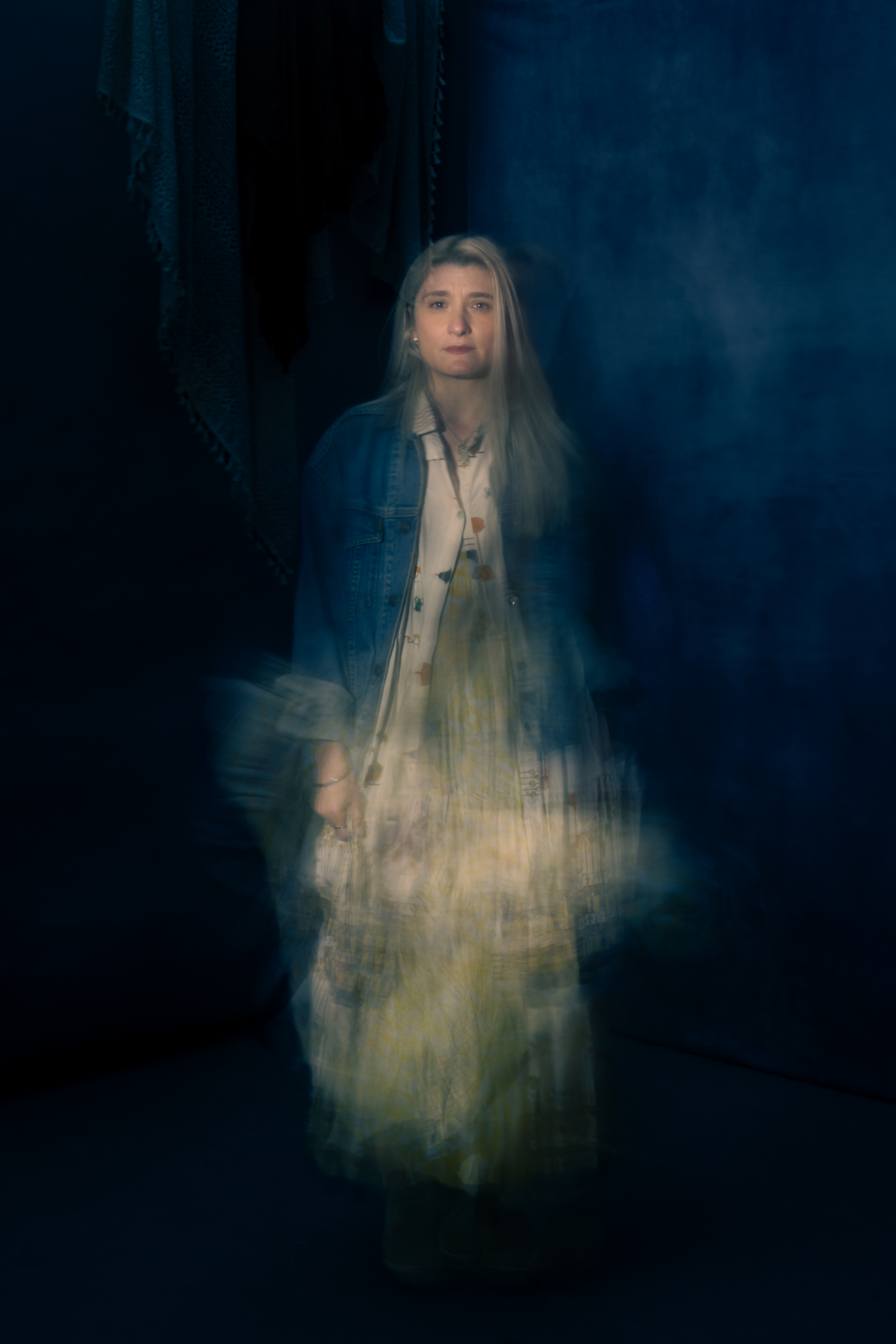
photo credit: portrait of Heather Christian by HanJie Chow, courtesy of the artist