Khaled Sabsabi Begins Again: The Venice Biennale, Tasawwuf, and the Australia Pavilion
At this year’s Venice Biennale, Khaled Sabsabi became one of only a few artists ever to be featured in both the main exhibition and a national pavilion at the same time. But, for a while, it was not certain that he would even make it there at all. Days after he was announced as the artist to represent Australia, his nomination was rescinded following a discriminatory campaign in the Murdoch-owned press that accused him of supporting terrorism. The controversy made it all the way to the Australian Parliament. After months of media coverage, support from the Australian and international art worlds, and an internal review, Sabsabi was reinstated in the pavilion and received an apology. Meanwhile, Koyo Kouoh had invited him to bring his work to In Minor Keys. Making up for lost time, he managed to create new installations for each venue.
Born and raised in Lebanon before the Civil War, Sabsabi and his family fled to Australia as the conflict escalated in the 1970s. He became a leading figure in the emerging Hip Hop scene of Western Sydney, one of Australia’s most diverse areas, before turning to the visual arts. His practice is always informed by these experiences: whether through music, paint, or video, the work is united by themes of migration, displacement, justice, community, and solidarity. Since 2010, his art has increasingly reflected the principles of Tasawwuf, often translated as Sufism, which is the inner, mystical dimension of Islam that focuses on each person’s individual path to purify the heart and experience a direct, intimate connection with God.
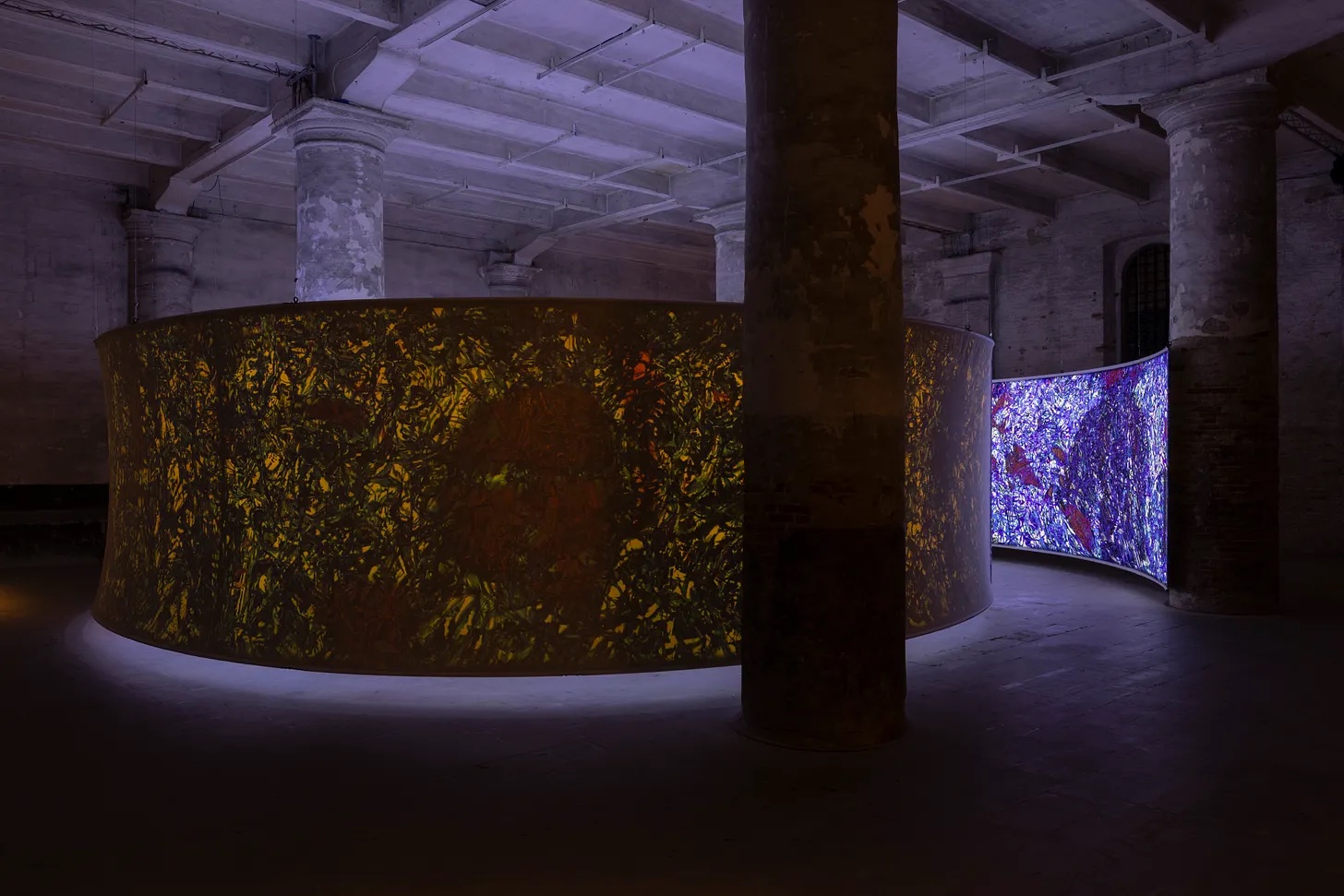
In the Arsenale, Kouoh’s exhibition opens with Sabsabi’s curving, glowing canvas, suspended above the ground in a dark room imbued with perfume. Visitors approach it from the outside, with the inner brushstrokes only faintly visible through the fabric, before entering the perimeter and seeing the painting activated by projected light that is mapped onto its surface. Titled “khalil”, which means “dear friend” in Arabic, the surface shines with ephemeral figures: faces and hands appear and disappear in changing fields of color with the booming murmur of the accompanying sound installation. Some will recognize that the term khalil also refers to the prophet Abraham, one of the religious figures shared by Judaism, Christianity, and Islam, which creates the opportunity to contemplate unity in diversity.
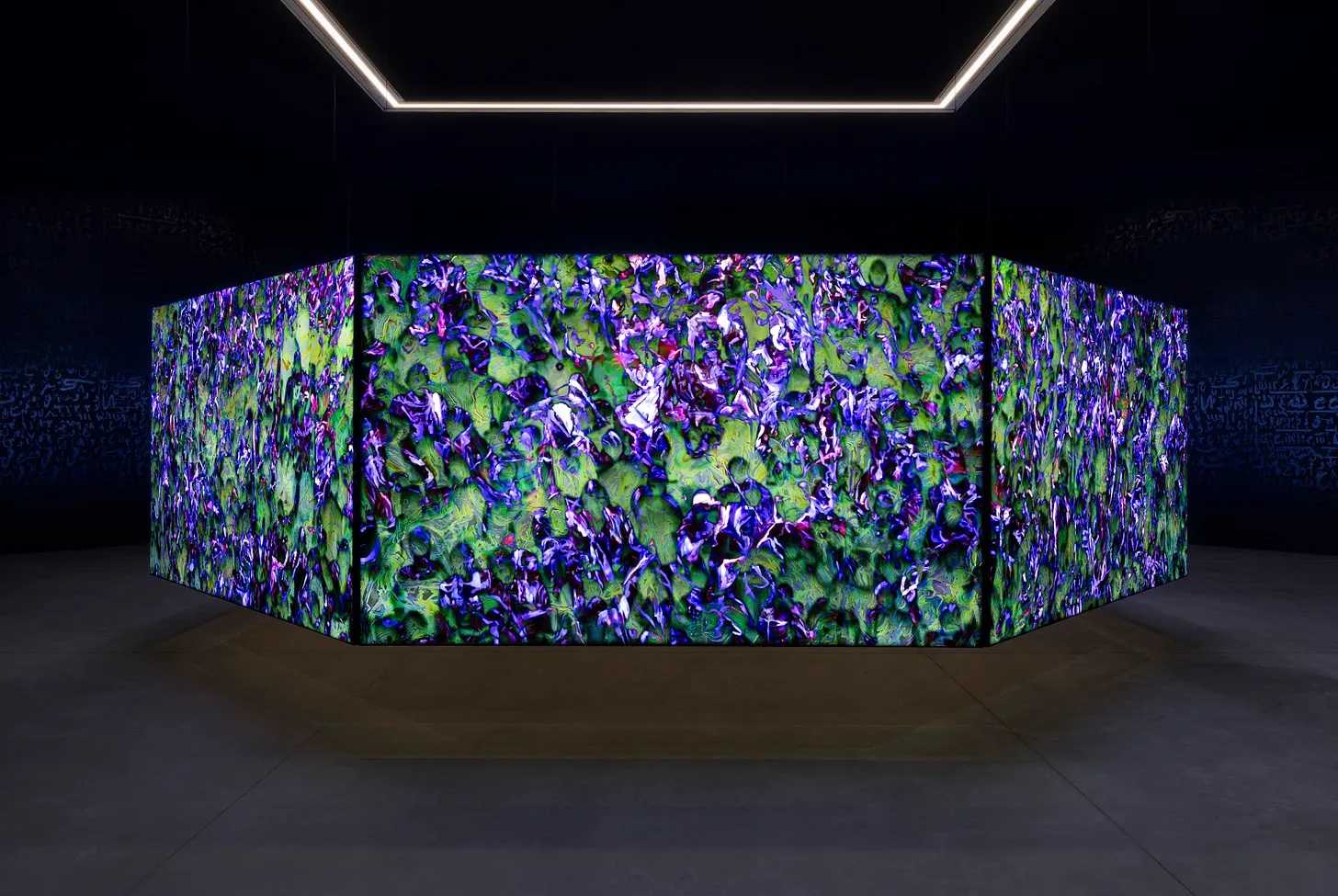
“khalil” was originally envisioned for the pavilion, but as the circumstances changed, a companion piece emerged. Sabsabi’s installation in the Giardini is “conference of one’s self”. While “khalil” is oriented inward, the eight paintings in the pavilion radiate outward, forming a floating octagon in the center of the room that is animated by projected light. An indistinct sound reverberates in a subtle counterclockwise movement as visitors circulate, surrounded by the dark outer walls that are dimly illuminated by the reflections of glossy black paint.
The title references “The Conference of the Birds”, a twelfth-century allegorical poem by Farid al-Din Attar that explores various dimensions of Tasawwuf. The story recounts the journey of diverse bird species in search of a leader, the mythical simurgh. After an arduous journey through seven valleys, thirty birds arrive at their destination and discover that the simurgh does not exist: instead, what they were seeking could be found within themselves all along. This realization turns on a literary pun: in Persian (Farsi), the word simurgh sounds like the phrase “thirty birds”. In this spirit, “conference of one’s self” brings diverse people together and prompts both an inner and outer search. The nature of that search is left open for each visitor.
This September, Sabsabi returns to Venice for the launch of his catalog, published by Creative Australia and Spector Books. Claire Dillon contributed an essay titled “forms of infinity, forms of affinity”. The two met when Sabsabi was finalizing his proposal for Venice while in residence at the American Academy in Rome, where Dillon was a Rome Prize fellow. Dillon’s catalog essay situates Sabsabi’s work within longer histories of Islamic and medieval art, especially through traditions and objects that are found in Venice. While Islam and Christianity are often presented as opposing forces today, they share much in common, and lessons from Mediterranean history testify to this fact. In Dillon’s essay, abstraction is interpreted not only as a response to specific religious context, but also as an open space for beholders of all faiths and backgrounds to engage with the art, no matter what its original intent might have been. In this way, Sabsabi’s work can take on infinite interpretations and foster affinity with infinite audiences.
Approaching Sabsabi’s practice from her particular expertise in Islamic art and its histories, Dillon offers a perspective that moves beyond the familiar narratives and recent controversies surrounding his art. This interview turns to the past, in terms of Sabsabi’s personal history as well as the longer traditions that inform his work, to illuminate dimensions of his practice that have received less attention. The following conversation has been edited for length and clarity.
Khaled Sabsabi as Interviewed by Claire Dillon
The Conference of the Birds and the Australia Pavilion
The title of your work for the Australia Pavilion—”conference of one’s self”—is a nod to the twelfth-century poem “The Conference of the Birds”. Despite this deliberate allusion to the poem, the art remains remarkably open. How do you navigate, and hope that visitors will navigate, the tension between explanation and individual interpretation?
I think there’s a fine line: you don’t want to be over-prescriptive or create a fixed point where a common realization is prepared for every viewer. I want it to remain as open and as vast as possible. It’s about creating places or positions that are open for others, so they can bring in their own experiences with various degrees of interpretation, or possibilities of absorbing that text.
For me, “The Conference of the Birds” is about that possibility. In a way, “conference of one’s self” is me thinking through this poem, and thinking not only about a broader unity, but also about unity within the self.
Is there a particular moment from the poem that felt especially resonant as you prepared these works for Venice?
“The Conference of the Birds” is about the idea of a journey. It’s continuously evolving, continuously changing: it’s funny, it’s sad, it’s profound, and there are so many peaks and dips and ebbs and flows. And those components, or those ideas, are central to what I do.
An important part of the poem is the very outset, the idea of the quest or journey. In the story, all of the world’s birds come together and lament that they are without a leader. The hoopoe comes forward and proposes that they seek out the legendary simurgh, the king of birds. That’s the moment where the idea is seeded: “What we’re looking for is achievable—it really does exist”. From there, each species of bird has to look deep within themselves to decide whether they will take this path. That starting point is where curiosity, faith, ability, intellect . . . it all comes into formation. Some of the species hesitate, representing the side of humanity that might opt for the more comfortable, logical, or easy route. Others, meanwhile, choose to become a part of the quest, even though they might not make it to the end. Symbolically, this moment is a threshold: you can choose to observe from afar, or you can choose to cross over. That’s where it begins.
The journey is also represented in the shape of “conference of one’s self”, because it has eight canvases or eight sides. In the poem, the birds travel through seven valleys, which represent the seven stages of the seeker’s journey. I added an eighth stage, which suggests completion and enlightenment.
Your emphasis on the beginning of the journey offers a new way to understand “conference of one’s self”. The installation is often contextualized through the revelation at the end of the poem, when the birds realize that the leader they sought could be found in their collective being.
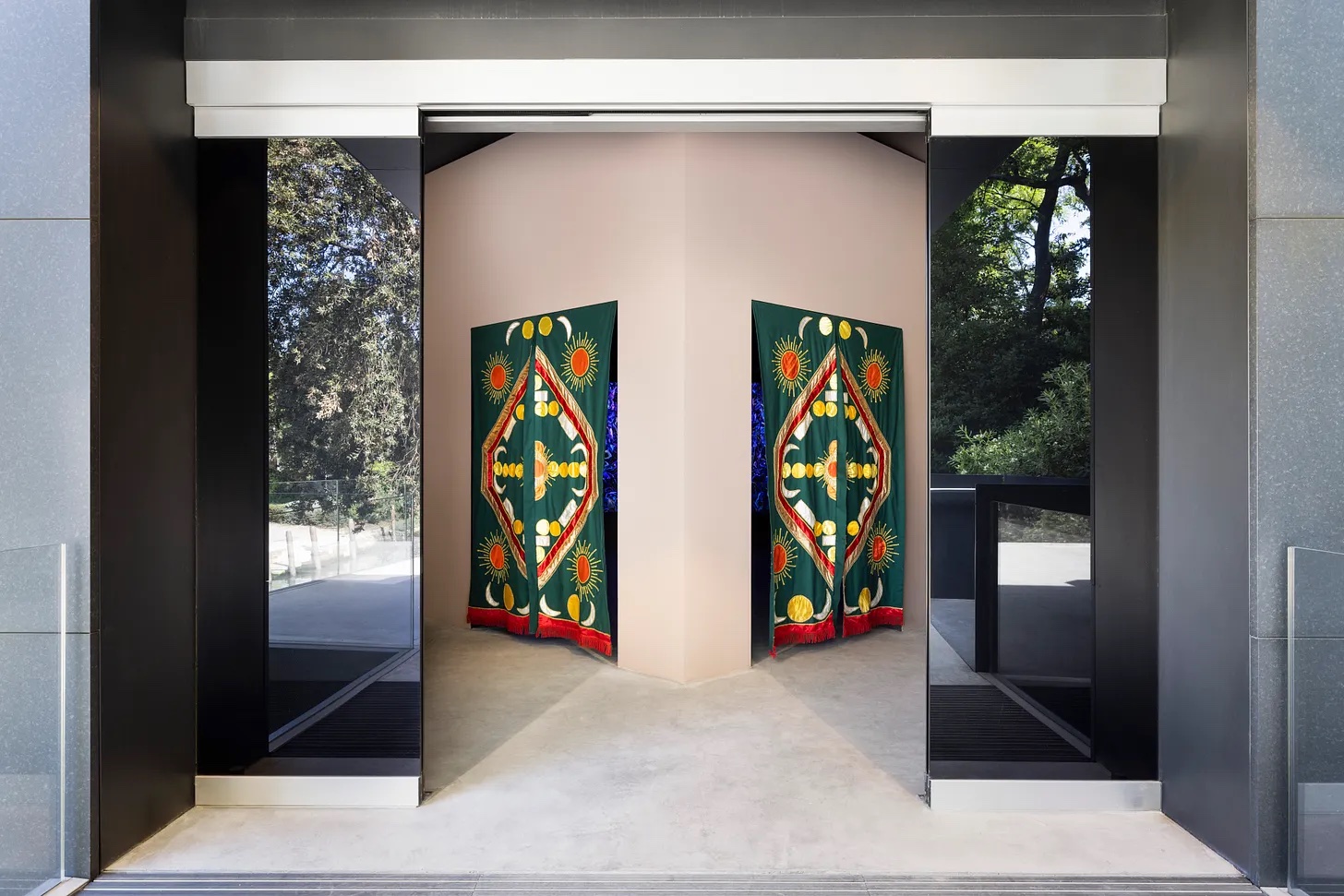
That’s because no one has asked the question before. People tend to focus on the end of “The Conference of the Birds”, and then they try to fit my work to it. But, for me, the story only creates a reference point to anchor the work, which provides the possibility for others to engage with it beyond whatever I have to say and beyond my physical being. The beginning is important. It’s important that each seeker finds their own path, and this is manifested at the entrance of the pavilion, which you encounter as you enter and exit the installation through the same point. What’s important is that you always come back to the beginning, a space for learning and unlearning, a place for remembering.
Artistic Resilience and Acceptance
Given the openness of the installation, visitors to the pavilion are often surprised that it was the subject of so much controversy. I’m less interested in revisiting the headlines than asking what that experience was like, and how it might have shaped the work.
The thing that I keep going back to over and over again is acceptance. As a Muslim, the notion of acceptance is fundamental. There are teachings that God only gives someone the weight that they are able to carry: not an ounce more, not an ounce less. And if a person weren’t able to carry that weight, it wouldn’t have happened. So, it’s this idea of accepting destiny and having faith. But, of course, it was very traumatic and very, very difficult. It was heartbreaking. It impacted me physically, impacted my body, impacted my health, impacted my family, and so on. Having my community, family, and friends around me, and their strength and support, kept me going.
Acceptance also characterized my experience making “khalil” and “conference of one’s self”. They had their own life force and energy, and that can be very hard to accept, you know: you make an artwork, you conceptualize an artwork, and then you want that artwork to be as you envisage it. But to realize that you need to let it go, and let it have its own existence—this notion can also be liberating. It’s a moment of mutual respect, and it’s required for this entity to happen.
For example, when “khalil” was first proposed, it involved the same media—video mapping, painting, et cetera—but it was supposed to be mounted on the walls of the Australia Pavilion in a fixed position. Once the commission was cancelled, I still made the work even though it didn’t have a home. At that point, “khalil” separated itself from the walls and became a standalone, lantern-like object, which creates the experience of outer and inner form. It took a while to accept that that’s what it wanted to be, but it was a moment of trust between the maker and the object. Out of that, obviously, “conference of one’s self” was later born.
Materials, Video Mapping, and Engineering
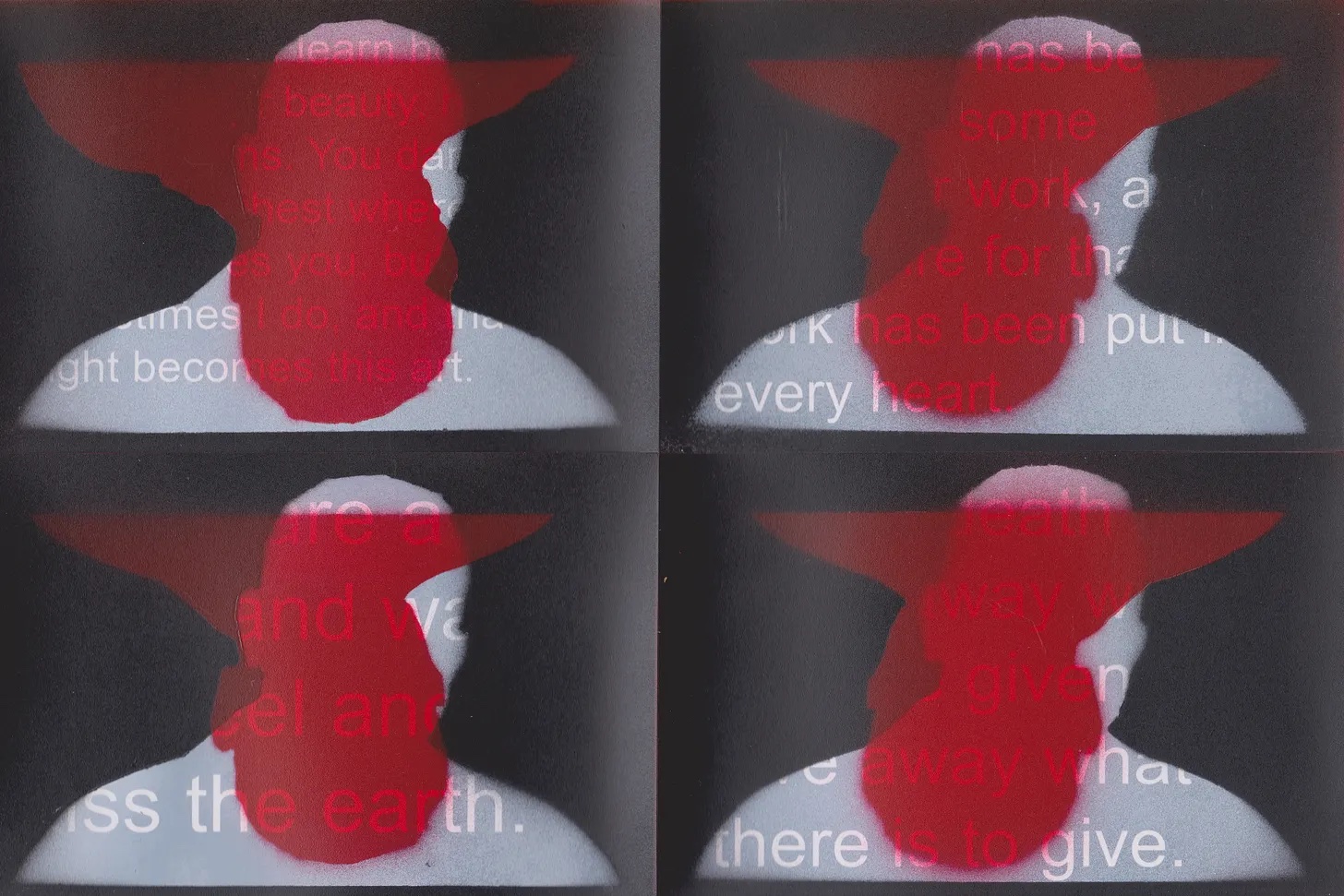
From your beginnings in Hip Hop until now, there are many visible continuities between your larger artistic practice and these installations in Venice. You shared an earlier work with us, “Alif Meem”, which offers a glimpse into your longstanding investigations of layering and inversion, the use of materials like stencils and spray paint, all juxtaposed with references to Tasawwuf. What feels new about the two projects in Venice, and what about them explores the same themes as your past work?
One recurring concept is the idea of the visible and the invisible. In the pavilion, I stenciled script on the walls, using a subtle gloss black spray paint on the matte black ground, which symbolically, or perhaps literally, makes distinctions between the visible and invisible. Using aerosol and stencils is a recurring theme throughout my practice.
Fusing video and painting together is something new. Before these works, I only made one work where I painted on a TV monitor. It’s never been shown—it’s called “Not Our Teachers” (2014–2020). There is, however, some continuity in process through another link: my public outdoor projects over the past two decades have included video mapping for festivals or exhibitions and other programs. These were typically one-off events where you’re projecting images onto objects, buildings, and architectural forms. Both of the works in Venice are video-mapped onto the paintings.
I’m sort of a purist when it comes to being able to make the work myself, and I’m really interested in understanding the science of things. This idea of engineering—which I studied in school—and reverse engineering have always been at play with me, even as a child. I feel that it’s critical to understand the medium you’re working with so that you can interrogate and challenge what the materials can manifest and be. I shoot all my video and make all my sound. I’ve transitioned from an analog world to a digital world, and really try to stretch and test the technologies. Even now, I still have desktops and computers that are running older platforms, which I pull out and use—they’re tools, essentially. It’s just like using a different gauge of brush.
In “conference of one’s self” and “khalil”, the paintings use five different colors, which I vectorized and separated, and then I inserted video content into those segments. But, as the colors blend, they don’t adhere to the vector sections. It creates an illusion: this is the moment of magic in the work, where people think that they’re looking at a static painting, but it begins to move and change. Since the paintings are suspended in air, they move slightly and the image will shift even further. It represents the idea of continuously questioning reality, and also having the realization that there is so much that we don’t know about what is within and around us. That comes directly from Islam, and also mysticism and spirituality in general.
Scent, Analog Sound, and Sacred Spaces
I want to turn to the sensory dimensions of the installations, like the scent and sound, which are difficult to convey in text and image. What is the relationship between looking, listening, and sensing in these works, and how do they shape our experience?
The idea of the experience has always been central in my work. And I should start by acknowledging that this experience is different for everyone—we all have different ways or abilities of connecting with different senses, whether sight or sound or otherwise. Regardless, all of these senses are interconnected to your being.
It is said that, if you go to sacred shrines of holy people or of prophets, certain visitors will receive a sweet scent from the shrine that pulls them in, like an invitation. On the scientific side of things, scent interacts with people differently, so it’s personal and individual. Scent also registers the possibility of the unseen. You can’t physically see it, but you know that it’s there.
Both of the works incorporate the fragrance of black oud. In “conference of one’s self”, it’s placed at the threshold, while in “khalil” it’s diffused throughout the space. Scent is one of the elements that connects the two works, which I haven’t spoken about before. In the Arsenale, you can smell the scent before you step into the first room, so you’re already interacting with the art before it comes into view.
In both installations, there’s also sound, which you can hear before you can see. You enter, the experience heightens, the senses awaken, and different parts of your being are engaged. As you move, you absorb, analyze, and reflect upon these emotions and these observations, and then the work is formed. You complete the work—the work is not formed until you engage with it.
The sound is from my archive. For “khalil”, it’s the opening of a nubah, which is a ceremony held on different holidays; it’s done outside, in public, in community, and it involves chanting, drums, and banners. It opens with an invitation, with the cymbal, and then the drum slowly builds up, the tempo and pace increase, and then it stops. I was interested not in the hit of the initial cymbal or the drum, but rather the reverberation of that hit.
I went back to analog technologies in order to slow down the sound eight times while avoiding digital distortion. I would record the sound on tape, then slow it down and rerecord it, over and over, bouncing between tape to tape to tape to tape to tape, and then finally to digital. The sound becomes something that you can’t associate with its original form anymore.
The treatment is similar for “conference of one’s self”, but the difference is that the sound has nothing to do with the self—it’s actually people chanting in a sporting match. It’s the idea of the everyday, ritualization, and all that sort of thing. Though we consider it mundane today, in one thousand years we may consider it—who knows?—something sacred.
During the vernissage, we also had multiple anasheed performances by members of the Al Rahma Islamic Association from Western Sydney. The anasheed tradition probably predates the time of the Prophet, peace be upon him. They’re songs of devotion, and stories can be told as well. For me, I feel that it offers a moment of cleansing. It’s also about possibilities of openings and offerings, and sharing blessings. It’s open to all people. My intention was always to have the group perform outside the pavilion, because it becomes a beacon, a call for inclusivity and openness, where everyone can decide whether or not they want to be drawn to it.
The anasheed and the accompanying blessings soften the heart; they give you a sense of calmness, a moment of reprieve. It’s an offering in response to all the uncertainties, and all the challenges—not just of the Biennale, but of the world—including Islamophobia, and how Muslims have been demonized, dehumanized, and generalized. Ultimately, what we all want is coexistence. Does the world have to be this way? We need to reconcile in order for change to occur.
Claire Dillon is an art historian of the medieval Mediterranean and its afterlives in the past, present, and future. Writing about textiles, design, monuments, and more. @clairepdillon