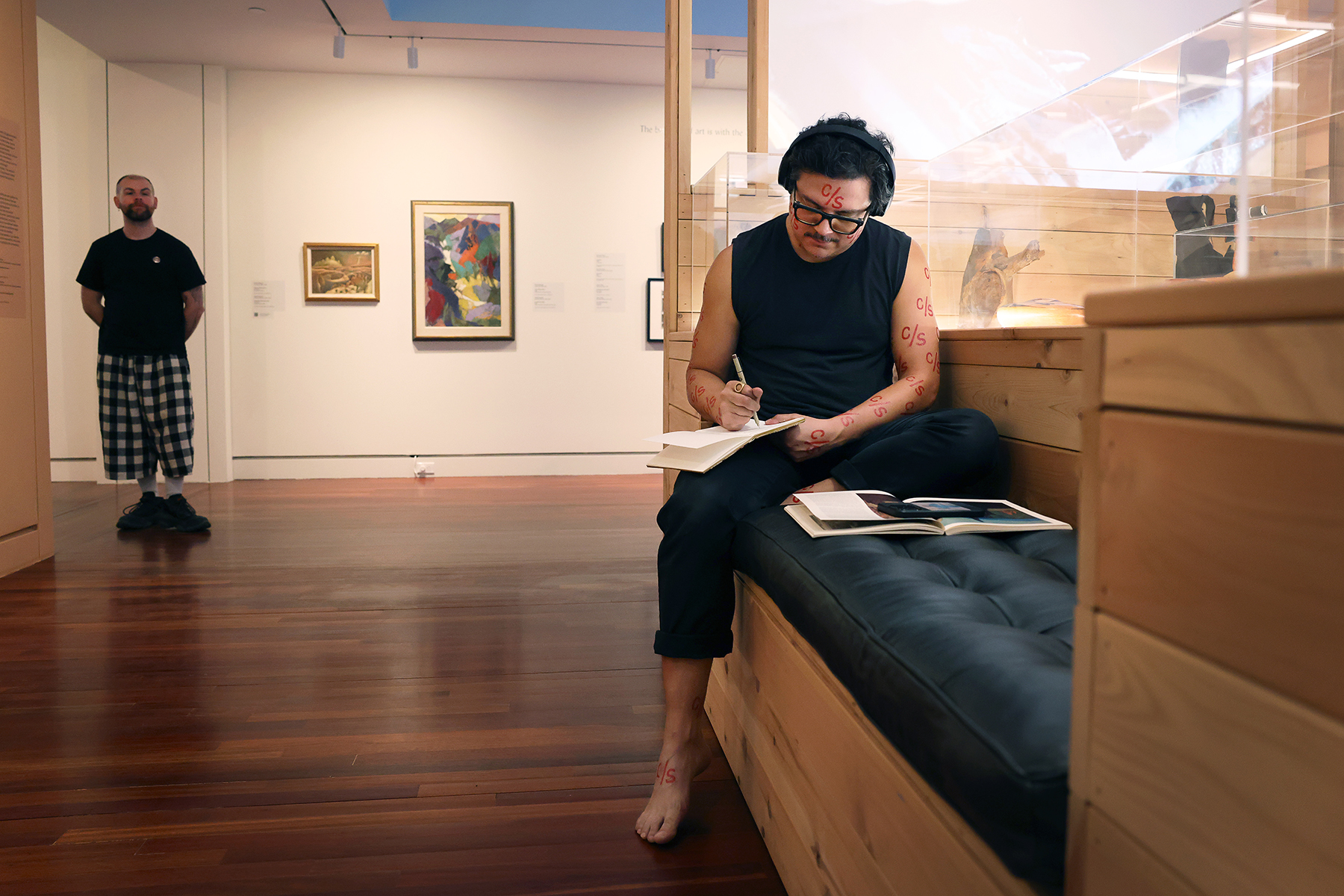
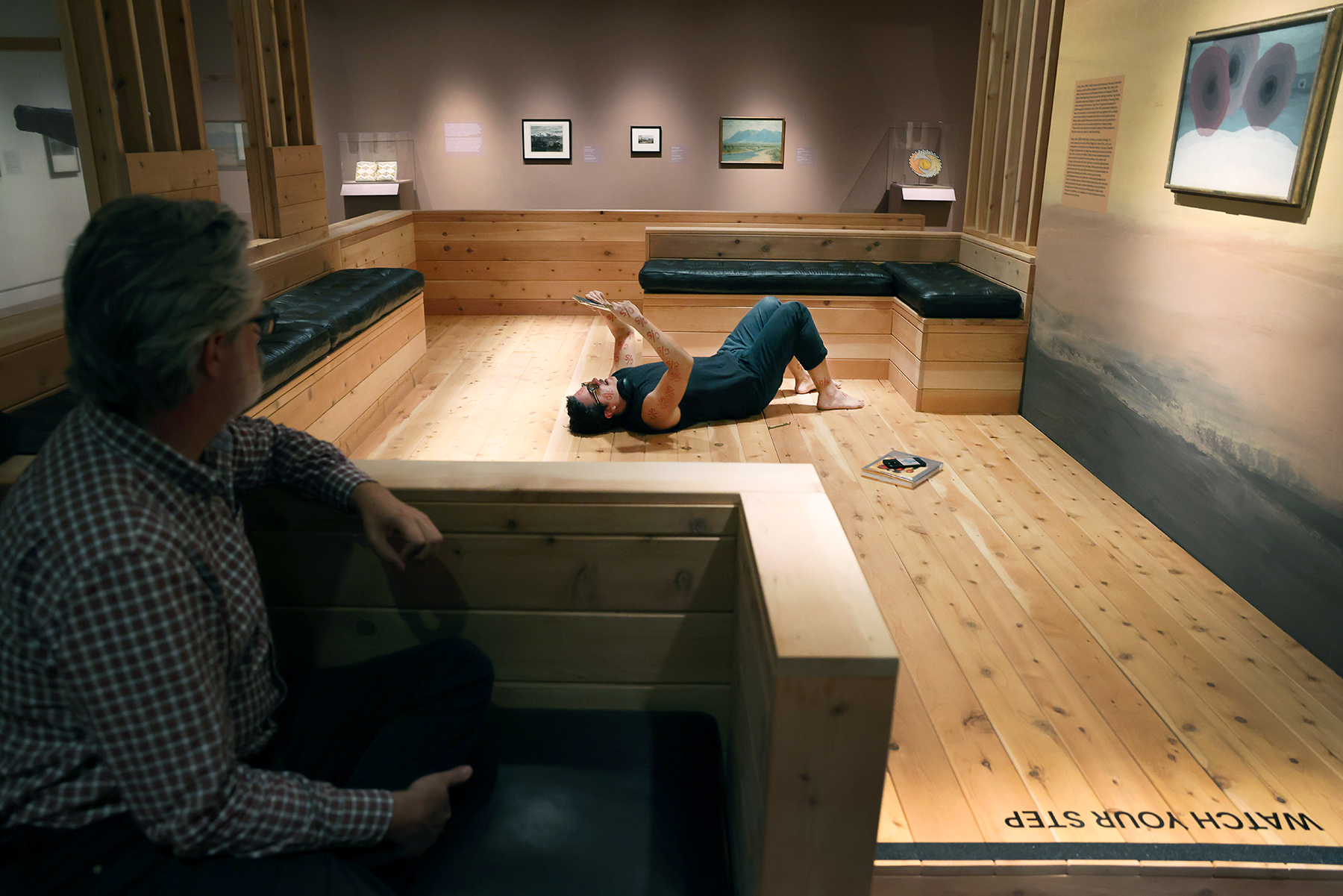
Josh T. Franco, Scriptorium con safos: Gathering Place, 2025, performance at Colorado Springs Fine Arts Center. Photo by Jamie Cotten / Colorado College
Josh T. Franco is an artist and art historian currently based in Hyattsville, Maryland. His dualistic practice, studio and scholarly, originates from his creative roots in West Texas, where he grew up surrounded by the intuitive and ever-evolving art environments constructed in his grandfather’s yard. For Josh, his lifelong immersion within the culture, history, objects, materials, sound, movement, space, and audience of the creative world coalesce into his ongoing “Scriptorium con safos” project, which he most recently performed at Colorado Springs Fine Arts Center at Colorado College. Witnessing the performance myself and chatting with Josh reminded me that immersion in this world is a choreographed balance of solitude and community . . . sometimes formidable but oh so blissful.
Josh T. Franco as Interviewed by Hayley Richardson
You are an artist whose “primary medium is the discipline of art history itself,” and a working art historian. I have to ask the “chicken or the egg” question . . . did your art practice grow from your scholarly pursuits or vice versa, or did they develop in tandem?
For many years, the narrative I held was that my AP art history course in high school was my awakening to the field. That is still in many ways true in terms of disciplinary training. However, after my grandfather passed away in 2015, there was a shift. He was a prolific yard artist, and I grew up among his creations in this constantly evolving hand-built environment. My brothers, cousins and I grew up watching and emulating him. This involved a lot of imagination and working with found objects and devised tools. I have been a maker of imagery, sculptural objects, spatial interventions, etc. since childhood. I was also a big reader from a young age. So now I say the art and scholarly pursuits really were always happening in tandem. It’s also important to note that my dissertation was a 2-year studio-based project involving a lot of collaborative research with fellow artists Joshua Saunders and Alison Kuo culminating in a large-scale installation and performance work in 2011. It was only after the show that I realized the subject of that work–the town of Marfa, Texas–would also be my dissertation subject. So the studio and the scholarly are inseparable for me. The book from the dissertation includes the related artworks and will be out in Fall 2026 from Duke University Press.
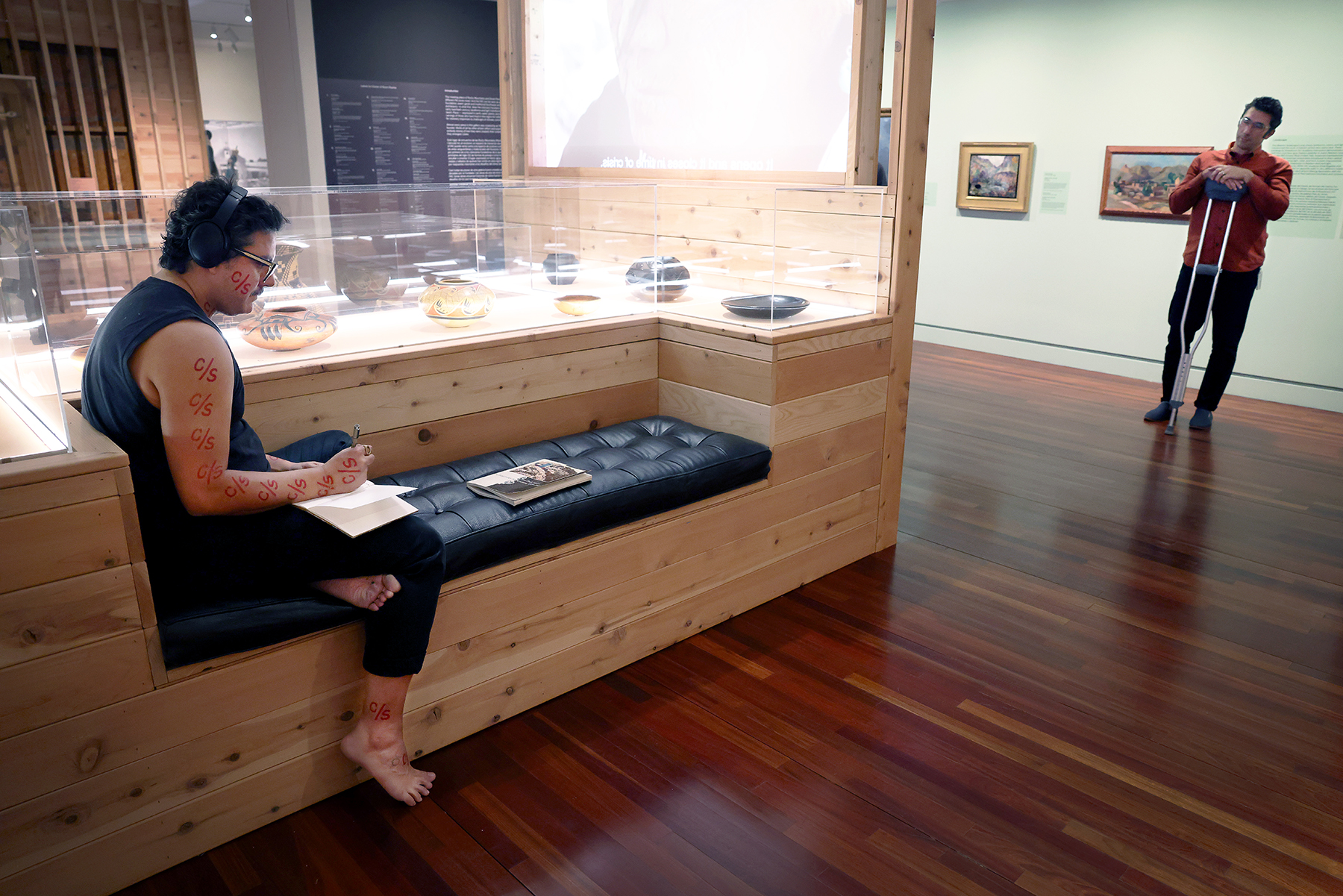
Your work “Scriptorium con safos,” which is a sculptural installation which can be activated as a performance, is the perfect embodiment of utilizing art history as medium. It has numerous elements at play with exhibitions and research at its core, as well as expressions of joy and enlightenment. Can you tell me about how you originally conceptualized this ongoing project?
The first Scriptorium came out of a very specific experience. As an art history PhD student, I proposed to teach a class on Chicano art in the department. The department–really just one faculty member among an otherwise wonderful supportive group–refused to cross-list it. I ended up teaching the class, but as a Latino studies course. No student received art history credit for it. I knew of the many historical instances of the discipline and museums rejecting Chicano art as unworthy of study, but it was wild to experience it directly in the 2010’s. I never forgot. In 2017, shortly after completing the doctorate, I received an invitation to be a visiting artist in the art and art history department at DePauw University. I am grateful for the opportunity and the timing; the invitation came when I was clearly ready to digest that experience, which meant making art from it.
My dissertation topic was directly tied to the Chicano art course I had proposed, as it works to understand the relationships between art by Mexican and Mexican-American Marfans with deep historical roots in West Texas, and the steady influx of people interested in so-called contemporary and Minimalist art that has occurred in the past 50-ish years. That first Scriptorium responded to a need for space in which I am not subject to disciplinary (or departmental) conventions or judgments. Thus the books on the ground mark out a spatial territory. The crystals emphasize groundedness, while also serving a practical purpose as bookweights. The “C/S” mark on my body and elsewhere in the work acts as a symbolic boundary. It stands for the phrase “con safos,” a Chicano term that signals solidarity, protection, and completion of a work of art. It typically appears abbreviated as “C/S” in paintings, murals, personal correspondence and a broad range of Chicano visual culture.
Books in the first scriptorium were arranged in a double arc; the inner row comprised books on Chicano art, while the outer ring included books on Minimalism. However, throughout the performance, they get mixed up. My promiscuity is the antidote to the rigid, possibly bigoted attitude that kept my Chicano art class from being listed in the art history department’s offerings.
I called the work Scriptorium con safos: Prologue, because I realized while making it that it could be useful for other topics, which it has been. Also, it’s an addictive work, at least for me. I think about it as being alone in my room, headphones on, doing what I do often in solitude, but as a performance in public. I crave opportunities to do it over and over.
I had the pleasure to witness this performance in action at Colorado Springs Fine Arts Center, predominantly within the exhibition “Gathering Place: Permanent Collection Reinstallation” which you had a hand in co-curating. How does the act of curating an exhibition compare & contrast with developing your own artistic response within it?
Gathering Place was such a dream experience. I do not consider myself a curator, but since 2020 I have been fortunate to receive a handful of invitations to guest curate in some amazing projects and institutions, the FAC among them. As an artist, I’ve taken these as opportunities to make new work that couldn’t happen without the collaboration of great institutions and teams.
In Colorado Springs, a new Scriptorium made sense. The project there is a fundamental re-imagining of the permanent collection installation following years of thinking with a 7-member curatorial team and FAC staff. It’s the result of a lot of deep study, which is what Scriptorium enables. Books were placed across the three wide thresholds of the galleries we had collectively curated. While the bibliography for each performance is planned, I never plan ahead which passages I am going to study and transcribe. In the moment, I realized I could also treat the wall text as another source, so that’s where I started. As I read my transcription of our exhibition statement, I unexpectedly choked up. It was the culmination of a really special collaboration that we were now offering to the world. I stopped myself crying that time, but I think in the future I’ll just let it happen.
These recent curatorial experiences have shown me that curating is a kind of making too. The difference between it and how I work in my studio is that there are a lot of people involved at every step. And now I have a whole body of work that is inseparable from institutions which is so interesting. For instance, Syracuse University Art Museum acquired Scriptorium con safos: Syracuse following a year-long installation. Writing out the paperwork for that pushed me to realize, in practical terms, how a work can exist within an institution as both a collection and a collaborator without my direct involvement.
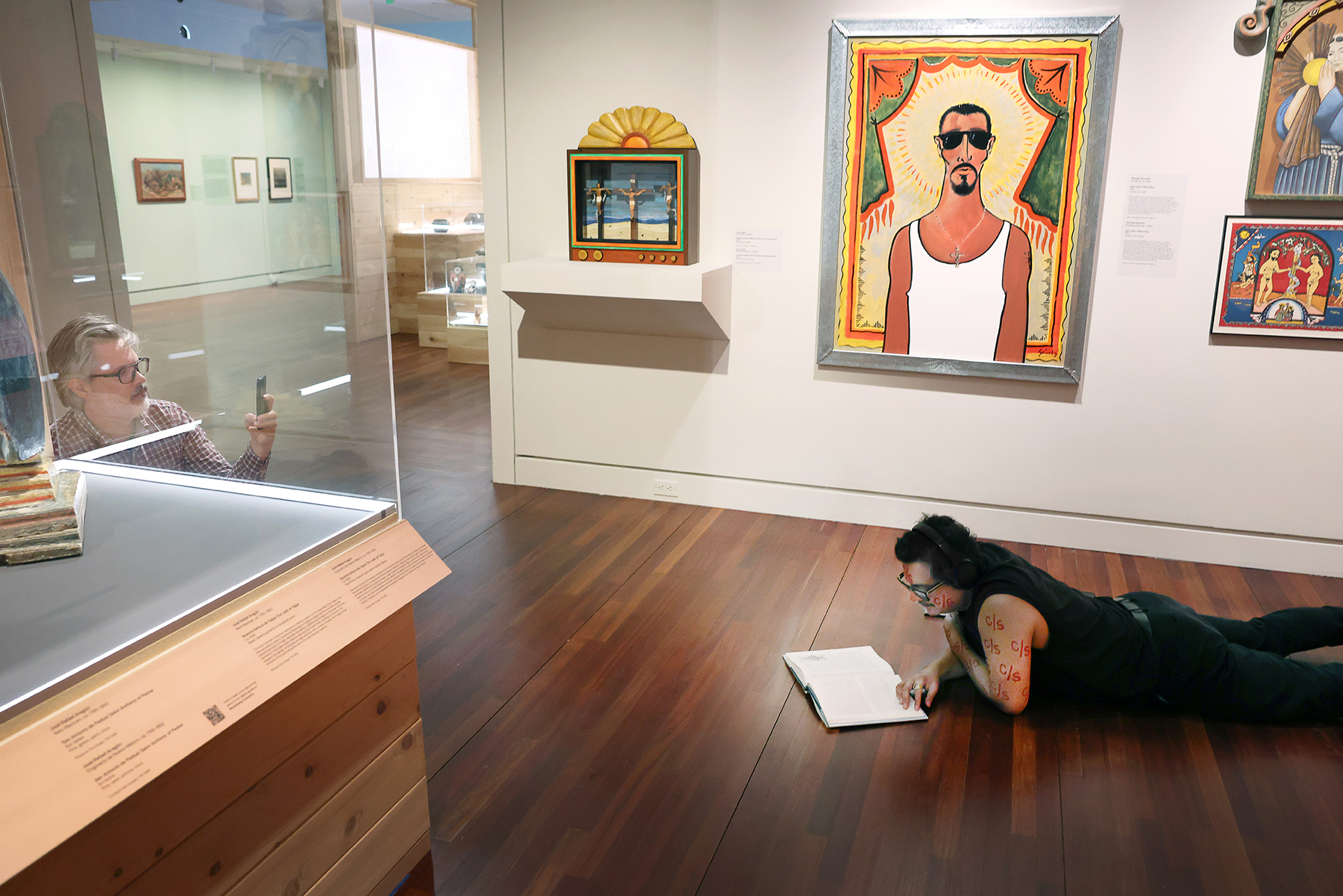
Josh T. Franco, Scriptorium con safos: Gathering Place, 2025, performance at Colorado Springs Fine Arts Center. Photo by Jamie Cotten / Colorado College
You’ve performed “Scriptorium con safos” five times. Each iteration employs components like movement (and rest), art historical texts, earth minerals, music, writing, and recitation that change with each exhibition and performance activation. What were some of the featured texts for the Colorado Springs performance? Playlist and mineral selections? How are these decisions made?
Some tracks from the playlist (again, what I might be listening to just hanging out alone in my room studying art through books):
Fog – The Ophelias
These Days – Foo Fighters
Standard Lines – Dashboard Confessional
Sympathy is a Knife – Charli xcx
Waiting – Alice Boman
Treehouse – kelseydog
Deceptacon – Le Tigre
Meet Me At Our Spot – The Anxiety, Willow & Tyler Cole
Man of the Year – Lorde
What Was That – Lorde
Drain You – Nirvana
Flash in the Pan – Jane Remover
Straight, No Chaser – Bush
Pinch and Roll – Hum
Age of Consent – New Order
I Fall Apart – Post Malone
Binz – Solange
Casual – Chappell Roan
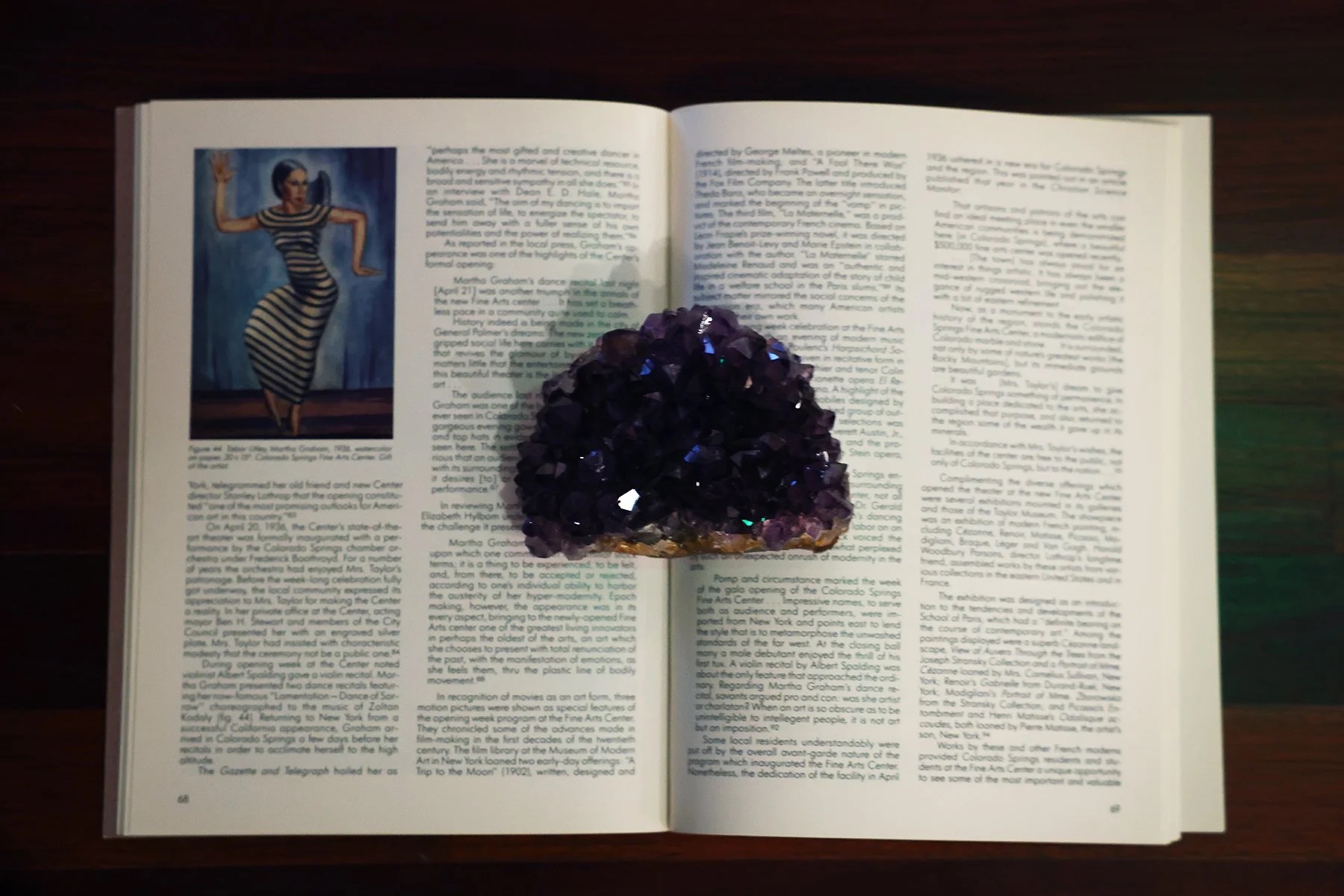
The books are chosen with much more intention than the music. FAC already includes books related to the exhibition in the entry hallway. We, the co-curators, had contributed to the list months prior, suggesting books related to the works and frameworks of our respective galleries. So for this Scriptorium, the books were already present. It was fun to perform selecting and removing them from the shelves to the floor as audience members looked on. Some of the bibliography for Gathering Place, which anyone who visits the show can peruse, can be reviewed here
I’m so glad you asked about the crystals, because Colorado opened the work up to colors in a new way. In the past, I’ve used a mix of palm-sized clear quartz chunks and selenite bars because they are readily available, relatively low-cost and, primarily, don’t command much visual attention as they are white and clear. ForGathering Place however, we had the budget and interest to elevate these choices a bit. It was also a fun outing for myself and FAC curator Katja Rivera who researched shops in the Colorado Springs area ahead of my trip for the performance. We drove around town and I think it was the third shop where we encountered the celestite and amethyst I ended up using. That pale translucent blue and the deep purple, respectively, are so seductive and play well with the dark wood floor and low lighting in those galleries. Shifting to these strong colors was significant for me as the artist and Katja as the curator, though the audience may not be aware how so.
What role does the audience play in your performance?
The audience has choices; they can be witnesses, fellow activators, or something else they imagine. Scriptorium is a non-narrative ambient performance. Like the weather, it’s there regardless. How you respond to it is up to you.
When I work with institutions, I ask that there be no announcements or signage. Nor is there a timed score or pre-planned sequence. If you catch me reading a transcription aloud; if you catch me dancing; if you catch me laying on the ground reading; this is all up to chance and the length of time you’re willing to stick around. Additionally, nothing is stopping someone from also picking up the books, annotating, and reading aloud themselves, or from dancing for that matter. I am making these tools that enable the study of art available, and it’s great if others find them useful as well.
People enter museums with very specific preconceptions of how to behave. Scriptorium questions this default, and audiences have to actively ask themselves what they are willing to do differently in light of what I am doing. Who says going to museums only means standing still in front of each artwork for a few moments? All I, my hosts, and audiences ever know ahead of time is when a performance is scheduled to begin and end. What happens in between depends on our collective decision-making in real time.
What projects do you have coming up in the new year?
Another project in Colorado Springs, happily for me. On March 6, an exhibition I curated opens there: “Where I Learned to Look: Art From the Yard.” This show was originally made at ICA Philadelphia, and I hadn’t planned for it to travel until the FAC asked. With the team there, we’ve organized some really special new additions that speak to the Southern Colorado context. I will also be a visiting artist at Missouri State University in March. There are a couple of other things in the works. I’m looking forward to 2026.
Hayley Richardson
Denver, Colorado
2025