Khaled Sabsabi Begins Again: The Venice Biennale, Tasawwuf, and the Australia Pavilion
At this year’s Venice Biennale, Khaled Sabsabi became one of only a few artists ever to be featured in both the main exhibition and a national pavilion at the same time. But, for a while, it was not certain that he would even make it there at all. Days after he was announced as the artist to represent Australia, his nomination was rescinded following a discriminatory campaign in the Murdoch-owned press that accused him of supporting terrorism. The controversy made it all the way to the Australian Parliament. After months of media coverage, support from the Australian and international art worlds, and an internal review, Sabsabi was reinstated in the pavilion and received an apology. Meanwhile, Koyo Kouoh had invited him to bring his work to In Minor Keys. Making up for lost time, he managed to create new installations for each venue.
Born and raised in Lebanon before the Civil War, Sabsabi and his family fled to Australia as the conflict escalated in the 1970s. He became a leading figure in the emerging Hip Hop scene of Western Sydney, one of Australia’s most diverse areas, before turning to the visual arts. His practice is always informed by these experiences: whether through music, paint, or video, the work is united by themes of migration, displacement, justice, community, and solidarity. Since 2010, his art has increasingly reflected the principles of Tasawwuf, often translated as Sufism, which is the inner, mystical dimension of Islam that focuses on each person’s individual path to purify the heart and experience a direct, intimate connection with God.
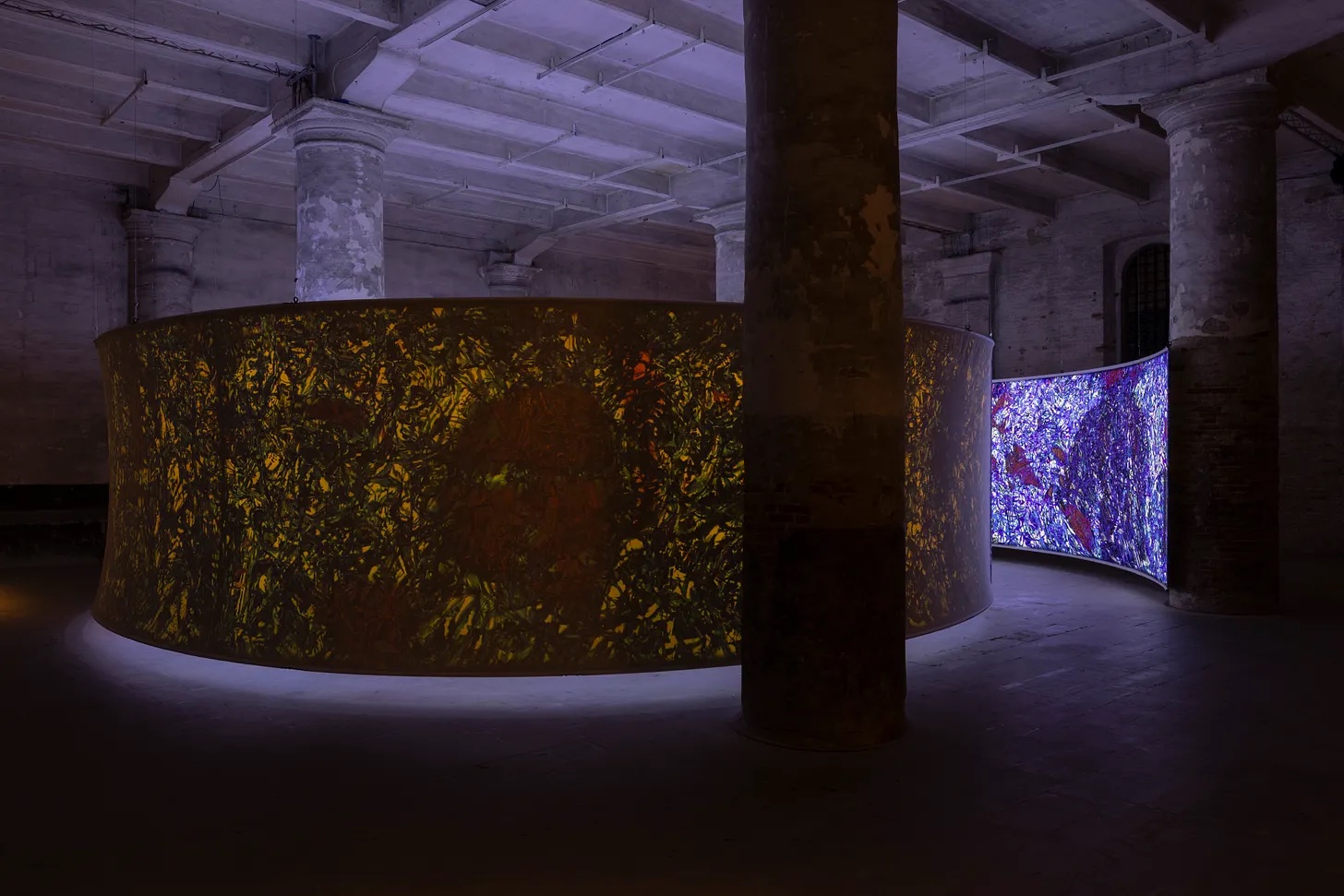
In the Arsenale, Kouoh’s exhibition opens with Sabsabi’s curving, glowing canvas, suspended above the ground in a dark room imbued with perfume. Visitors approach it from the outside, with the inner brushstrokes only faintly visible through the fabric, before entering the perimeter and seeing the painting activated by projected light that is mapped onto its surface. Titled “khalil”, which means “dear friend” in Arabic, the surface shines with ephemeral figures: faces and hands appear and disappear in changing fields of color with the booming murmur of the accompanying sound installation. Some will recognize that the term khalil also refers to the prophet Abraham, one of the religious figures shared by Judaism, Christianity, and Islam, which creates the opportunity to contemplate unity in diversity.
“khalil” was originally envisioned for the pavilion, but as the circumstances changed, a companion piece emerged. Sabsabi’s installation in the Giardini is “conference of one’s self”. While “khalil” is oriented inward, the eight paintings in the pavilion radiate outward, forming a floating octagon in the center of the room that is animated by projected light. An indistinct sound reverberates in a subtle counterclockwise movement as visitors circulate, surrounded by the dark outer walls that are dimly illuminated by the reflections of glossy black paint.
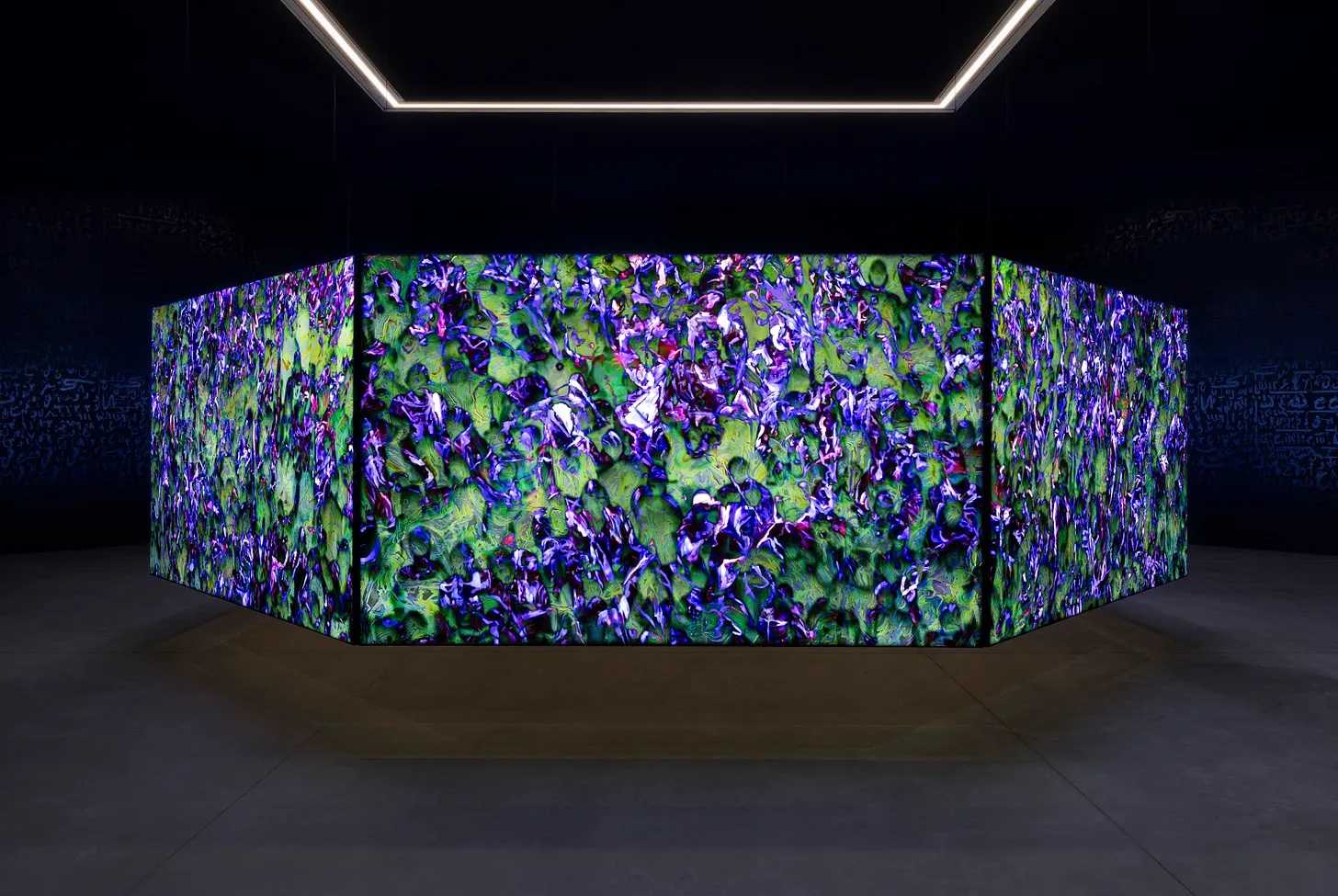
The title references “The Conference of the Birds”, a twelfth-century allegorical poem by Farid al-Din Attar that explores various dimensions of Tasawwuf. The story recounts the journey of diverse bird species in search of a leader, the mythical simurgh. After an arduous journey through seven valleys, thirty birds arrive at their destination and discover that the simurgh does not exist: instead, what they were seeking could be found within themselves all along. This realization turns on a literary pun: in Persian (Farsi), the word simurgh sounds like the phrase “thirty birds”. In this spirit, “conference of one’s self” brings diverse people together and prompts both an inner and outer search. The nature of that search is left open for each visitor.
This September, Sabsabi returns to Venice for the launch of his catalog, published by Creative Australia and Spector Books. Claire Dillon contributed an essay titled “forms of infinity, forms of affinity”. The two met when Sabsabi was finalizing his proposal for Venice while in residence at the American Academy in Rome, where Dillon was a Rome Prize fellow. Dillon’s catalog essay situates Sabsabi’s work within longer histories of Islamic and medieval art, especially through traditions and objects that are found in Venice. While Islam and Christianity are often presented as opposing forces today, they share much in common, and lessons from Mediterranean history testify to this fact. In Dillon’s essay, abstraction is interpreted not only as a response to specific religious context, but also as an open space for beholders of all faiths and backgrounds to engage with the art, no matter what its original intent might have been. In this way, Sabsabi’s work can take on infinite interpretations and foster affinity with infinite audiences.
Approaching Sabsabi’s practice from her particular expertise in Islamic art and its histories, Dillon offers a perspective that moves beyond the familiar narratives and recent controversies surrounding his art. This interview turns to the past, in terms of Sabsabi’s personal history as well as the longer traditions that inform his work, to illuminate dimensions of his practice that have received less attention. The following conversation has been edited for length and clarity.
Khaled Sabsabi as Interviewed by Claire Dillon
The Conference of the Birds and the Australia Pavilion
The title of your work for the Australia Pavilion—”conference of one’s self”—is a nod to the twelfth-century poem “The Conference of the Birds”. Despite this deliberate allusion to the poem, the art remains remarkably open. How do you navigate, and hope that visitors will navigate, the tension between explanation and individual interpretation?
I think there’s a fine line: you don’t want to be over-prescriptive or create a fixed point where a common realization is prepared for every viewer. I want it to remain as open and as vast as possible. It’s about creating places or positions that are open for others, so they can bring in their own experiences with various degrees of interpretation, or possibilities of absorbing that text.
For me, “The Conference of the Birds” is about that possibility. In a way, “conference of one’s self” is me thinking through this poem, and thinking not only about a broader unity, but also about unity within the self.
Is there a particular moment from the poem that felt especially resonant as you prepared these works for Venice?
“The Conference of the Birds” is about the idea of a journey. It’s continuously evolving, continuously changing: it’s funny, it’s sad, it’s profound, and there are so many peaks and dips and ebbs and flows. And those components, or those ideas, are central to what I do.
An important part of the poem is the very outset, the idea of the quest or journey. In the story, all of the world’s birds come together and lament that they are without a leader. The hoopoe comes forward and proposes that they seek out the legendary simurgh, the king of birds. That’s the moment where the idea is seeded: “What we’re looking for is achievable—it really does exist”. From there, each species of bird has to look deep within themselves to decide whether they will take this path. That starting point is where curiosity, faith, ability, intellect . . . it all comes into formation. Some of the species hesitate, representing the side of humanity that might opt for the more comfortable, logical, or easy route. Others, meanwhile, choose to become a part of the quest, even though they might not make it to the end. Symbolically, this moment is a threshold: you can choose to observe from afar, or you can choose to cross over. That’s where it begins.
The journey is also represented in the shape of “conference of one’s self”, because it has eight canvases or eight sides. In the poem, the birds travel through seven valleys, which represent the seven stages of the seeker’s journey. I added an eighth stage, which suggests completion and enlightenment.
Your emphasis on the beginning of the journey offers a new way to understand “conference of one’s self”. The installation is often contextualized through the revelation at the end of the poem, when the birds realize that the leader they sought could be found in their collective being.
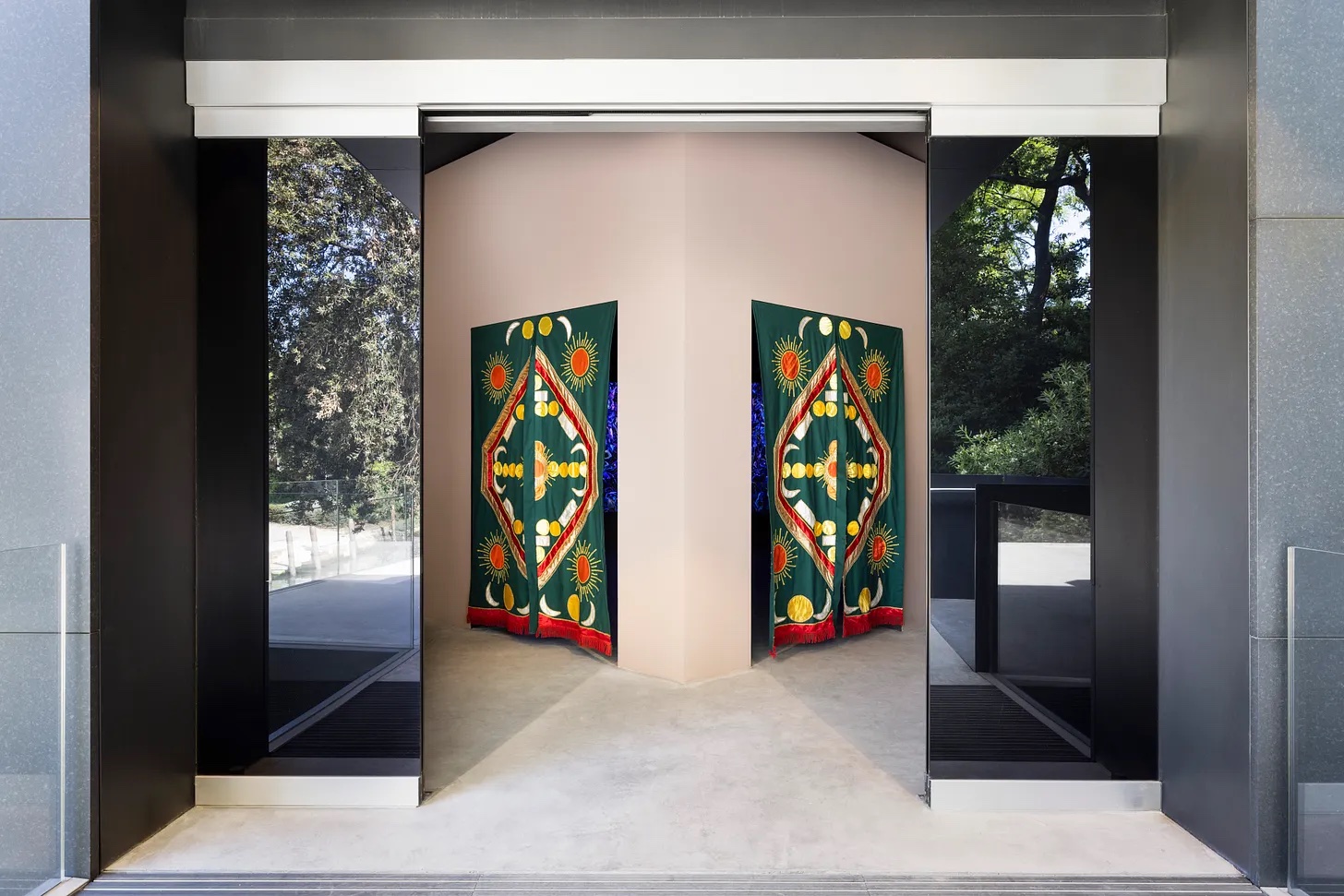
That’s because no one has asked the question before. People tend to focus on the end of “The Conference of the Birds”, and then they try to fit my work to it. But, for me, the story only creates a reference point to anchor the work, which provides the possibility for others to engage with it beyond whatever I have to say and beyond my physical being. The beginning is important. It’s important that each seeker finds their own path, and this is manifested at the entrance of the pavilion, which you encounter as you enter and exit the installation through the same point. What’s important is that you always come back to the beginning, a space for learning and unlearning, a place for remembering.
Artistic Resilience and Acceptance
Given the openness of the installation, visitors to the pavilion are often surprised that it was the subject of so much controversy. I’m less interested in revisiting the headlines than asking what that experience was like, and how it might have shaped the work.
The thing that I keep going back to over and over again is acceptance. As a Muslim, the notion of acceptance is fundamental. There are teachings that God only gives someone the weight that they are able to carry: not an ounce more, not an ounce less. And if a person weren’t able to carry that weight, it wouldn’t have happened. So, it’s this idea of accepting destiny and having faith. But, of course, it was very traumatic and very, very difficult. It was heartbreaking. It impacted me physically, impacted my body, impacted my health, impacted my family, and so on. Having my community, family, and friends around me, and their strength and support, kept me going.
Acceptance also characterized my experience making “khalil” and “conference of one’s self”. They had their own life force and energy, and that can be very hard to accept, you know: you make an artwork, you conceptualize an artwork, and then you want that artwork to be as you envisage it. But to realize that you need to let it go, and let it have its own existence—this notion can also be liberating. It’s a moment of mutual respect, and it’s required for this entity to happen.
For example, when “khalil” was first proposed, it involved the same media—video mapping, painting, et cetera—but it was supposed to be mounted on the walls of the Australia Pavilion in a fixed position. Once the commission was cancelled, I still made the work even though it didn’t have a home. At that point, “khalil” separated itself from the walls and became a standalone, lantern-like object, which creates the experience of outer and inner form. It took a while to accept that that’s what it wanted to be, but it was a moment of trust between the maker and the object. Out of that, obviously, “conference of one’s self” was later born.
Materials, Video Mapping, and Engineering
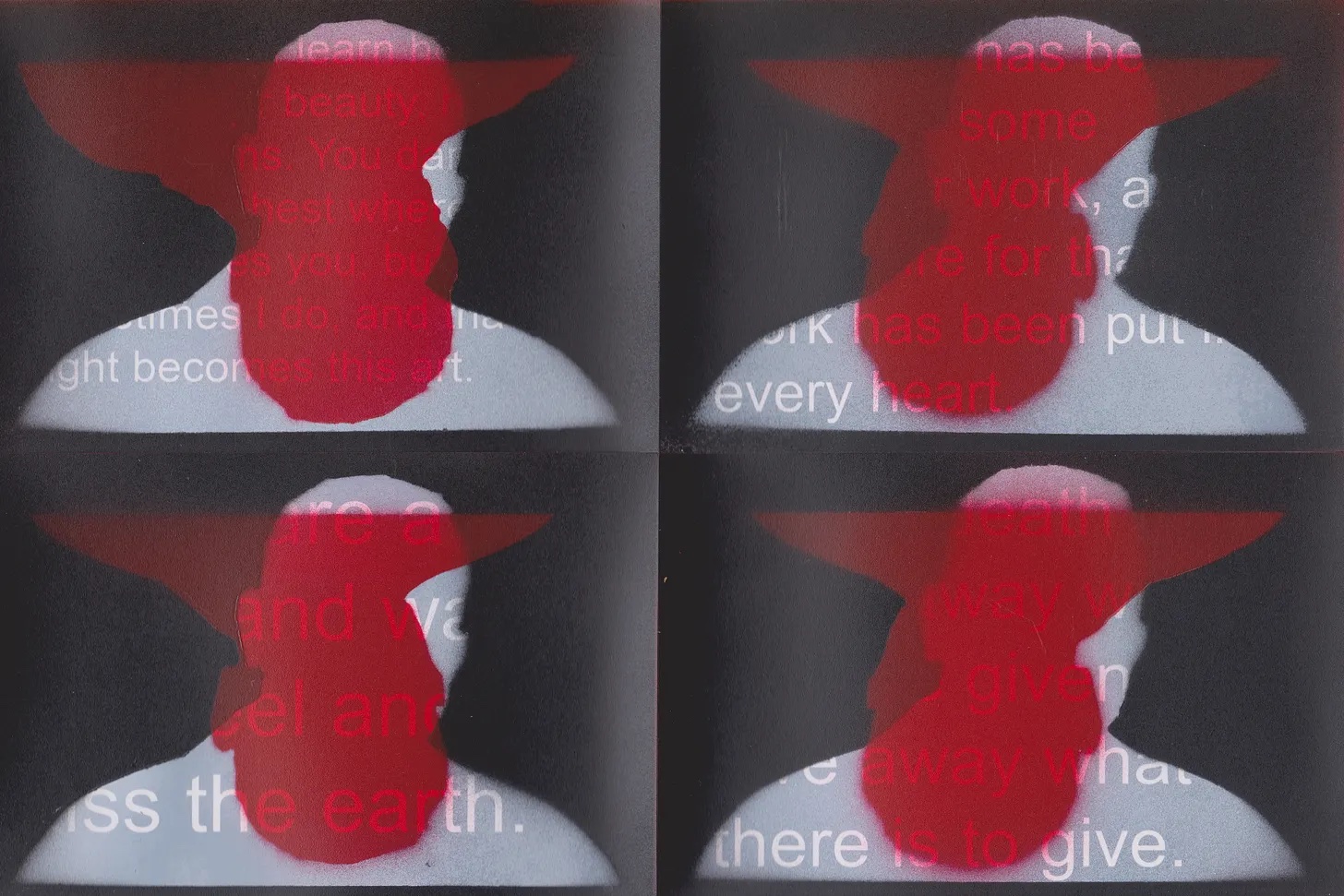
From your beginnings in Hip Hop until now, there are many visible continuities between your larger artistic practice and these installations in Venice. You shared an earlier work with us, “Alif Meem”, which offers a glimpse into your longstanding investigations of layering and inversion, the use of materials like stencils and spray paint, all juxtaposed with references to Tasawwuf. What feels new about the two projects in Venice, and what about them explores the same themes as your past work?
One recurring concept is the idea of the visible and the invisible. In the pavilion, I stenciled script on the walls, using a subtle gloss black spray paint on the matte black ground, which symbolically, or perhaps literally, makes distinctions between the visible and invisible. Using aerosol and stencils is a recurring theme throughout my practice.
Fusing video and painting together is something new. Before these works, I only made one work where I painted on a TV monitor. It’s never been shown—it’s called “Not Our Teachers” (2014–2020). There is, however, some continuity in process through another link: my public outdoor projects over the past two decades have included video mapping for festivals or exhibitions and other programs. These were typically one-off events where you’re projecting images onto objects, buildings, and architectural forms. Both of the works in Venice are video-mapped onto the paintings.
I’m sort of a purist when it comes to being able to make the work myself, and I’m really interested in understanding the science of things. This idea of engineering—which I studied in school—and reverse engineering have always been at play with me, even as a child. I feel that it’s critical to understand the medium you’re working with so that you can interrogate and challenge what the materials can manifest and be. I shoot all my video and make all my sound. I’ve transitioned from an analog world to a digital world, and really try to stretch and test the technologies. Even now, I still have desktops and computers that are running older platforms, which I pull out and use—they’re tools, essentially. It’s just like using a different gauge of brush.
In “conference of one’s self” and “khalil”, the paintings use five different colors, which I vectorized and separated, and then I inserted video content into those segments. But, as the colors blend, they don’t adhere to the vector sections. It creates an illusion: this is the moment of magic in the work, where people think that they’re looking at a static painting, but it begins to move and change. Since the paintings are suspended in air, they move slightly and the image will shift even further. It represents the idea of continuously questioning reality, and also having the realization that there is so much that we don’t know about what is within and around us. That comes directly from Islam, and also mysticism and spirituality in general.
Scent, Analog Sound, and Sacred Spaces
I want to turn to the sensory dimensions of the installations, like the scent and sound, which are difficult to convey in text and image. What is the relationship between looking, listening, and sensing in these works, and how do they shape our experience?
The idea of the experience has always been central in my work. And I should start by acknowledging that this experience is different for everyone—we all have different ways or abilities of connecting with different senses, whether sight or sound or otherwise. Regardless, all of these senses are interconnected to your being.
It is said that, if you go to sacred shrines of holy people or of prophets, certain visitors will receive a sweet scent from the shrine that pulls them in, like an invitation. On the scientific side of things, scent interacts with people differently, so it’s personal and individual. Scent also registers the possibility of the unseen. You can’t physically see it, but you know that it’s there.
Both of the works incorporate the fragrance of black oud. In “conference of one’s self”, it’s placed at the threshold, while in “khalil” it’s diffused throughout the space. Scent is one of the elements that connects the two works, which I haven’t spoken about before. In the Arsenale, you can smell the scent before you step into the first room, so you’re already interacting with the art before it comes into view.
In both installations, there’s also sound, which you can hear before you can see. You enter, the experience heightens, the senses awaken, and different parts of your being are engaged. As you move, you absorb, analyze, and reflect upon these emotions and these observations, and then the work is formed. You complete the work—the work is not formed until you engage with it.
The sound is from my archive. For “khalil”, it’s the opening of a nubah, which is a ceremony held on different holidays; it’s done outside, in public, in community, and it involves chanting, drums, and banners. It opens with an invitation, with the cymbal, and then the drum slowly builds up, the tempo and pace increase, and then it stops. I was interested not in the hit of the initial cymbal or the drum, but rather the reverberation of that hit.
I went back to analog technologies in order to slow down the sound eight times while avoiding digital distortion. I would record the sound on tape, then slow it down and rerecord it, over and over, bouncing between tape to tape to tape to tape to tape, and then finally to digital. The sound becomes something that you can’t associate with its original form anymore.
The treatment is similar for “conference of one’s self”, but the difference is that the sound has nothing to do with the self—it’s actually people chanting in a sporting match. It’s the idea of the everyday, ritualization, and all that sort of thing. Though we consider it mundane today, in one thousand years we may consider it—who knows?—something sacred.
During the vernissage, we also had multiple anasheed performances by members of the Al Rahma Islamic Association from Western Sydney. The anasheed tradition probably predates the time of the Prophet, peace be upon him. They’re songs of devotion, and stories can be told as well. For me, I feel that it offers a moment of cleansing. It’s also about possibilities of openings and offerings, and sharing blessings. It’s open to all people. My intention was always to have the group perform outside the pavilion, because it becomes a beacon, a call for inclusivity and openness, where everyone can decide whether or not they want to be drawn to it.
The anasheed and the accompanying blessings soften the heart; they give you a sense of calmness, a moment of reprieve. It’s an offering in response to all the uncertainties, and all the challenges—not just of the Biennale, but of the world—including Islamophobia, and how Muslims have been demonized, dehumanized, and generalized. Ultimately, what we all want is coexistence. Does the world have to be this way? We need to reconcile in order for change to occur.
Claire Dillon is an art historian of the medieval Mediterranean and its afterlives in the past, present, and future. Writing about textiles, design, monuments, and more. @clairepdillon
Cowboys, Sun, Snow, Fire, Labor Wars, Gold and Genocide: 150 Years of Colorado in a Rare Curated Survey at MCA Denver
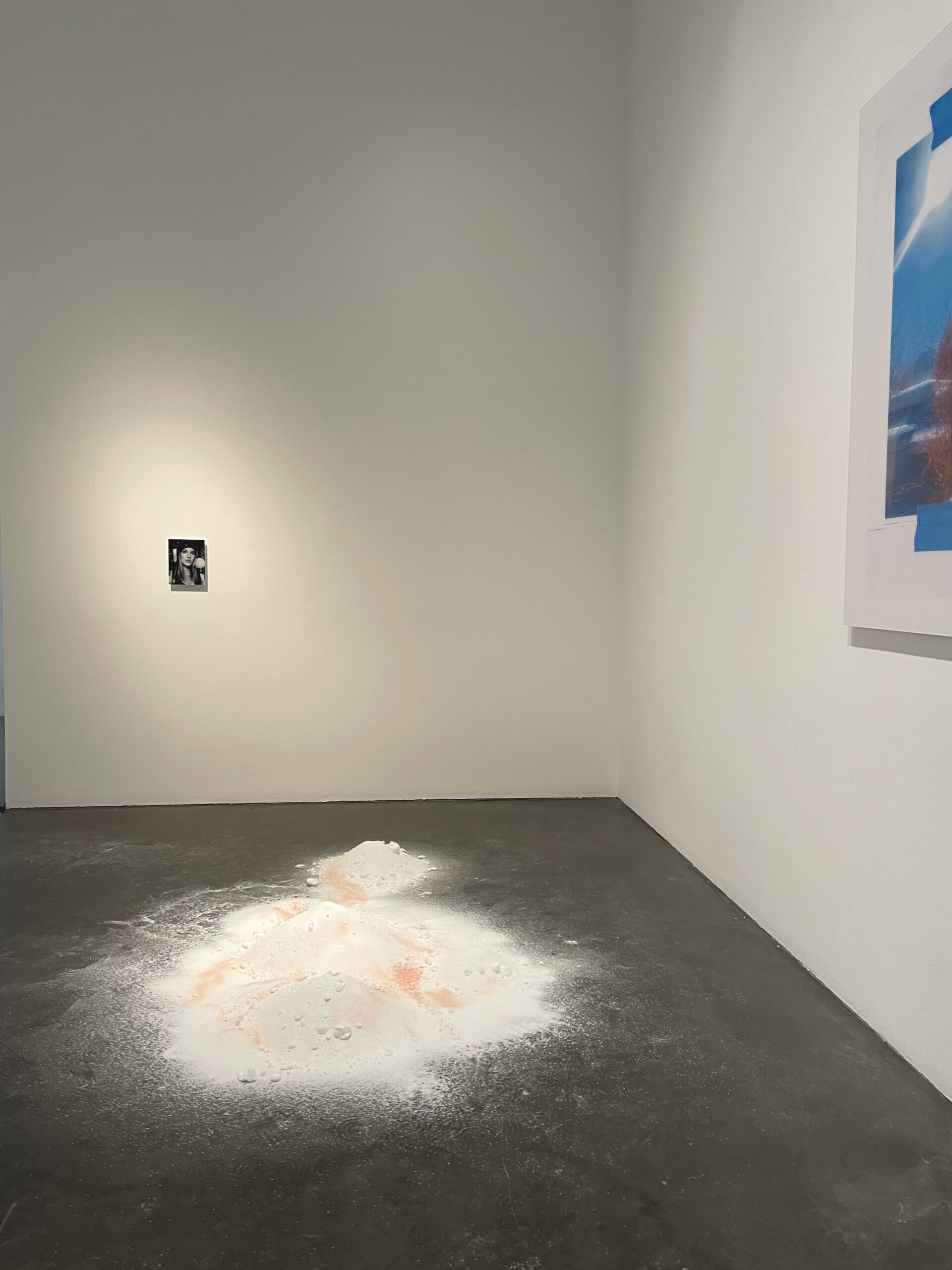
Devon Dikeou, THE INCONSPICUOUSES
.
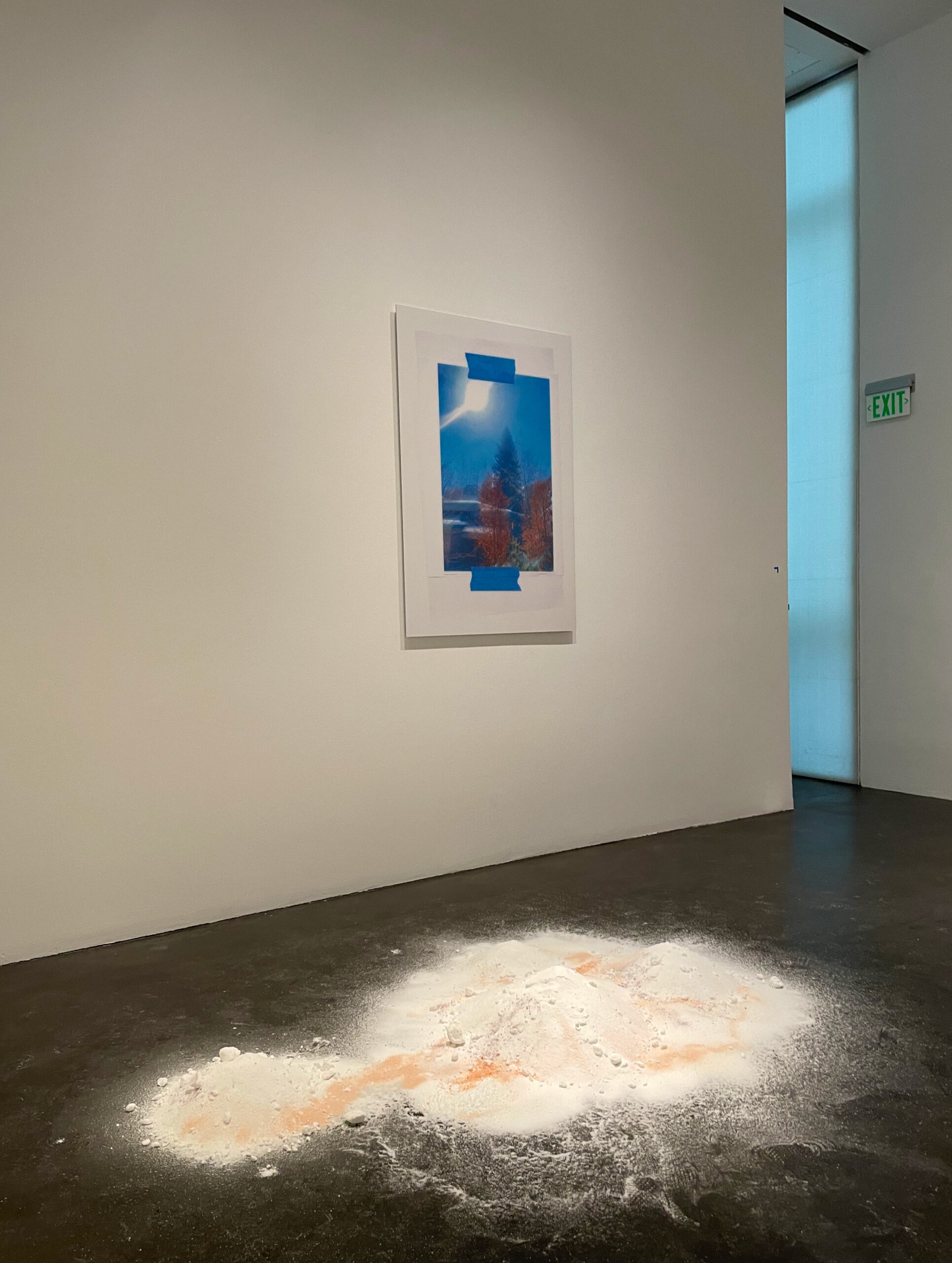
Floor: “Aspen Snow: Mountain (MCA Denver: David Adjaye Building)” 2024/2025 Ongoing
200 Pounds of Salt (Various Blends), Spread Over the MCA Denver: David Adjaye Building, Concrete, Mary Caulkins & Karl Kister Gallery. Dimensions variable
.
Wall Right: “Vision Board (American Academy in Rome: Rome Prize; McKim, Mead & White Building)” 2024/25, Ongoing; Photograph of a Vision Board Including a Collage with Painters Tape, Photographic Print Out from a Window in Aspen (Taken by an Aspen Domestic), Bulletin Board at American Academy for Rome Prize Project, THE INCONSPICUOUSES—based on Annibale Carracci’s exploration of Landscape as a Primary Subject and
.
Middle Ground, and Inspirational Window of Stevie Nicks’s Song, “Landslide”. Real Window for the Stevie Nicks’s Song Unknown’; C-Print on Aluminum
Wall Far: “Stevie (American Academy in Rome: Rome Prize; McKim, Mead & White Building)” 2024/2025 Ongoing; Appropriated Image of Stevie Nicks from the Internet, from Approximately the Time She Wrote the Song, “Landslide”, Inspired—Lore Has It—of a View from a Window of an
.
Aspen Lodge where She Worked as a Domestic; C-Print on aluminum, 11 x 8 1/2”
.
Photo credit: Devon Dikeou
On the occasion of 150 years of statehood, Colorado Currents, a survey of 28 contemporary artists who claim Colorado as home or homeland, is now on view at the Museum of Contemporary Art Denver (MCA Denver). Among them is zing’s founder, artist-editor-publisher-curator, Devon Dikeou, who presents recent work from her fellowship at the American Academy in Rome. Born and raised in the Queen City of the Plains, Devon and her brother Pany also founded Dikeou Collection, a trove of contemporary art in downtown Denver, which has since become a fixture of the local scene.
The show presents a rare look at Colorado as a hub of artistic activity, featuring work carefully researched, organized, and selected rather than chosen through open call. The project is led by Miranda Lash (MCA Denver Ellen Bruss Chief Curator)—founder of the modern and contemporary art department at the New Orleans Museum of Art. She further spent six years at the Speed Art Museum (Louisville, Kentucky), where she co-organized Southern Accent, a survey of the American South in contemporary art. She is joined in her efforts by Leilani Lynch (MCA Denver curator), who previously was a curator at The Bass (Miami). At MCA Denver she has organized Kambui Olujimi: Movements Towards Freedom (2024), Anna Tsouhlarakis: Indigenous Absurdities, and Breakthroughs: A Celebration of RedLine at 15 (both 2023).
Miranda Lash and Leilani Lynch on Curating Colorado Currents
as Interviewed by Rachel Dalamangas
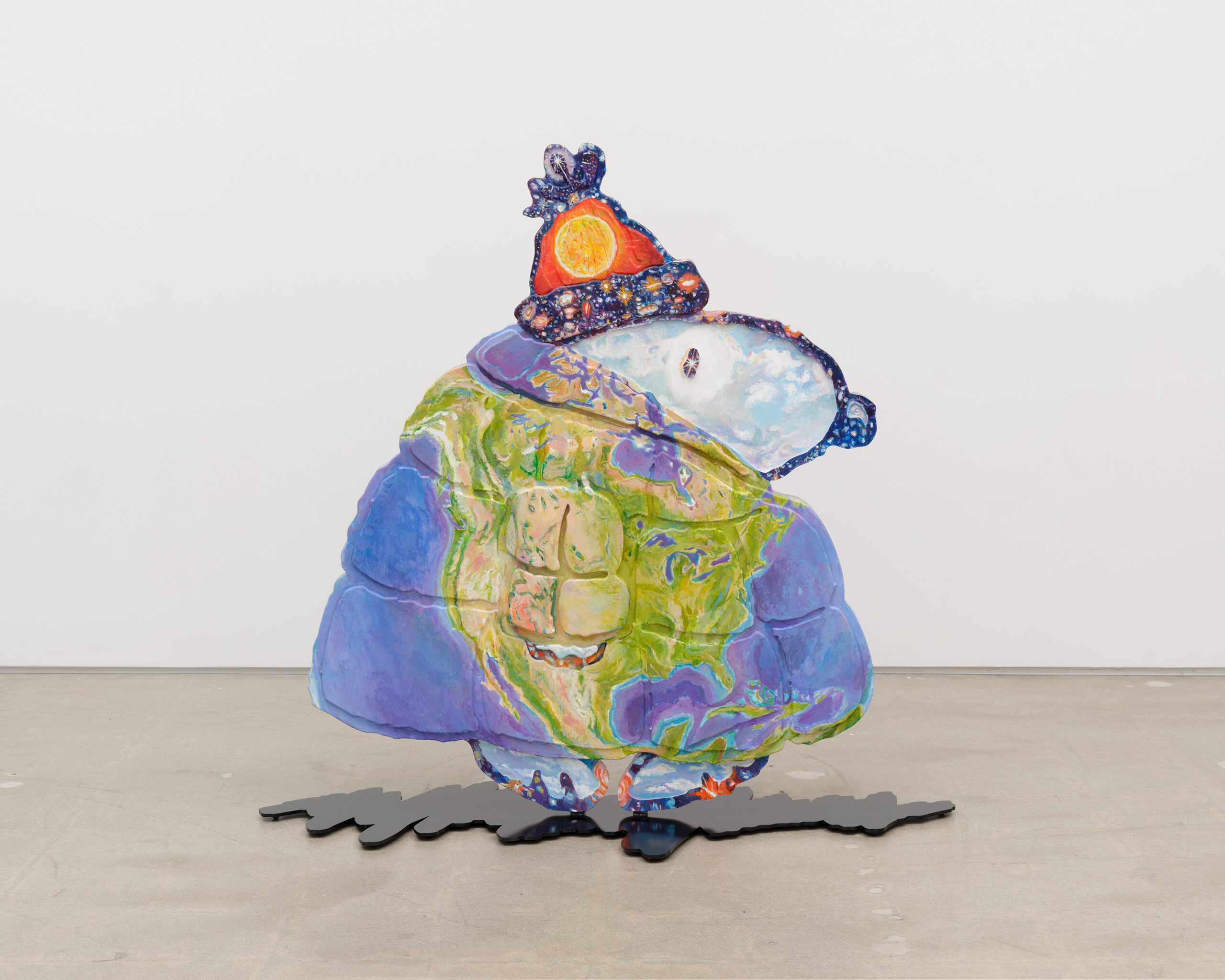
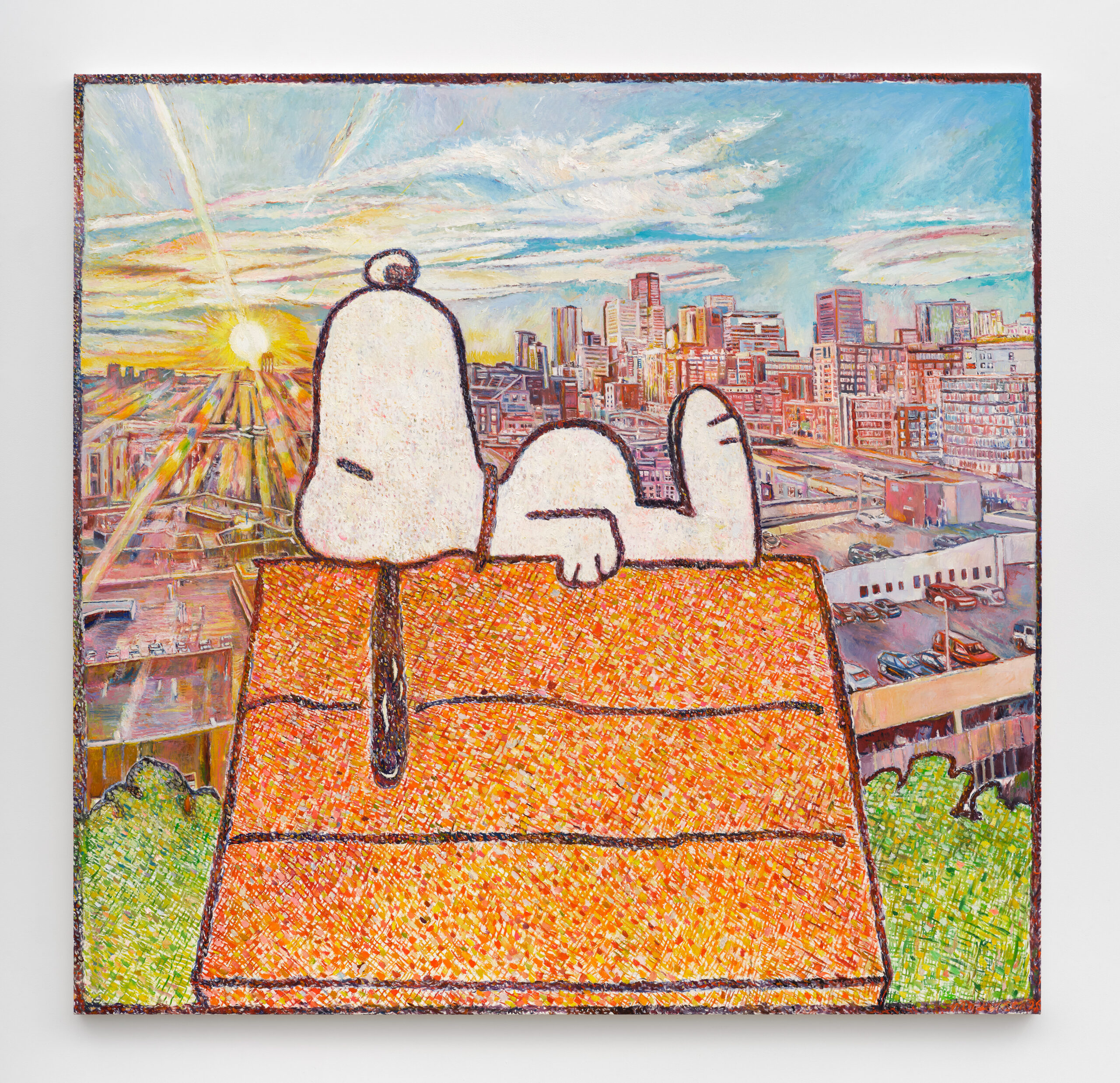
Keith Mayerson “Earth Snoopy” 2026, Acrylic on wood and steel, 48 × 49 × 18″
Photo credit: Wes Magyar
Are you both originally from Colorado?
LL: Neither of us! I’m from California originally, but I was living in Miami at the time before moving here. So I’ve been here almost four years.
ML: I’m also a California native—so, you know, we both tilt west in our leanings. I was living in Louisville, Kentucky before coming here. I’ve done a lot of work about how we understand the American South, which is in so many ways also a complicated region to understand.
To me it felt correct to bring the same type of open-ended questions to Colorado—really to any place that has deep histories of violence and deep histories of beauty. How do you hold both? Acknowledging the darkness doesn’t mean that you can’t appreciate all the things you love about a place—and in fact I think it translates into deeper love, because real love needs understanding of what it is.
I would build upon that theme of holding both. For example, Ronald Rael’s beautiful 3D-printed adobe structure is called “Coyota.” It’s based on a term used in the San Luis Valley for people of mixed lineage.
The Spanish colonizers brought over to what was then New Spain what they called the system of castes—a caste system based on your racial lineage. At the top of this hierarchy were people who were of purely Spanish descent. At the bottom of the hierarchy were people who were of Indigenous and African descent. And then they had a ranked system based on how much blood you had of different races. So coyota was a caste category for people of mixed Indigenous and Hispanic descent.
But because terms and ideas migrate over time, it’s now a way of describing with positivity mixed lineage in southern Colorado—embracing this idea of being born of multiple cultures.
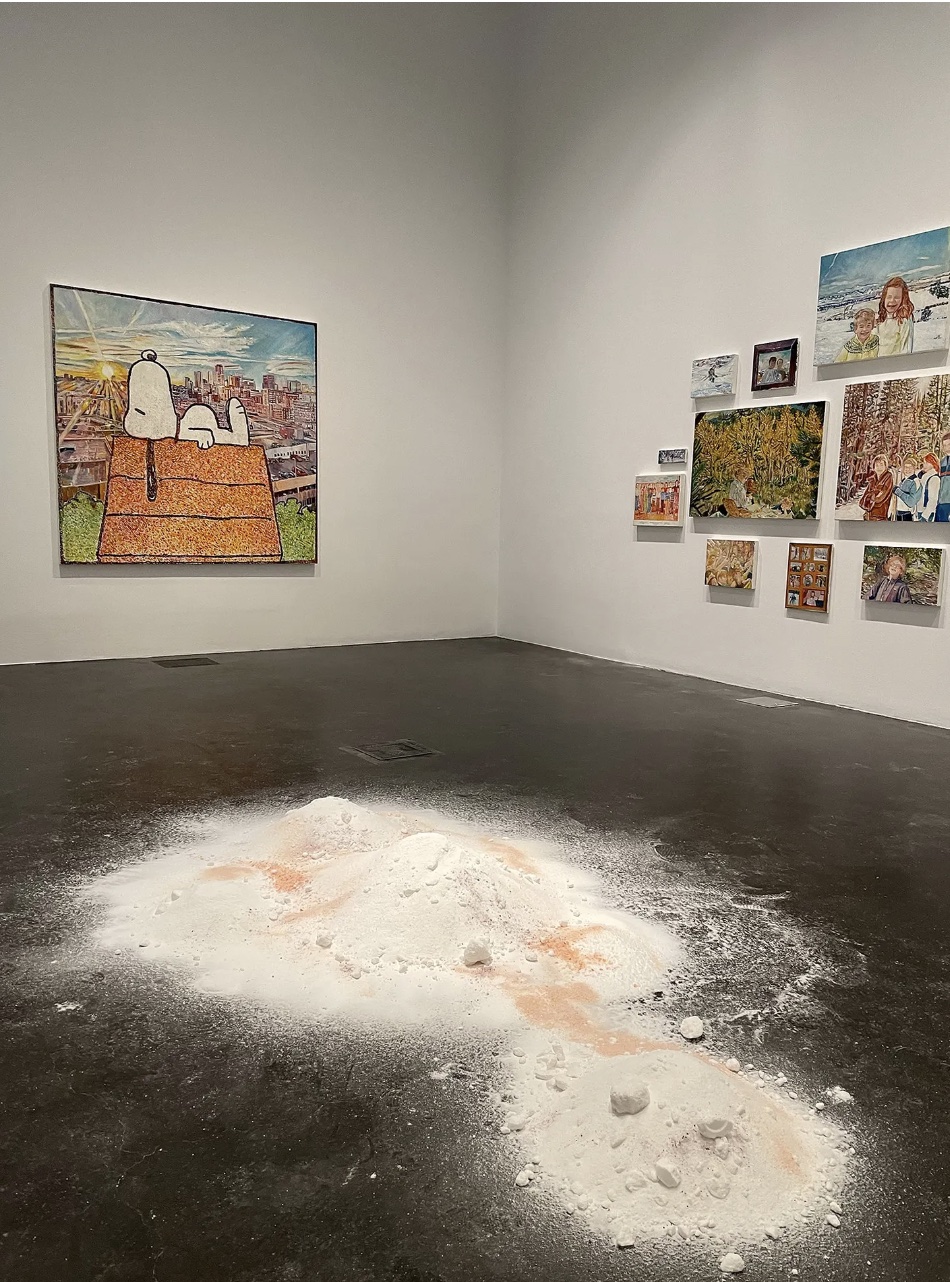
Keith Mayerson, “Snoopy Dawn over Denver” 2026, Oil on linen, 70 x 72”; Salon Wall of Family Photos, Oil on Linen, Ongoing
.
Devon Dikeou, THE INCONSPICUOUSES “Aspen Snow: Mountain (MCA Denver: David Adjaye Building)” 2024/2025 Ongoing; 200 Pounds of Salt (Various Blends), Spread Over the MCA Denver: David Adjaye Building, Concrete, Mary Caulkins & Karl Kister Gallery. Dimensions variable
.
Photo credit: Hayley Richardson
Who Is a Coloradan?
Keith [Mayerson] and I, when we were chatting, were trying to figure out: what does it mean to be a Coloradan? And it’s funny, because we’re coming from the perspective of diaspora Coloradans, and then you’re coming as transplants into Colorado. What does it mean to be a Coloradan?
LL: I think it comes with an appreciation for place. One of the things Colorado stands for is really the natural beauty that is here—but layered in that are so many histories and complications. A progressive spirit, I think, at least where we stand now. And a spirit of openness.
But that’s my perspective. In thinking about our conversations with artists, it was interesting just to pose that question—I don’t know that the question of what does Colorado mean, or what emblematizes this place, comes up all that often. Maybe in specific subsets. Whereas maybe different states get that question more, and maybe it’s the region.
ML: And I think it’s also fair to say we met so many incredible artists that essentially said, “I’m not really interested in that question.”
I think being outdoors is often part of it. My children’s school has this sign above one of the doorways that says, “There’s no such thing as bad weather, just inappropriate dress.” Whatever the weather is doing, we’re going to still be out.
There’s this awareness of water and land, and how the land has been used. Because this was considered the frontier, there is this spirit of openness—come here and define yourself and do what you want. The flip side of that coin is, it’s on you to decide what is good for you. There are many nuances to rugged individualism and how that plays out.
A great example that I remember noticing with an artist who was visiting Colorado: we were going through Independence Pass, and she said, “How are there no guardrails on most of this winding path?” And I replied, “I think it comes from this ethos of, it is your choice to take this path, and also your assumption of risk. If it works out for you, great, but it’s your responsibility to take care of yourself.”
That libertarian ethos can sometimes play out in providing a sense of freedom—the idea that someone can do whatever they want. In other cases it leads to holes in infrastructure, as well as holes in acknowledging our histories and maybe what is owed.
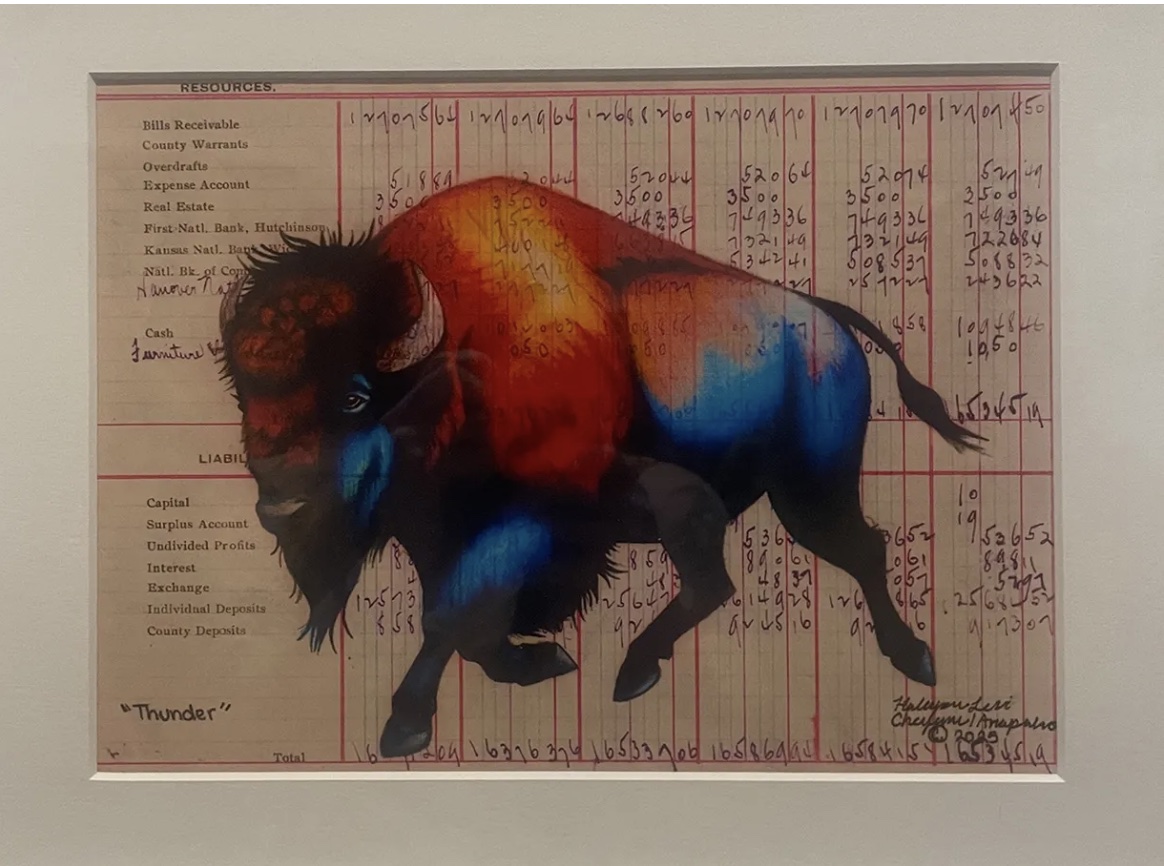
Halcyon Levi, “Thunder” 2026 Giclée on Paper, Framed: 13.5 x 15.5”
And that shows in the way this exhibit is structured: it’s not exclusively Colorado natives.
LL: I think we wanted to intentionally leave that a little bit more open than saying you had to be from here or be living here. We have many artists who are living in Colorado, practicing here, and also many like Keith [Mayerson] or Caleb [Hahne Quintana] who don’t live here now but grew up here; and then others like George Curtis Levi, his wife Heather, and their daughter Halcyon [Levi] who are Cheyenne and Arapaho and live in Oklahoma, but reflect the history of Indigenous communities being driven out.
Colorado is a homeland for those people, but they no longer reside here. That doesn’t mean they’re no longer tied to this place. It was really that feeling of connection to Colorado that we ended up expanding into.
ML: We decided to choose artists who consider Colorado home or homelands; acknowledging the Indigenous tribes who considered Colorado homeland, but who may not live here for reasons of historical expulsion.
I would use DesertArtLAB as an example. Their practice is very much grounded in understanding the flora and fauna and ecology of the desert, and acknowledging that deserts, mountains, rivers don’t stop at the state lines. Their piece involves mapping the image of the cholla cactus over this region, expanding into New Mexico, conveying that this is another way to think about region. The state line is almost irrelevant.
They also talk about how one of the reasons the southern border was placed where it is was to divide the Hispano population to diminish their voting power. That was very intentionally executed.
They asked me the question: “Haven’t you ever thought how strange it is that Colorado is a box, with no correlation to any geologic phenomenon? A lot of other state boundaries are determined by mountains or lakes.” That’s not an accident. There were intentional political decisions around that demarcation.
So that was another reason that we thought, let’s let go of the box. Let’s literally think outside the box.
Masculinity, Cesar Chavez, and the Ideals Worth Keeping
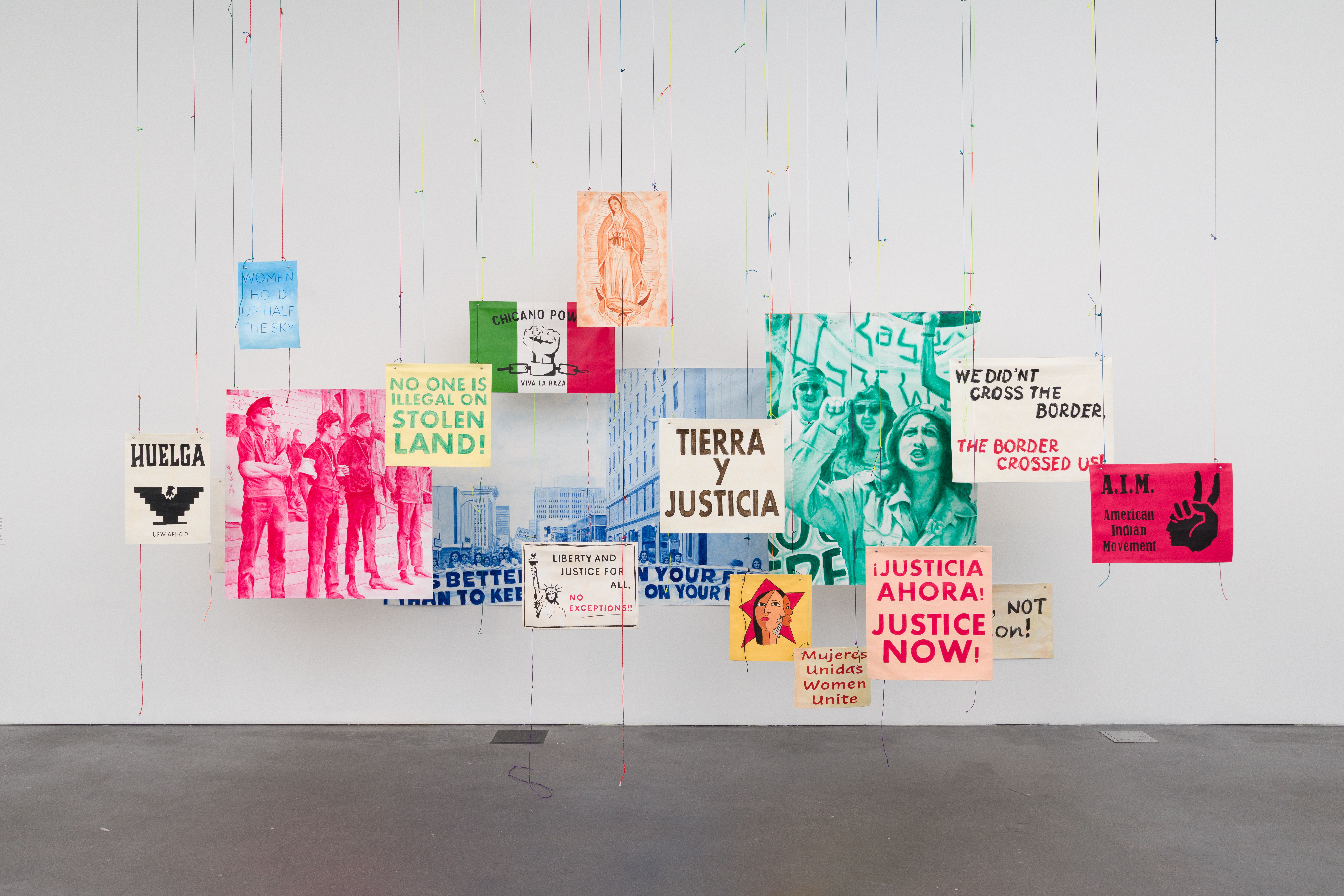 Carlos Frésquez, “. . . and Still, I March!” 2026, Acrylic on Unstretched Canvas, Approximately 108 x 180 x 48″
Photo credit: Wes Magyar
Something that surprised me was how masculinity was explored and expressed in the show, particularly because it is fully present without being centered.
ML: The point isn’t to say that any one identity or approach is wrong. The point is to say there is space in this country for everyone and everyone’s approach. There’s a beautiful painting in the show by Keith Mayerson of him with his husband, just sitting on the ground. There’s nothing extraordinary in what they’re doing, other than just asserting that they have a right to be there.
What kinds of masculinity are acceptable is an active conversation we had on a number of fronts, and how we talk about it. For example, Carlos Frésquez and I talked a lot about the revelations that came out in the last year about Cesar Chavez—these deeply saddening and painful accounts of how he abused young girls. I grew up revering Cesar Chavez. My mom is a family physician for migrant workers, so I was always taught to think of him as a heroic figure.
We talked a lot about what it means within the context of upholding the ideals of the Chicano movement. How do we talk about that moment? How do we talk about United Farm Workers? You might notice in his multi-panel painting, he decided: I’m going to show the symbol of the United Farm Workers movement, the eagle, because it’s true to the history. But there are no references to Cesar Chavez.
In every case in the exhibition, we had to be guided by what the artist felt like they wanted to do. We really don’t like being prescriptive about these things. One of the joys and challenges of contemporary art is that you’re often very directly speaking to the moment.
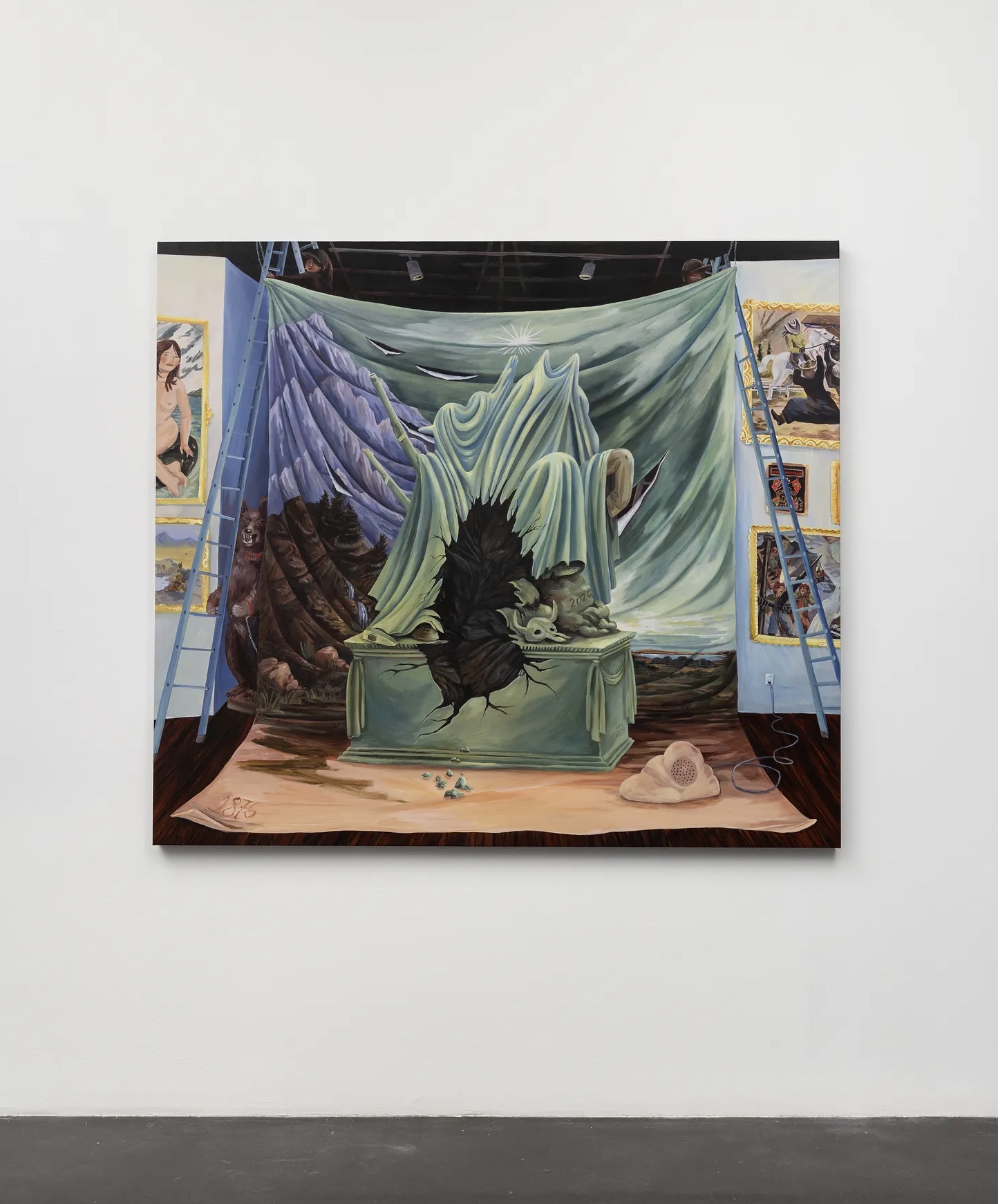
Grace Kennison, “Everything Conquered” 2026, Acrylic on canvas, 61 x 69 x 2”
Photo credit: Wes Magyar
The show doesn’t shy away from addressing the violence that still haunts the land: mass shootings, massacres, near-erasure.
LL: I think the earliest conversations about the show and the timing are because of this anniversary [of 150 years of statehood]. We started there, but our research with artists began to lead us to think more expansively—this isn’t just a celebration, although many of the works in the show do celebrate this day. I think every work ultimately is in some way speaking towards what this place is, if not always in a tone that’s celebratory. But also acknowledging that for others it isn’t a celebration, and it’s not a significant moment.
ML: I do believe that artists lead the way, and if they’re pointing us toward new ideas of how we can think about gender—or really anything else—it’s worth listening to. They’re always seeing around corners.
Grace Kennison made this amazing painting that addresses how one holds the idea of contradictions. It’s a painting within a painting that shows a shrouded monument. You can see on the stonework of the shrouded monument, 2026, and then in the corner, 1876—a reference to the year that statehood was established.
This willingness to hold the contradictions within history—where America’s ideals clash with its systemic cruelties—complements our nationwide revisioning of the grand monument, in the wake of so many Confederate memorials coming down. The widespread removal of these monuments triggered discussions around the country, asking, what are we commemorating with these statues? What are we marking? What did these used to mark? And what do we want to do in the future?
I think it’s really interesting that Kennison shrouds the central monument related to Colorado’s sesquicentennial, but then on the sides of the painting, within these mini-paintings [within the painting], she commemorates the Western Federation of Miners. There are histories of labor that haven’t been commemorated with big statues but are no less relevant.
Also the whole painting is set within a museum—basically implicating the role of the museum in marking time and holding histories. Because it’s Grace Kennison’s work, and her work always questions what is real? What is a construct? You see fake rocks, you see people pinning up lights—indicating, ultimately, the narrative is what we construct.
Fire, Water, and Land Use in Colorado Art
Do you see any patterns emerge across a large show of 28 artists like this?
LL: A lot of the artists engage with the various histories of Colorado—whether that be mining, ranching, the Indigenous communities that have been based here—all the way to more urban concerns, family histories, wanting to trace back roots and pronouncing what Colorado is from various perspectives, and acknowledging that it’s not a monolith, obviously.
And then, really, nature. Nature plays a huge role, and that is arguably one of the biggest through lines, I think. The ways in which people move here to enjoy nature—but also nature is unpredictable and is doing things that we can’t really control. There’s a lot of artworks that talk about land and water usage.
ML: There are definite themes around our responsibility to the land, and the historical uses of the land. You can’t talk about Colorado without talking about mining. It’s a big part of the story of why the Indigenous populations were pushed out, and how people amassed wealth here.
A number of the artists in the show talk about water and water usage, what water means. There’s an homage to water by JayCee Beyale with neon lights—it’s gorgeous. Maeve Eichelberger talks about the upper and lower basin in her clothing-based work. She has a piece called “Prosperity”, and it’s a saddle with images of Telluride as one of Colorado’s many gold rush towns.
But there’s also very loving approaches to land, to nature, to landscape—artists that love being close to nature. We have these wonderful drawings by Evan Forrest Mann that come from walking in nature, making work in nature.
Fire plays a role too. Erica Osborne’s very close-looking at the burn scars and the life that returns. We’re in love with this painting called “First Responders”, inspired by her trips out to the mountains’ burn scars with scientists. She studies the first plants that return after fires. They’re so often plants used to heal the body. Aloes and arnicas—the same salves that we use on the body after a burn are often the first responders when the mountainside has been burned.
Erica talked to us about the history of fire management—not just in Colorado but in the US—and this ethos that pervaded for almost a century, that every fire is bad, which resulted in an extremely proactive role in suppressing every fire. We all grew up with Smokey Bear and the idea that “only you can prevent forest fires.”
That approach is very much grounded in a colonial ethos. There’s a great recent exhibition called Fire Kinship: Southern California Native Ecology and Art, organized by the Fowler Museum in LA. It addresses how the early Spanish colonial settlers coming to California and to the West aggressively stopped Indigenous burns. The exhibition acknowledges what so many tribes understood for centuries, if not millennia: that fire was an important part of how the landscape regenerated and cleansed itself. They’d been doing controlled burns long before Europeans arrived.
Taking such an active stance against fire for so many years is one of the reasons we have such severe fires now—the undergrowth hasn’t been cleared.
That’s a recurrent gesture in the exhibit—recognizing loss as much as gain. How do you show, for example, fire as regeneration without minimizing what people lost?
ML: We didn’t want to skim over the terrible loss that is associated with fires. Some of our artists in the show speak very directly to that loss.
LL: Erin Hyunhee Kang is an artist based in Boulder who lost her home in the Marshall Fire. She’s thinking about that very personal loss of losing your space and having to rebuild. There is a projection of her home amidst water, and then the construction sounds of rebuilding—thinking about that kind of regrowth and rebuilding from both, like, what does nature do, and also how do we as citizens of the state and of the broader world cope after paying the price of some of these practices?
Colorado’s Histories of Activism and Censorship
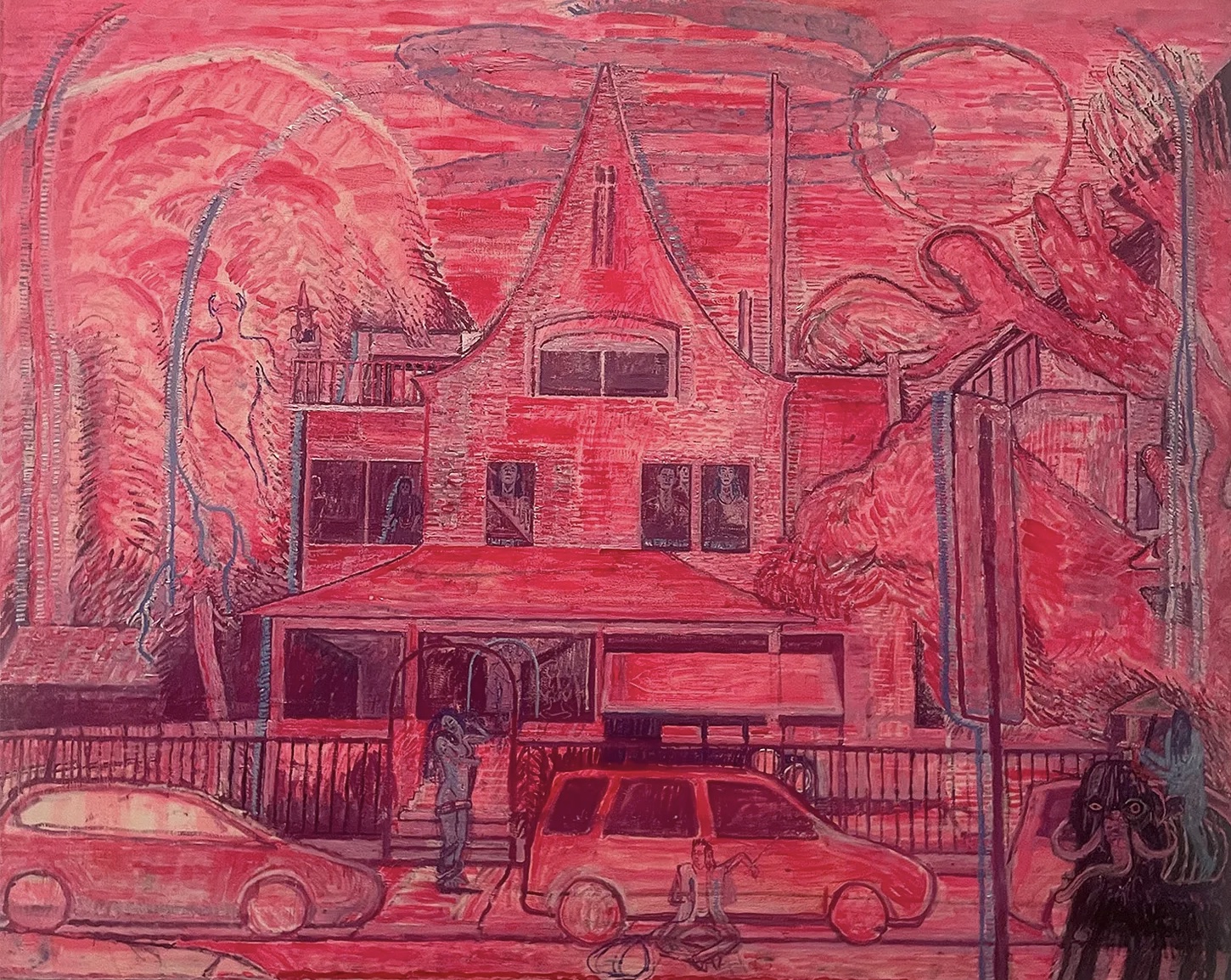
Lydia Farrell, “Lilith”, 2026, Oil on Canvas, 48 x 60”
ML: I think another important theme bouncing around is also the histories of activism here in Colorado. We live in one of the more progressive states in the US and part of that traces back to very long histories of activism here.
From the late 19th through most of the 20th century, discrimination was legal here. Segregation was actively enforced. Colorado was a major site of activity for the Chicano movement. Colorado also played a significant role in advancing LGBTQ+ rights. There are these beautiful histories of activism that inform why we have certain freedoms here that are very precious and we wanted to acknowledge that through several artists’ work.
I do appreciate that we can talk about these things in Colorado, because Colorado is not a state that has currently flagged words related to gender as subject to review or censure. And I say that in contrast to Texas, which has very recently passed laws subjecting certain forms to review, and in contrast to the museums that are under review by the federal government, where there are reviews and censure of using certain terms as they relate to gender.
So, the fact that we can even have this conversation right now—we can talk about the work of Lydia Farrell and use the word trans and use the word advocacy and be completely open. No artist in the show would be happy to say my work is about my identity and nothing else. That’s just way too simplistic an approach to their practice. But it is inevitably part of what informs their work.
I’m saying that because I don’t want that to be a freedom we take for granted, because it is being actively dismantled in different parts of this same country. And this is not metaphorical. It’s very literal. This is not conjecture. This is not speculation. There are very coordinated and active efforts to censure what art we can show and how we can talk about it.
But like any place, it’s complicated. We do talk about mass shootings in the show as well. It is part of Colorado’s story.
Devon Dikeou’s THE INCONSPICUOUSES at MCA Denver
Devon Dikeou’s THE INCONSPICUOUSES was first conceived in the McKim, Mead & White building at the American Academy in Rome. In Denver, the site-responsive work has David Adjaye to contend with.
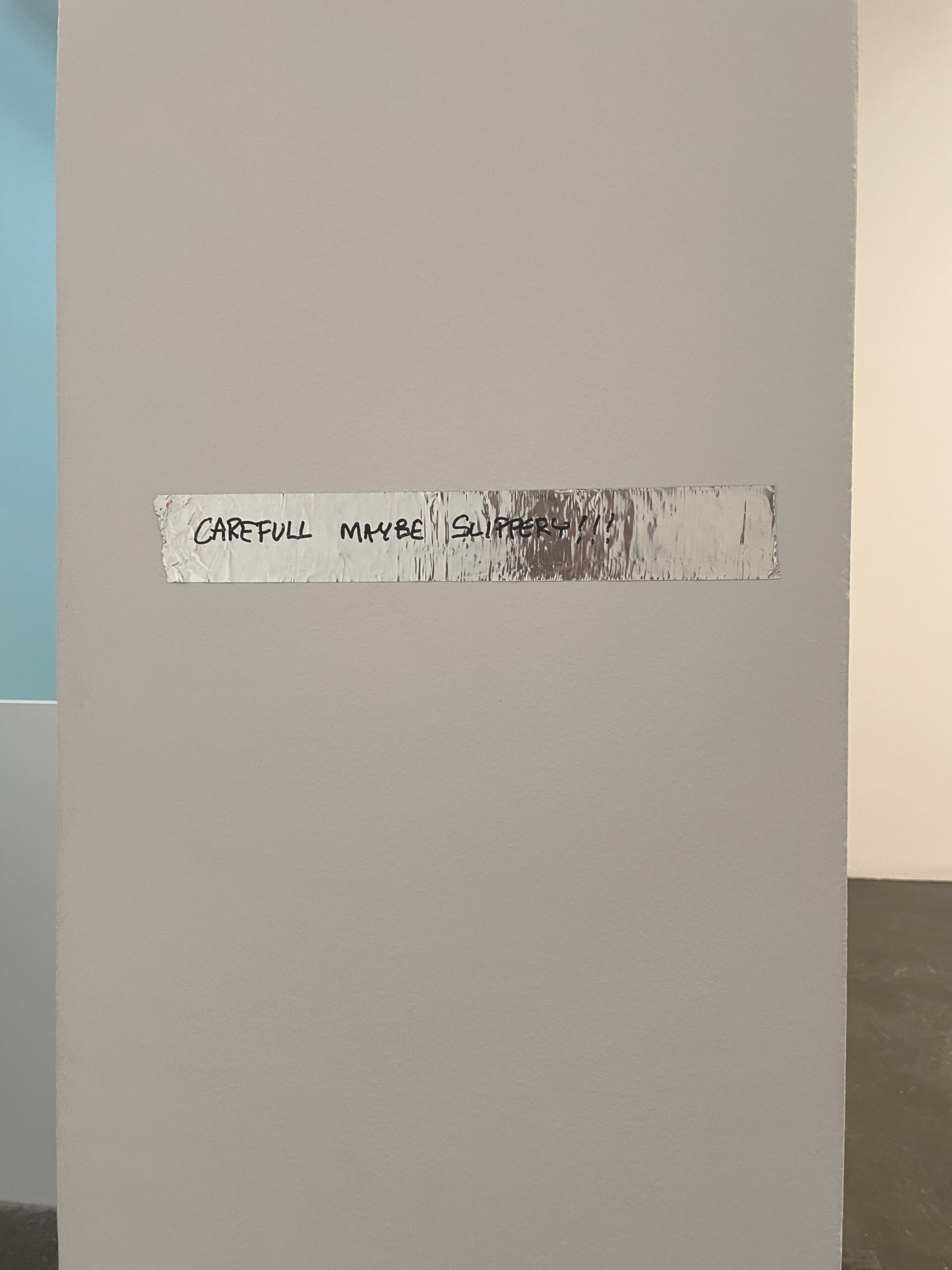
Devon Dikeou, THE INCONSPICUOUSES “Tape (MCA Denver: David Adjaye Building)” 2024/25 Ongoing; Foil Multi-Purpose Tape and Sharpie Taped Near the Installation of Aspen Snow (Both Versions) with Cautionary Instructions
.
Photo credit: Devon Dikeou
Devon Dikeou, THE INCONSPICUOUSES
.
“Vision Board (American Academy in Rome: Rome Prize; McKim, Mead & White Building)” 2024/25, Ongoing
Photograph of a Vision Board Including a Collage with Painters Tape, Photographic Print Out from a Window in Aspen (Taken by an Aspen Domestic), Bulletin Board at American Academy for Rome Prize Project, THE INCONSPICUOUSES—based on Annibale Carracci’s exploration of Landscape as a Primary Subject and Middle Ground, and Inspirational Window of Stevie Nicks’s Song, “Landslide”. Real Window for the Stevie Nicks’s Song Unknown
C-Print on Aluminum
.
“Aspen Snow (MCA Denver: David Adjaye Building)” 2024/25, Ongoing; 200 Pounds of Salt (Various Blends), Spread Over the MCA Denver: David Adjaye Building, Concrete, Mary Caulkins & Karl Kister Gallery; Dimensions variable
.
Photo credit: Devon Dikeou
Loss and Nostalgia: Devon Dikeou, Keith Mayerson, and Margaret Kasahara on Memory in Colorado
I attended Littleton public schools myself.
ML: I think that is part of contemporary life. We’re both parents, and so part of the reality of being a parent is knowing that the school is not a safe zone per se. And so how do you cope with that and deal with that, and do it in a way that feels sensitive to the loss?
I think of Margaret Kasahara. She has a daily drawing practice of notations, chronicling her life in Colorado Springs. There are drawings that do touch upon, for example, the King Soopers shooting in Boulder and the Club Q shooting in Colorado Springs. Her method is abstract, but I think very elegant. She has these incredibly small, detailed graphite drawings. They’re so intricate. You have to get so close to them to see the detail.
And then she puts single grains of rice arranged in a grid. She talked to us about the idea of the preciousness of a single grain of rice, reminding her of the single snowflake of falling snow, the single individual, the preciousness of every individual life. She gilded grains of rice in silver and in gold. And it was her way of indicating preciousness of life, fleetingness of life, trying to capture that. That was her way of paying homage to that loss.
So it’s not a comprehensive show.
LL: No, there’s no way.
ML: There’s no way. But we tried. And I think Devon [Dikeou]’s and Keith [Mayerson]’s work also touches on the sweetness of some memories in Colorado. Keith, as you know, because you did a beautiful interview with him—speaks to tender moments of growing up in Colorado, what it means to be Coloradan, what it means to grow up in snow.
I think Devon very much in her own ways is linking personal memories of growing up with snow in Aspen to this beloved pop culture legend of Stevie Nicks composing “Landslide” looking out at the Aspen snow.
There’s a lot of moments where the root of the inspiration is personal, but then it extends out to these universal themes.
I really appreciate the ambition that the artists brought to the show. I would use Marcus [Correa] as an example: biking the streets of Denver, crisscrossing the city, flying in a photographer from Paris, working with dozens of designers. But doing it because it’s about home, and this assertion that more people need to understand what home is for him. He’s one who said, I’ve been talking for years about how Denver is distinct, it’s its own voice. The North Side is not the same as a Latino neighborhood in Los Angeles. They’re not interchangeable.
The artists really wanted to present their best work. Because home is always emotionally loaded, and home can be the hardest place to talk about.
Colorado Currents was co-curated by Miranda Lash, MCA Denver Ellen Bruss Chief Curator, and Leilani Lynch, MCA Denver curator, and is on view through November 1.
In 1837, at a séance table in upstate New York or a parlor in London, painting was used as a form of existential connection. The spiritualist painters such as Georgiana Houghton with her “spirit drawings,” or Hilma af Klint taking dictation from the unseen, believed painting could also be a medium (pun unavoidable) for talking to the dead. It was a quintessential American impulse even when practiced abroad: part faith, part showbiz, staged in the same parlors and theaters as vaudeville, promising that the past remains in conversation with the present.
Artist Keith Mayerson has used instead the term “method acting” to describe his approach to painting, but listen to him describe his process with playlists built from his family’s eight-track tapes, the energies he “sutures into,” his mother’s spirit arriving at the easel, and one can almost hear the Fox Sisters tapping out their approval.
Since 2001, when Mayerson watched the towers fall with his NYU students from Washington Square Park, he has been painting “My American Dream”: a sprawling oeuvre of hundreds of canvases of Snoopy, John Denver, civil rights heroes, family snapshots. The project poses an ongoing act of connection with an America he insists, against considerable evidence, is still alive.
This month, Mayerson returns home. Colorado Currents, opening at MCA Denver on July 24 includes three bodies of his work, among them a family salon wall honoring his mother, Lois, who passed away last November. “I’m not the Hollywood Medium or anything like that,” he told me from his easel in Riverside, “but sometimes I do feel like she’s kind of coming to me as I’m painting.”
Keith Mayerson as Interviewed by Rachel Dalamangas
How did growing up in Colorado shape you creatively and as an artist?
Growing up in Colorado, I think it was really about the environment and that spirit that really inspired me, and that people were very accepting. There was no pretension, I don’t think, in Denver or Colorado.
For the MCA Denver Colorado Currents show, I have a few bodies of work that I’m grateful to have included. There will be a large 72 x 70″ painting of Snoopy on his doghouse, “Snoopy Dawn over Denver,” with a background view of the sunrise from my parents’ downtown Denver condo; my first-ever sculpture, “Earth Snoopy”; and a family wall of salon images based on the “Rogues Wall” salon of photos my folks had in their bedroom.
My mom sadly passed away last November, and the salon is to honor her and to celebrate growing up in Colorado. A few of these paintings (and the Snoopy sculpture!) are from the solo show I had at the Aspen Art Museum this past spring, entitled “My American Dream: Rocky Mountain High.”
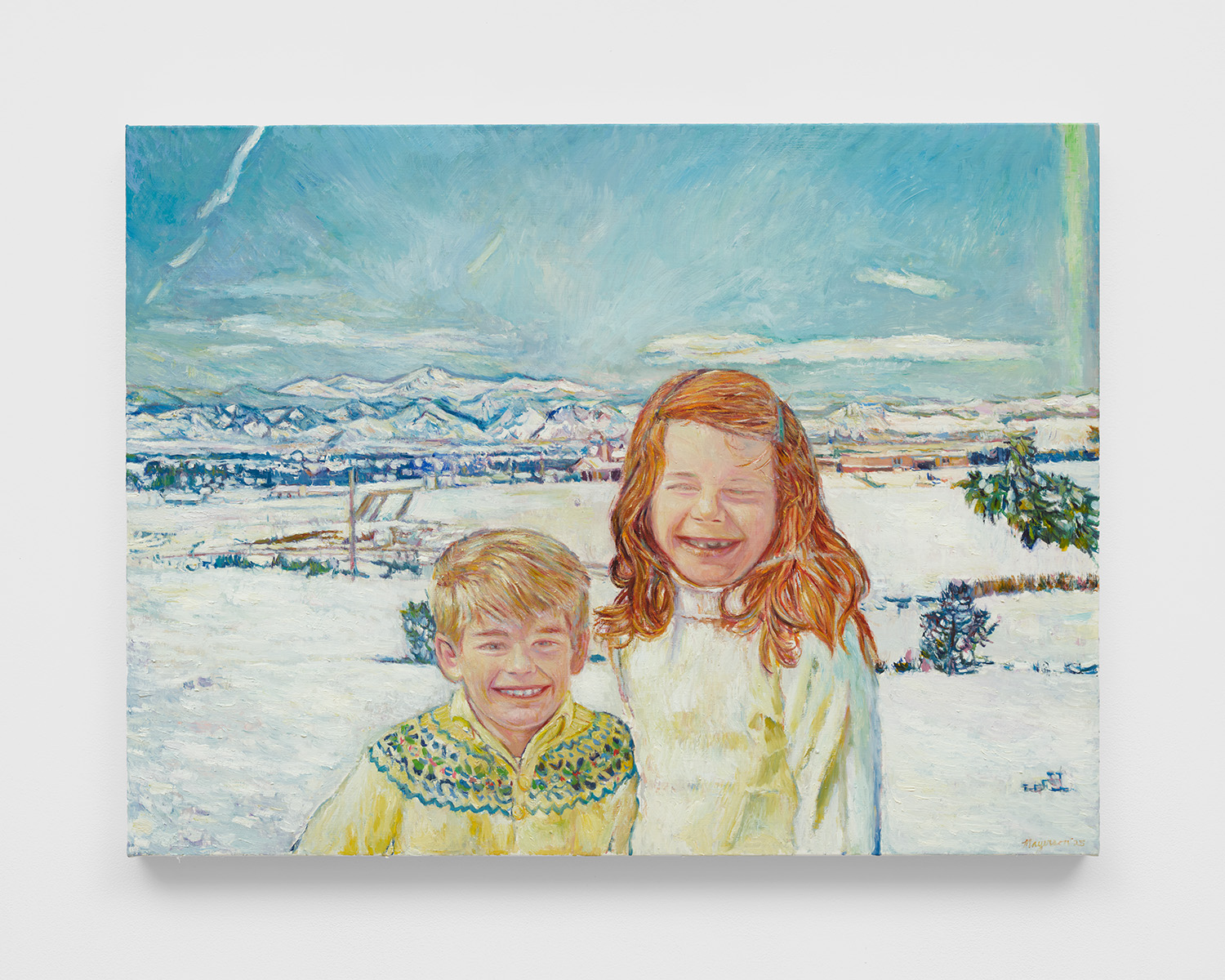
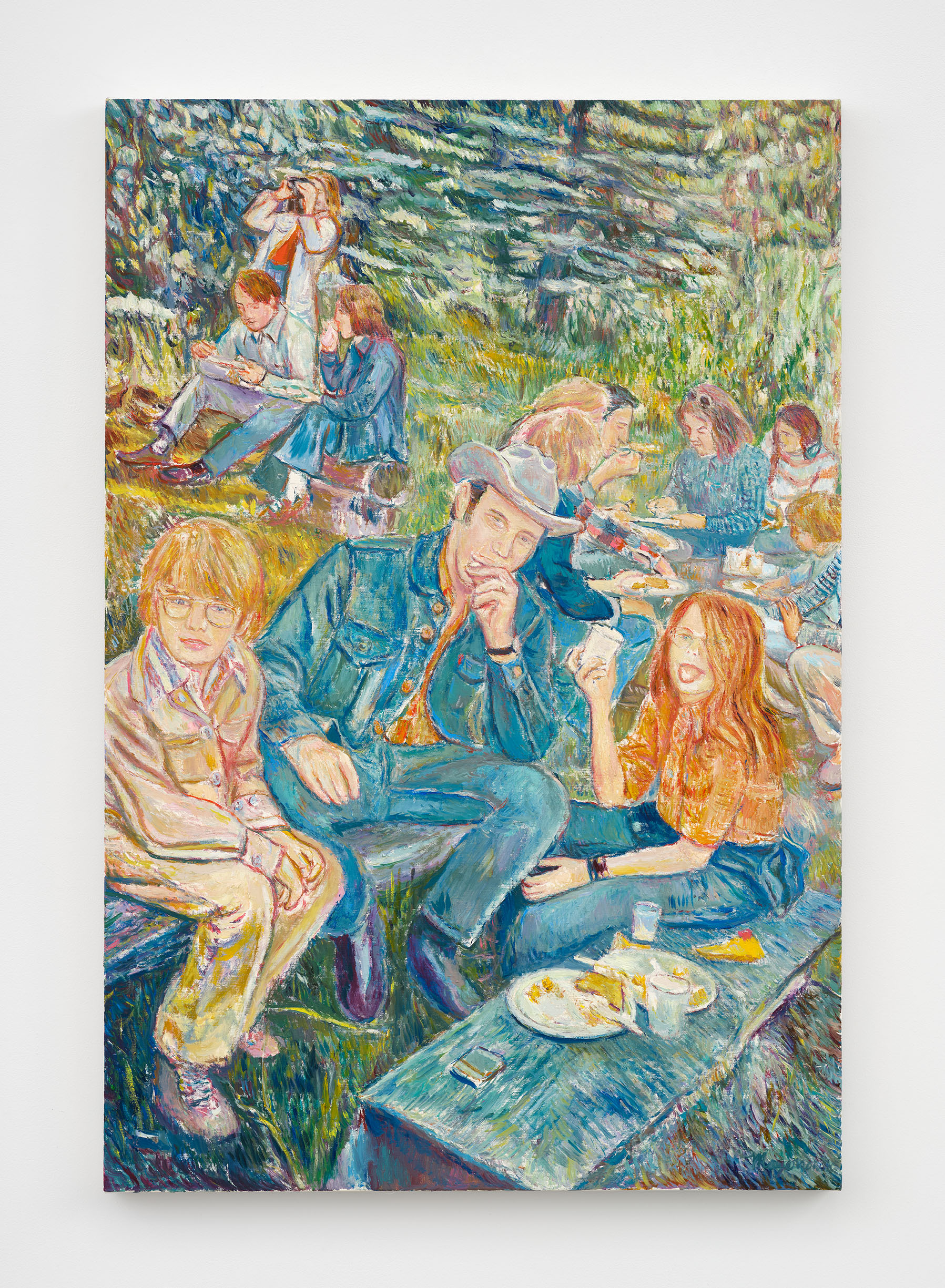
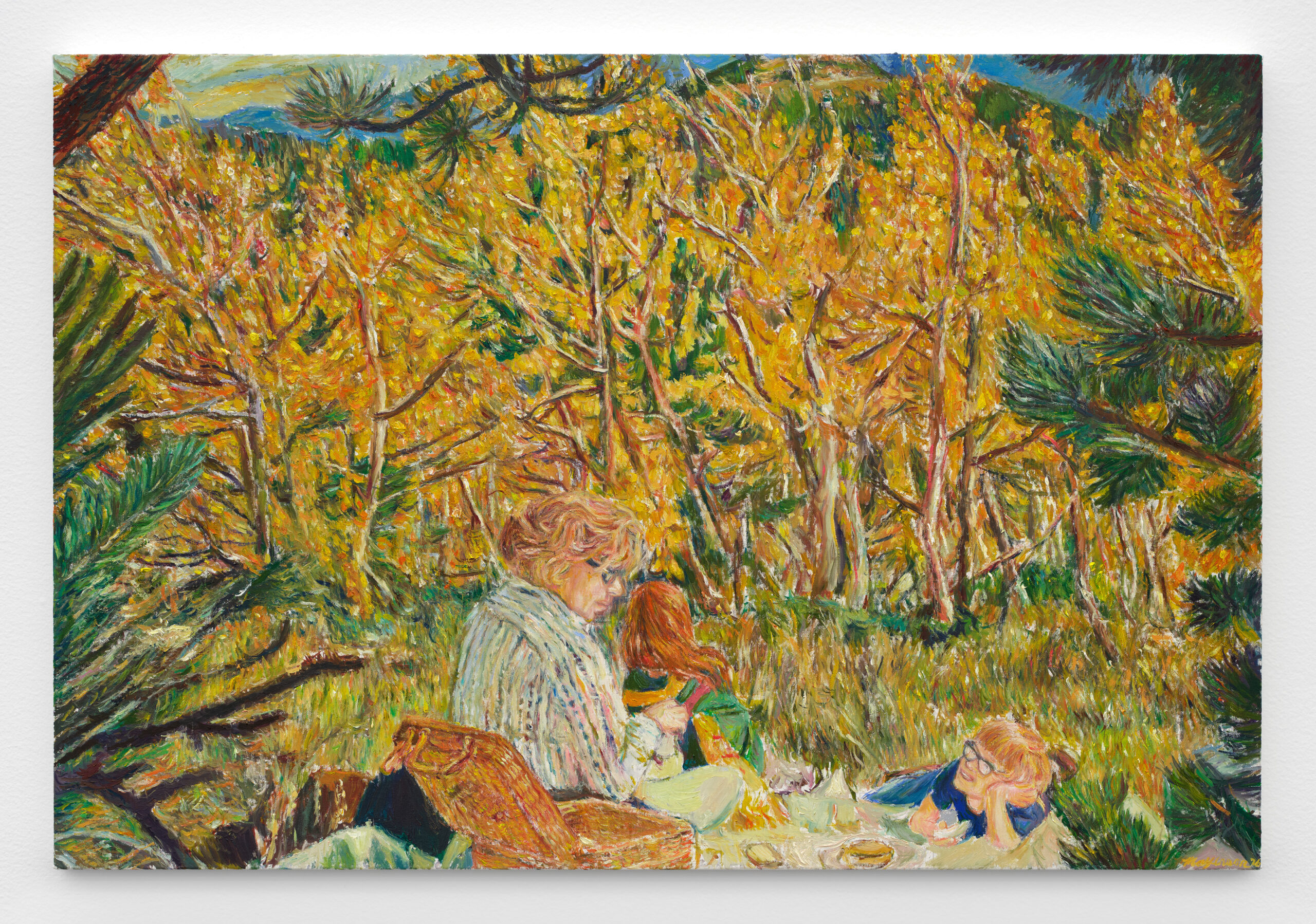
For the Family Salon, one is a painting of us having a picnic—my mom, my sister, and I—in Central City, from a photo taken by my dad. Weirdly, it was at the old cemetery that was there, but they had these beautiful aspen trees, and it was a favorite place for picnics for many folks. Also included is “Rocky Mountain Babies,” a picture of my sister and me from where we grew up in Greenwood Village, in the suburbs of Denver. Behind us, you can see the Rocky Mountains and West Middle School, where I used to walk through the snowy fields to get to school (which are now a whole bunch of houses and fences).
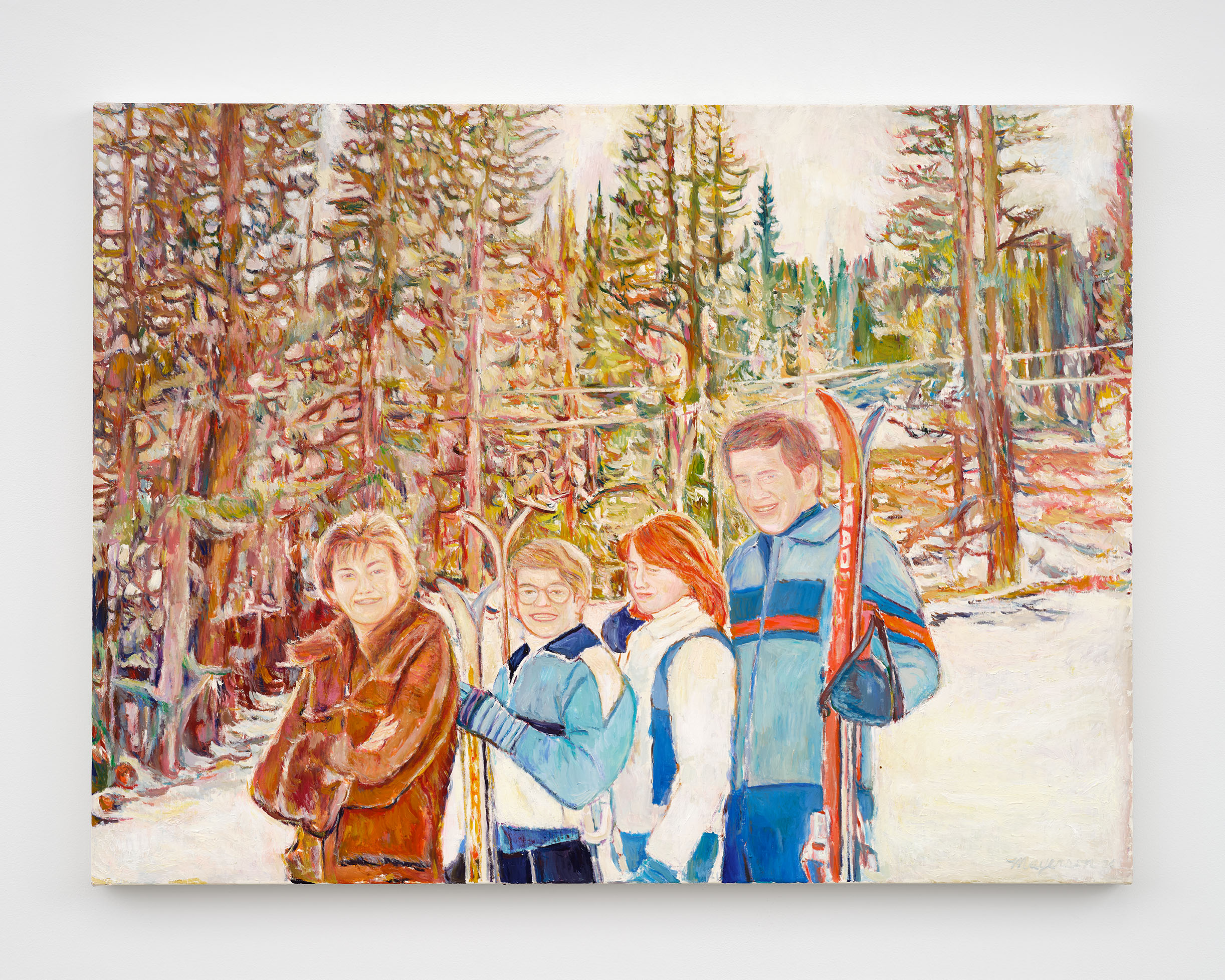
Also for the salon, I’m doing a different version of a 1977 Christmas card photo that was at the Aspen Art Museum. For the AAM, I painted an outtake from this humble shoot (my fellow 11-year-old friend Craig Young took the pictures for us!). In the AAM version, it was on the bunny hill at Copper Mountain where, as a group meeting post, there was a Cherokee sign in the background. Even in the ’70s, they were trying to be a little PC by having it be not for Indigenous people but conflated instead with the Cherokee station wagon. We decided that was just too edgy for the MCA Denver, so I created a new painting of the actual image we used for the Christmas card instead.
At the MCA Denver, I’m going to show the “Earth Snoopy” sculpture, and on the front of the sculpture is a picture of the sun in his hat and North America on his puffy jacket, and on the other side is a picture of the moon in his hat and Russia in the East. Hopefully, our world isn’t flat anymore, but this shows the West that is in constant conflict with the East, while we are all of the same Earth, and it’s obvious that the world has been turned upside down.
“Snoopy Dawn over Denver” is a painting I did exclusively for the show, and it’s Snoopy on his doghouse with a dawn over Denver in the background. This was actually from the guest room balcony at my parents’ condo at the Flower Mill Lofts, just five minutes away from the MCA Denver.
I was there to take care of Dad after Mom had passed, and I woke up really early, and this beautiful sunrise was happening right over the baseball stadium, and you can see downtown Denver behind us. My dad was Jewish, my mom was Southern Baptist, so I’m sort of a religious mutt, but I’m spiritual, and I feel like this was almost like my mom coming from the celestial heavens to tell me everything was okay . . .
I’m also from Colorado. I grew up in Littleton. I was looking at your paintings before this conversation and I thought he really gets Colorado color, you know, like that kind of clear bright sunlight that Colorado gets.
Unfortunately, with global warming, I feel like the sun’s beaming even harder in the mountains when you’re skiing. The atmosphere feels thinner than it used to be. But there’s nothing that presses my buttons more than being in the mountains, or even being in Denver, and being in that atmosphere and just feeling the cool air and that bright sky, and I’m so grateful that you said that.
Where did you go to high school?
I went to Cherry Creek. Everybody hated Creekers because we had one of the biggest schools, and so we had the best football team because we had so many kids to choose from!
 I went to Heritage High School, which was where one of the South Park guys, Matt Stone, I think, went there too. I mean I was a little kid when he was there but he’s a fellow alumnus.
I was talking to Miranda Lash, the curator of the MCA Denver show. We had a nice talk after the LA Frieze fair and about Colorado artists and people from Colorado who are involved in the arts and there’s too few, but there are some. You know, John Currin was from Boulder . . .
It’s interesting how we migrate out of Colorado and spread the word. One of my first jobs after college I was at the Robert Miller Gallery back in 1989 and I worked the front desk and gallerists Cheim & Read were the directors. They showed Kusama, and Joan Mitchell when I was there. They showed Alice Neel, and my heroes Mapplethorpe and Basquiat right after they died. I worked the front desk wearing my grandfather’s three-piece suits and they said, “Keith, you don’t have to be so nice to everybody.” I’m like, “But I’m from Colorado. We’re just nice people. We’re warm and open and affable. We can’t help it!” I like to think that I’ve maintained that attitude my entire career and my life.
 Did you know that Colorado also often gets rated as having the most attractive people because of how athletic everybody is. And so how I explain Coloradans out in the wild is that we are a very friendly and attractive, but poorly dressed people. Do not dress up. People will wonder what is going on with you.
But I mean, what a period in America to be an artist, and to have an art career in which you’re resisting cynicism, right? Have you ever had a period where your sincerity was tested?
I think it is that I don’t want to immerse myself in, you know, gay, homophobic kinds of feelings of repression or whatever. It is kind of interesting because I think, at least for my personal story as a gay man making the pictures that I do, sometimes people question the intent of the works, especially if they see them in reproduction. I actually make serious paintings about Kermit the Frog and the Peanuts gang that sometimes take a moment for folks to realize aren’t ironic!
Seeing a painting in person is never the same as seeing a digital reproduction. And hopefully the painterliness of a painting, how you could see brush strokes and maybe the tenderness of how it’s been painted which helps for the total integrity of the work to come through.
I’ve been creating this whole body of work called “My American Dream” since 2000, when I saw 9/11 happen. I had these nightmares of people jumping and falling from the World Trade Center, so I finally painted the scene of the second plane almost crashing into the building. My friends were like, “You know, you can never show this painting, right?” I’m like, “Yeah, I don’t want to show it.” “You can never sell this painting, right?” I’m like, “Yeah, I would never want to sell it.” But it ended up being at the Whitney, which I’m very proud of. I was doing it because I had to get the nightmares out and to record that historical event.
 The way you speak about your process reminds me of spiritualist painting, which is very American, has a lot to do with Americana and showbiz and all those things, too. The thing about how you’re sitting in conversation with something and you’re connecting to it; can you tell me more about that?
I did theater, and I wrote and directed plays and acted when I was at Brown. But later, I realized that I was more interested in rendering things.
Like a method actor, I really love the idea that in the meditation of something, you could channel the entities that you’re working with, or suture into the avatars of the characters that you’re portraying, or at least honor them to help bring their spirit and worlds to life.
After my mom died, I was doing a lot of these personal works from my own photos of landscapes, but also, of course, my family, and I was playing a lot of her favorite music, some of which happened to be Ella Fitzgerald. So I’ve been listening to a lot of Ella, whom I love. And with the painting I’m doing right now of our Colorado ski family, I made a playlist of all of our eight-track tapes. I have John Denver, the “Cabaret” soundtrack, the “Fiddler on the Roof” soundtrack, Simon & Garfunkel, and some of their favorite music, like Ella, playing when I paint. As it shuffles songs, I’m really thinking about my past and who I was then and who I am now, but also trying to get into that place of what it was like to be alive in 1977 and what those feelings were like . . .
Then, with my mom passing . . . I’m not the Hollywood Medium or anything like that, but channeling a little bit of my mom—in a good way and not in a serious spiritual way—where I’m really feeling like I’m channeling her, but, um, sort of feeling her spirit, and sometimes I do feel like she’s kind of coming to me as I’m painting.
I love Cézanne, but also the American Transcendental spirit, and Marsden Hartley, Charles Burchfield, Arthur Dove, and that first wave of American modernism—O’Keeffe and more—where they really are going back into nature and, in a non-denominational way, trying to find the spirit in that nature. Not trying to make things look real like a photo but trying to imbue the essence of what they’re seeing and the nature that flows through everything.
For me, I’m trying to extrapolate not just the dot matrix of what I’m looking at from my photos I printed out with my computer but trying to think about my thoughts. And as things become more abstract, especially painting nature, when you’re painting all those leaves or all those landscapes, it’s incredibly difficult to individuate those essential elements, but your mind’s making up stuff, and I think projecting an unconscious world onto it.
My epiphany about postmodernity is about agency being reified into Capital, like flour and pizza dough through the capitalist machine, and I think that’s definitely what happened to poor Elvis and Marilyn, and what Warhol successfully did with his imagery in the time that it was important to acknowledge this. But I think in the era post-Warhol, post-Richter, my job is to penetrate the surface of the photo, and, like Bonnard and Vuillard and the beginning of painters using photography as source material, to dive into the world that is portrayed in the photo and bring it to life on the canvas.
I think that’s just so important as an artist in the 21st century, not just being able to take care of your stuff, of the business of art, but to be able to make work in the world and have it exist without taking away the spirit or the soul of what it is that you were creating.
Another text I love to read to teach is Roland Barthes’ “The Third Meaning,” where, looking at Eisenstein film stills, he explains that the first meaning is literally what’s going on in the image. The second meaning is symbolically what the artist might have been intending. But the third meaning is sort of this vertical response of emotion and feelings—taking the work that an artist might create and just projecting it into your own life in a way that the artist would never even understand. Like, “Oh, this reminds me of my grandmother,” or “This is like when I was having that picnic in the park when I was five with my parents.”
For me, the third meaning is the thing that really makes a work of art, especially fine art, have a life of its own.
Hopefully, if we’re thinking our thoughts while making art, figuring out the puzzles in our mind’s eye about what the talisman of the image might be about, as we’re solving the puzzle of the composition in front of us, we might be solving the puzzles in our mind, and we “wake up” from our rendering with epiphanies and great art. I always say that art’s not necessarily therapy, but I think everybody’s working something out, even intellectually.
Right. It’s a statement that art does not have to be just a vehicle for someone else’s wealth that they’ve run out of places to stuff.
So, if I want to access my unconsciousness through painting, what do I do?
Well, first I always say, make something that’s meaningful. Like, why else do anything? As long as you care about it. Create a playlist for yourself that is about the image that you’re painting.
As you’re painting and allowing yourself to be free and in the flow of creation, hopefully learning the tools of your trade, being able to have access to your practice in a way that you aren’t thinking about technical things, then it can be a very liberating feeling.
Growing up skiing in Colorado, I really think that painting, for me, is a lot like skiing. You’re listening to music, and your body’s kind of doing things automatically. When you’re skiing, if you’re a good skier, you’re just having fun cruising down the slope and thinking your thoughts, and your mind is in one place, your body is in sort of another place, but you’re united, where your body is doing this action that makes you feel good. And when I’m carving turns with my brush, it feels very much like I’m carving turns when I was skiing, and then something extra can come out, like that extra thing that you can’t control: your unconscious thoughts, your emotions, your feelings, the painterliness of something that hopefully makes a work have a life of its own that extends beyond you to help enlighten the world.
Rachel Dalamangas
July 2026
New York, New York
Images (top to bottom):
“Snoopy Dawn over Denver,” 2026, Oil on linen, 70 x 72 in
“Rocky Mountain Babies (My Sister And I),” 2025, Oil on linen, 24¼ × 32 in
“Earth Snoopy,” 2026, Acrylic on wood and steel, 48 × 49 × 18 in
“Estes Park Picnic, August, 1975,” 2026; Oil on linen, 40 x 27 in
“Picnic in the Aspen Grove with Mom, at the Old Cemetery in Central City, CO, Fall 1972,” Oil on linen, 2025
“The Mayerson Family Ski Clan, Copper Mountain, 1977,” 2026, Oil on linen, 30 x 45 in
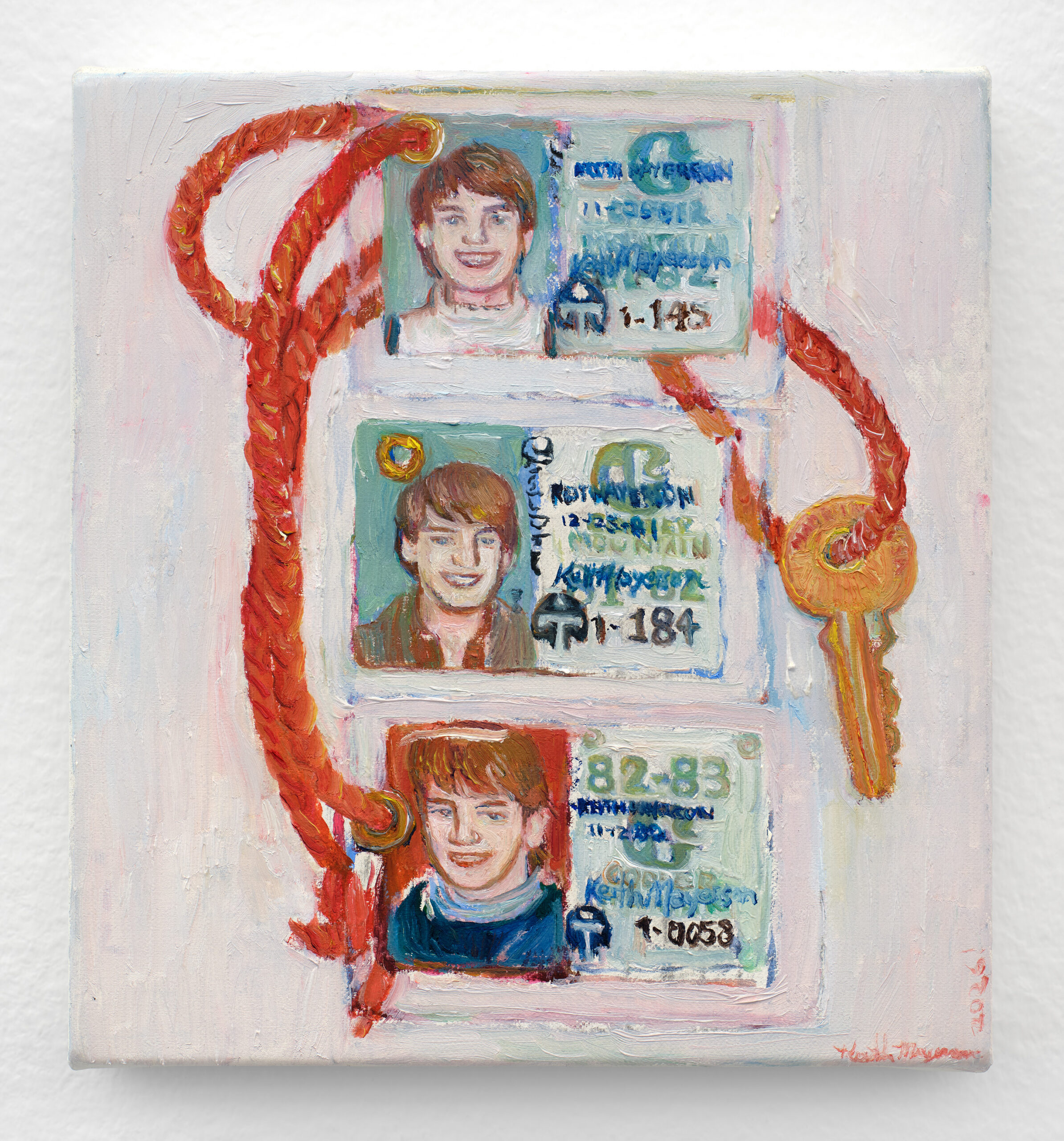
“Copper Mountain Ski Passes, 1981-83 (from when the artist was ages 15–16),” 2026, Oil on linen, 7½ × 7 in
All images courtesy of the artist and KARMA Gallery.
Colorado Currents curated by Miranda Lash, Ellen Bruss, and Leilani Lynch at MCA Denver will feature 28 Colorado artists, on view July 24-Nov 1, 2026.
Correction: an earlier posted version of this article mis-stated the number of works currently in “My American Dream” as 140. As of July 2026, that figure is actually in the hundreds. zing regrets the error.
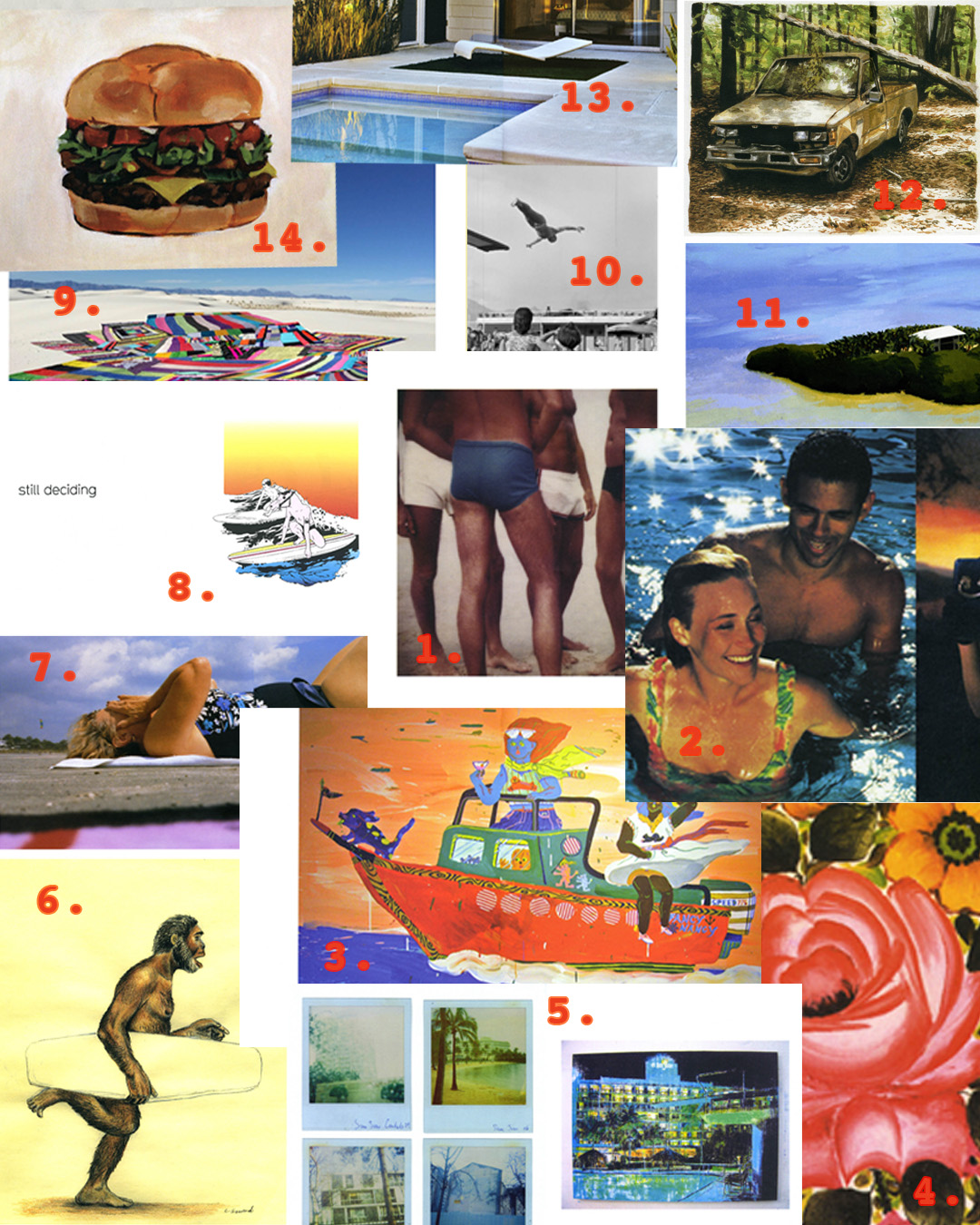
1.Joseph F Lovett, curated by Mary Barone “Gay Sex in the 70s” Issue 21
Curator’s Note: Tom Bianchi’s Polaroids from the 70s were the beginnings of his career as a photographer. When I interviewed him for my film GAY Sex in the 70s, we looked over the Polaroids that I watched him take 30 years ago. I was struck by how they captured the sensuality of the era. I was so happy to be able to use them in the film and to show a selection of them in zing.
Joseph F Lovett, Director of GAY Sex in the 70s www.gaysexinthe70s.com, www.tombianchi.com
2. Jane Hart “Hollywood 101” Issue 15
Curator’s Note: Jane Hart is a curator, publisher, and artist who resides in Beachwood Canyon, Los Angeles —the location of the Hollywood sign. From somewhat humble origins, this now historic structure has become one of the most photographed an iconic landmarks on the planet. Each day, countless individuals throng to the intersection of the small cul-de-sac where Ms. Hart lives and works—which provides a prime vantage point for capturing images of the sign nestled up above in the hills.
3. Misaki Kawaii “Vitamin Island” Issue 22
Curator’s Note: thanks for putting my works in this issue! when I was little, my mom was looking for me in home. she found me playing in the toilet. after that day, my mom put lock on the toilet door. I love tropical ocean!
4. Luis Miguel Suro & Rodolfo Riviera “Language of Flowers” Issue 20
Curator’s Note: I invited Rodolfo Rivera to join this artist project by asking him to realize a series of decorative oil/canvas flower patterns for ceramics, a practice he has been realizing in the last 40 years in my father’s ceramic workshop in Tlaquepaque, I intend to demonstrate that a painting, strategic for decorative and visual purposes only, can, by switching materials (like oil/canvas), open a strong reference to the presence of flowers and nature’s interpretation in the history of art.
5. Enoc Perez “Form & Memory” Issue 22
Curator’s Note: Enoc Perez is an artist living and working in New York City.
6. Lawrence Seward “Drawings Bad Good” Issue 19
Curator’s Note: These drawings were plucked out of a couple of sketch books in an attempt to get a job doing a wall mural. Some of them are drawings for sculptures and others are simply illustrations of ideas. The selection process resembled roulette with the result looking like a BINGO card partially filled. Still, I hope these drawings elicit a pleasurable uncomplex response much like eating a good doughnut or swatting a pesky fly with a rolled up newspaper.
7. Marisa Aragona “Sunday” Issue 19
Curator’s Note: Marisa Aragona, 27, has wildly curly hair and always eats cherries on her birthday. Originally hailing from the Washington DC area she recently relocated to San Francisco after a seven year stint in NYC where she received her BFA from the School of Visual Arts. She is now studying at the San Francisco Art Institute for her MFA and “getting back to nature” in beautiful California. Marisa’s favorite photographic subjects include birthday cakes and girls in their panties. Look for Marisa’s work in this Fall’s current Photo Review. Look for Marisa with her camera and/or sipping a Shirley Temple. Recent exhibition include NYC’s PS122, The Independent Artists Organization and Seattle’s Photographic Center Northwest. You can reach Marisa at marisaaragona@hotmail.com
8. Faile “Faile” Issue 18
Curator’s Note: Faile is a constantly evolving idea and interpretation through art and design, a creative group of three young heads from the USA, Canada, and Japan, who celebrate this exploration as a team. Faile can be contacted through faile.net.
9. Karin Bravin “Proposal” Issue 25
Curator’s Note: In 1986 I was hired by the Peggy Guggenheim Collection to work for the Venice Biennale’s American Pavilion. One of the highlights of my time there was a friendship that developed with James Lee Byars. He was a fixture in Venice and had the capacity to find beauty in even the most mundane aspects of the city. He often would draw my eye to small, quiet details most would overlook. Each time I saw him, he would urge me to approach the Guggenheim with his idea for a site-specific project; it was poetic and beautiful and would have transformed the experience of passing in front of the Peggy Guggenheim Collection while on The Grand Canal. Subsequently, and probably not coincidently, I have spent the last decade, working with artists on various site-specific installations and curating in the public realm. For my zing project, I have asked six artists to envision their dream site-specific artwork. It didn’t need to be feasible—as long as they could render it with sketches, Photoshop, diagrams or text. While these particular projects may or may not come to fruition, the logistics and realization of an actual aesthetic intervention is an exciting process. Facilitating site-specific work that enables viewers to see and think about space and context differently than they have before is an artist’s greatest calling and challenge. The artists selected have all made extremely successful installations or projects in the public sphere, both indoors and outdoors. Thank you: William Corwin, Rachel B Hayes, Fabian Marcaccio, Melissa McGill, Jason Middlebrook, Jean Shin, and James Lee Byars.
10. Gaston Karquel, curated by Geraldine Postel & David Magnin—Collection David Magnin, Issue 25
Curator’s Note: David Magnin is an art collector and merchant born and raised in the French Alps. He collects contemporary art, and design, specializing in Charlotte Perriand over the last 20 years. From this quest of expertise in collecting Perriand, he discovered the photos of Gaston Karquel whom over a period of 30 years followed the Modernists from Le Corbusier, Jean Prouvé, Charlotte Perriand, and also UAM (Union of Modern Artists). Among the photos Magnin acquired was this series of “Megève: Two Days in the Summer of 1948.”
For the past two years David Magnin has collaborated with Geraldine Postel, a free electron wearing many hats in the fields of art and publishing. From associate publisher of referent art & fashion magazines over the years, she has occupied the roles of an artist, curator, art or advertising director. This curatorial project entitled “Megève: Two Days in the Summer 1948” by Gaston Karquel, is born from an edit of these Gaston Karquel images and will celebrate its anniversary with an exhibition in Megève in the Museum of l’Ermitage du Calvaire, where some of these images were taken 70 years ago.
11. Patricia Cronin “Classified” Issue 16
Curator’s Note: Patricia Cronin is a New York based artist. She moved a lot as a child and ever since has been searching for that perfect home. In keeping with this theme, she is currently overwhelmed with a three ton marble mortuary sculpture funded by Grand Arts, Kansas City, Missouri. It will be exhibited there, at The Aldrich Museum of Contemporary Art, Ridgefield, Connecticut, and ultimately, at her final resting place. Unless, of course, someone buys it, which might help pay for some real estate that would come in handy while she’s still alive. She teaches at Columbia University and School of Visual Arts.
12. Harrison Haynes “Mobile Acres” Issue 19
Curator’s Note: I’m writing to you from Woodinville, Washington where my band is recording some music. The studio is a renovated horse-barn and it’s reminding me of where I grew up: the rural outskirts of the North Carolina Piedmont, somewhere between the suburbs and the country. My parents’ friends, and my friends as well since my folks took me everywhere with them, were DIY redneck-hippies: welders and carpenters that listened to ZZ Top and burned big vanilla scented candles in their outhouses. They hosted demolition derbies, volleyball parties, big oyster roasts every fall, and homemade fireworks on the fourth of July. (The fireworks were made by a lunatic blacksmith, so the finale was the detonation of a homemade bomb underneath an anvil, and the resulting spectacle of a 300 pound block of steel soaring upwards into the night sky.)
13. Anna Knoebel & Tom Sibley “Kaiser Collectible” Issue 22
Curator’s Note: My good friend Danielle Kalinoski introduced me to Robert Kaiser in Jamaica. “Robert collects Modern homes,” she said. Intrigued (who wouldn’t be?), I flew to Orlando to see for myself. Tom Sibley came along so we could create this project for zing. We spent the weekend enjoying Robert’s unique and superbly restored home, nestled in a quiet community near those infamous theme parks. To experience Robert’s home yourself (as a vacation rental), email him at rlk@designage.net (http://www.themodernhouse.net/tmh/holiday).
14. Walter Robinson “Big & Beautiful” Issue 23
Curator’s Note: BURGER KING My original idea was for Walter Robinson to show his paintings of cheeseburgers in a series at Haunch of Venison Gallery this summer as an enhancement of Andy Warhol’s Soup Cans, 50 years after Campbell’s by Warhol first shocked the world. But as it turns out, a single cheeseburger was enough, as everyone at last week’s Haunch party posed in front of just one juicy Wallyburger for paparazzo Billy Farrell.
The Wallyburger becomes more excessive the more you examine its contents: drip equivalence achieves stasis in the paint Robinson meticulously applies, the tomatoes rolling into cheese in the imagery and the automatic Pavlovian drool which ensues. Never underestimate the power of a burger, even a painted one. Hamburglar Beth DeWoody couldn’t resist, requesting another Wallyburger for an upcoming London show that she is curating.
Only Walter Robinson shall suffer from too much surburgerrealism. To look at one Wallyburger is a trip to Wendy’s. To paint them is to be, and want to devour, the whole franchise. —Charlie Finch, New York, July 29, 2012.
Editor’s Note: The above curators’ notes are taken from the print issue in which the project was published. Therefore please note links and email addresses are dated and may be broken.
New York, New York
July 2026
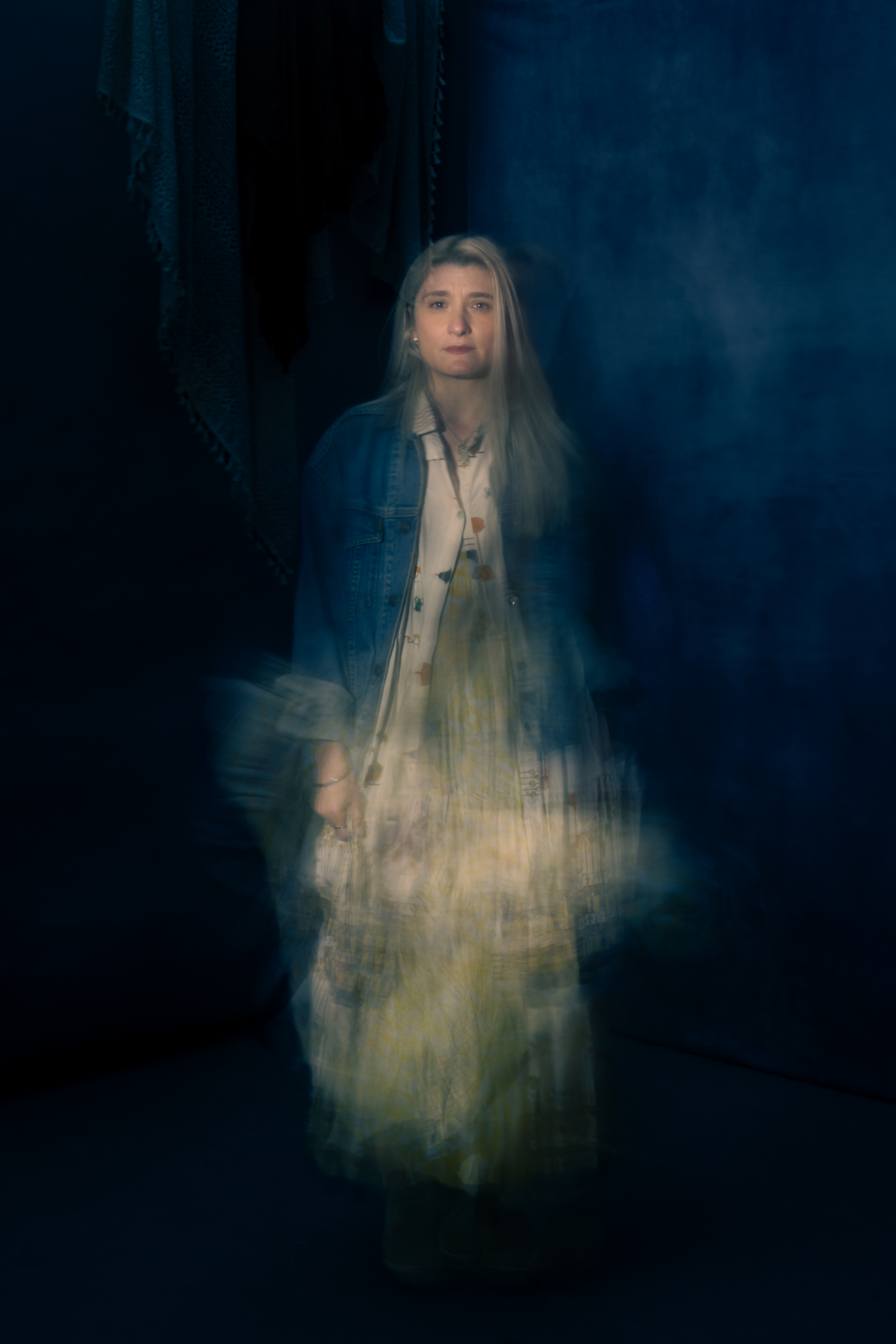
Are you the same person you were a decade ago?
If you asked me to explain Animal Wisdom—a riveting quasi-immersive seance/play/existential crisis with no plot—based on what I remember from experiencing it at Bushwick Starr nearly ten years ago, I would say it is about death. Everybody’s and nobody’s. A series of deaths performed onstage, but also the many selves we go through and bury in one lifetime, and about death as something we all do ‘alone together.’
I was in a cynical period of my life. I’d watched the agonizing weeks my father spent dying of cancer at the age of 61. I was in my 30s and it felt like the great claw of capitalism had reached out and plucked me up like a stuffed animal in one of those toy vending machines and installed me in a life I was tremendously unhappy in and said, “you go here.” I was no longer sure what I wanted in a career or in a personal life or anything really but apparently I was put on this strange, glorious earth to take messages, make lunch reservations, send invites to ‘important’ people to ‘important’ events, manage ‘important’ projects and about a hundred other ‘important’ things, none of which had anything to do with anything that really mattered. Most of all, I had become disconnected from the closest thing I’ve ever had to religion: art.
Watching Obie-award winning playwright and musician Heather Christian take center stage that night was like witnessing a medium thin the veil between what the living can know about the dead and what the dead can tell the living about life. I remember thinking she played the piano like she was riding a horse: the instrument becoming more animal than object, powerful and willful.
In one scene, the lights in the theater went out and you could hear the music with your whole body, the voices of the performers, instruments, piano, and whatever other ghosts might be there, vibrating up and down the string of one’s own soul. There was an uncanny sense of both fear at the great emptiness, a black hole without a bottom that awaits us all, as well as a near-delirious relief at being one drop in an unimaginably great ocean.
In its second production, which will run through June 14 at Signature Theatre’s Romulus Linney Courtyard Theatre, directed by Keenan Tyler Oliphant, there are a number of changes to Animal Wisdom. Mum’s the word on how certain immersive elements and effects have been adjusted to suit the performance space. But perhaps the most notable difference is that Christian is no longer performing the intensely personal role of H, choosing to pass it on to longtime friend Kenita Miller, with Emma Duncan sharing the role in select matinees. And since Animal Wisdom is at its core about ‘escorting whatever ghost you have through hell and out the other side,’ this felt like a natural progression: what happens, Christian asks, if it’s just a ‘channel of a channel’? What if the onion’s just one layer thicker?
Heather Christian as Interviewed by Rachel Dalamangas
On your decision not to perform H for this production, you say that you’ve never seen your own play and want to see what someone else can show you about the role. Can you tell me more about the decision?
It’s tricky with work like this, which is not overtly autobiographical because there’s no narrative per se. There’s micro narratives and I’m very much telling stories surrealistically, poetically, sometimes in code.
I used the show as a way to get something out of me. And it’s ten years later and I’m ten years older and a lot of those specific griefs and questions live in a different place in my body. I felt like I articulated something for myself and with the help of the audience that showed up every single night, I was reminded that we are broken in community together.
But I’m not in the same place I was, and so it’s necessarily going to have to be a performance to a certain extent and if it’s already going to be a performance, I am more interested in the idea of the show becoming something that can expand beyond the bounds of my body.
And the piece is already about channeling and putting on the personality of your past selves, but also putting on the personality of whatever ghost it is that you’re trying to escort through hell and out the other side.
So this felt like a natural progression. What happens if it’s just a channel of a channel, if the onion’s just one layer thicker.
Tell me a little bit more about your creative practice actually. How much is it a kind of practice of spirituality?
I mean, all of it. I don’t know how I’m defining spirituality. I think because spirituality is so alive in my life that it infests everything that I become obsessed with. So I’m not thinking ever in terms of making something specifically spiritual but it always ends up that way because that’s just the kind of story that I am drawn to.
I’m interested in these unanswerable questions that increasingly we don’t sit with in this age of information where we can Google anything including why are we here? We don’t really have time to sit with those kinds of questions, nor do we have the practice of sitting with them.
There’s no real place to do that anymore because the churches have become more and more fundamentalist, and it’s gotten more tied up with politics. Christianity has turned into a four-letter word for a lot of us with moral conscience who want to be living in a place that has a moral conscience in terms of how it treats people.
There’s not really a place for us to go and mourn. There’s not really a place for us to go and scream. There’s not a productive place other than a protest for us to feel like we can get any of that shit out or to sit in contemplation of it.
And I don’t know that we’re going to get out of this tangle that we’ve gotten ourselves into, which is the confluence of so many different socopolitical and economic and technological things. Unless we sit with it as individuals either in community or alone or alone in community, which is, I think, what theater is.
I feel compelled to create a space where we can sit with these questions that we don’t have time or the wherewithal or the emotional distance to come up with a productive solution of how we might individually move forward, let alone how we might move forward as a group of humans.
And this big question of God or logic I think is just a deeply unhelpful lens of how to think about life.
Ultimately, I want to be doing what Carl Sagan was doing for a living, which is like everything’s a mystery. We can only know so much. But isn’t this stuff really cool? The whole point is curiosity. The whole point is to try to understand. That’s what makes a meaningful life. Knowledge that we will never have any of the answers regardless of what Google says.
That’s interesting because a lot of art right now is nihilistic and everything is just very bleak, and that’s something that stands out in Animal Wisdom. There’s this relief in being able to marvel at how tiny you actually are and that a lot of existence is unknowable.
This is why I think nihilism is such horseshit is because nihilism is a decision that it means nothing. We don’t have enough information to make a decision that it means nothing.
That reminds me of the blackout scene, which was one of the most beautiful experiences I’ve personally ever had at the theater. You’re in this cramped little playhouse and then you’re in the dark with the music and the space suddenly feels so big and vast.
You forget where you are at a certain point. And playing an instrument in the dark like that is a whole different experience.
In order to play an instrument in total darkness like that, I had to put gaff tape on different notes on the piano so I could get them by feel and orient myself ‘cuz you completely lose where you are. With a spatial instrument like a piano or a guitar or a cello, it’s like it’s a different thing. And it’s a weird trust thing. It’s very spiritual because it’s like you actually know how to do it. Your brain has told you that you’re an idiot way more than you actually are an idiot.
Where did you get the idea for the blackout scene and playing in the dark?
Well, there’s always a point where I’m like, we can’t get any further so we need to break everything. The idea was that the power should go out in the theater.
Then I spent some time in rooms that were truly dark, like a planetarium, and there is something that it does where it completely dislocates you from whatever you were doing before.
You could be having a conversation about lunch and then you walk into the planetarium and then that happens and it’s like what were we talking about?
I just had like a hunch that it was the right thing and I had to fight for it ‘cuz at every stage somebody was like that’s a terrible idea. But you can’t know until an audience shows up.
Does the darkness in your work ever scare you?
I do what I do specifically ‘cuz it scares me.
I’m about to be 45 years old. I’ve up until this stage in my life had this thing in me that was like if you’re not going to leave blood on the floor then why are you doing it? Why are we here?
I have felt at every stage that if I’m scared of a thing that means that I just need to do it. Like if I’m scared of a thing that means that it’s pointing me towards it.
When I started to write Animal Wisdom, I was just like, I don’t know what I’m doing. I think I’m telling my life story, but I don’t know what I’m doing and I don’t know where to go with it. And my friend, Salty Brine, was like, I want you to sit down and think of the scariest thing that you could say in a room full of people and then say exactly that out loud.
I think we went to a lot of places that we went in Animal Wisdom because Salty said that to me. I do a lot of things that scare the crap out of me because it feels like no show is just a show for me, like a show has to be some sort of ritualistic thing.
And that’s just my weirdness I think because I grew up singing at church where it’s like something needs to change by the end of tonight—not just for the audience but for the people who are performing it. The art kind of needs to be a vehicle or some sort of medium for us to put something inside and either let go or be changed a little bit. And you can’t really get at that unless you’ve got some blood in the game.
Since your work does ask these really big questions, I was wondering what do you think we lose when we pass and what do you think carries on?
Oh wow. I think that’s a question that changes periodically throughout life. When I wrote the show I thought a very specific thing, which is like what you lose is direct participation in the narrative, almost like the mundane narrative.
Like when my grandparents passed, they were no longer coming to my shows, we were no longer talking about the work. I was no longer going to Shreveport to see them. So those details I think you lose, but my experience has been I can feel them and they show up for the big stuff and the truly small shit that I thought was truly small they’re like that’s actually the point. You know, I think you gain perspective when you die.
I think the big relief after passing is that secrets are no longer necessary. In southern families, secrets are a big thing.
I’m now ten years older and I’ve had more people die on me and I’ve had a miscarriage so I have a little angel spirit that I feel attached to me now.
I still grieve these people and I still grieve these spirits because in my human body, the life that’s going on right now is the only important thing that I can think of. But I think when you pass, you get to understand what’s actually important.
Are you working on anything else after this show?
I work on way too much at once. That’s not meant to be a brag. I am compulsive and need a place to put all of it.
I’m working on my first opera, which is a retelling of the Dido and Aeneas story through the lens of a Baroque opera. The tech goes horribly wrong and the tech is being run by the Gods. So it’s like a Baroque opera that sits inside a straight play and it’s all whackadoo.
Then I’m trying to write a teeny tiny Gilgamesh. I’m calling it a teacup Gilgamesh. I don’t know why yet. I also adapted The Book of Revelations, which I don’t know how that becomes a show. We shall see.
So there’s a lot that’s cooking. I just haven’t had a whole lot of time. You’re sometimes doing two or three shows that you’ve already finished at once, but all of that stuff eats those logistical brains, eats the time that your creative brain can kind of be an idiot. ‘Cuz I don’t know about you, but my creative brain needs time to be an idiot—and that person doesn’t answer emails.
Rachel Dalamangas
New York, NY
May 2026
photo credit: portrait of Heather Christian by HanJie Chow, courtesy of the artist